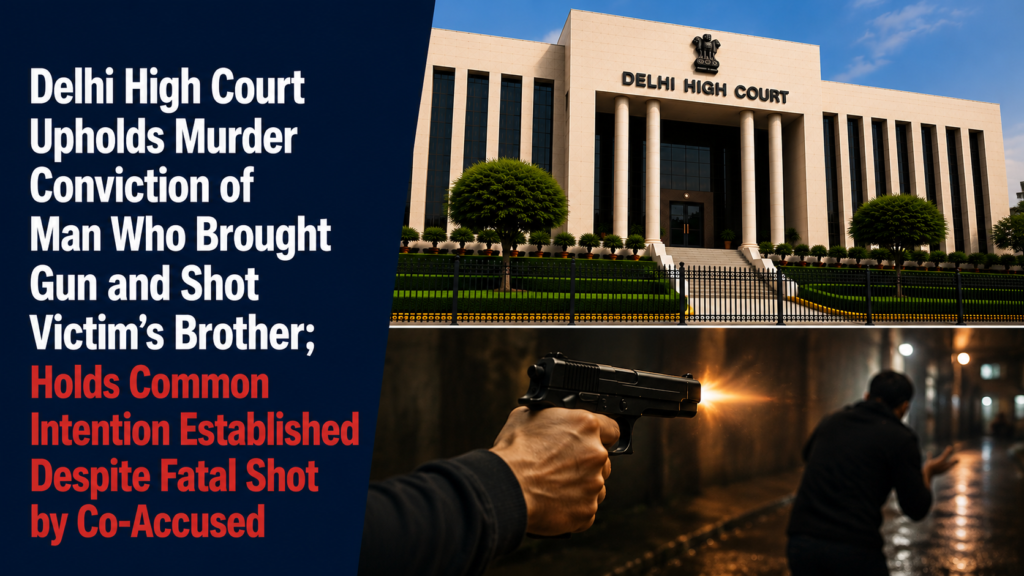
Delhi High Court Upholds Murder Conviction of Man Who Brought Gun and Shot Victim’s Brother; Holds Common Intention Established Despite Fatal Shot by Co-Accused

Delhi High Court Orders Convict to Surrender in 1985 Murder Case; Upholds Section 302/34 Conviction Despite Challenges to Medical and Ballistic Evidence
Facts
The appeal was filed by Ashwani Kumar and Sanjay Kumar against their conviction dated 5 April 2004 under Sections 302/307/34 IPC and the consequential sentence imposed by the Additional Sessions Judge in Sessions Case No. 43/2001 arising from FIR No. 225/1985, Police Station Krishna Nagar, Delhi. During the appeal, Ashwani Kumar died and proceedings against him abated in November 2025, leaving Sanjay Kumar’s appeal for determination.
The prosecution case arose from an incident on 2 June 1985. Rajesh Kumar, Bharat Bhushan, Vipin Kumar and Satish Kumar were passing near Ashwani Kumar’s house when a verbal quarrel escalated into stone-pelting. A co-accused initially attempted to fire a country-made pistol, but it did not work. Ashwani then allegedly directed Sanjay to bring a gun. Sanjay brought a double-barrel gun and fired at Vipin Kumar (PW-3), hitting him in the neck.
When Bharat Bhushan attempted to overpower Sanjay, Ashwani snatched the gun from Sanjay and fired at Bharat Bhushan’s abdomen. Bharat Bhushan subsequently succumbed to the gunshot injury.
During investigation, the police recovered the double-barrel gun and cartridge belt. A cross-FIR was also registered against members of the complainant’s side arising from the same occurrence.
The prosecution examined 21 witnesses, including injured eyewitness Vipin Kumar (PW-3), complainant Rajesh Kumar (PW-2), and other eyewitnesses. The case therefore rested substantially upon direct ocular testimony supported by medical and forensic material.
Issues
The principal questions before the High Court were:
- Whether Sanjay Kumar could be convicted for Bharat Bhushan’s murder under Section 302 read with Section 34 IPC, even though the fatal shot was fired by Ashwani Kumar.
- Whether the evidence established that Sanjay shared a common intention with Ashwani to commit the murder.
- Whether the testimony of injured eyewitness PW-3 and the other eyewitnesses was sufficiently reliable to sustain the conviction.
- Whether the post-mortem report could be relied upon when the doctor who conducted the post-mortem was not examined and the report was proved through the hospital Record Clerk.
- Whether the absence of a conclusive ballistic opinion linking the recovered DBBL gun with the projectile/wad recovered from the deceased created reasonable doubt.
Appellant’s Arguments
Sanjay Kumar’s primary contention was that the prosecution itself attributed different acts to the two brothers.
Sanjay had allegedly brought the gun and fired at Vipin Kumar. However, the fatal shot that killed Bharat Bhushan was admittedly fired by Ashwani Kumar after he snatched the weapon from Sanjay.
The defence argued that Sanjay’s presence at the scene, participation in the quarrel, relationship with Ashwani and firing at another individual could not automatically make him liable for Ashwani’s subsequent act under Section 34 IPC.
It was argued that there was no evidence that Sanjay:
- exhorted Ashwani to kill Bharat Bhushan;
- restrained Bharat Bhushan;
- prevented anybody from rescuing him;
- facilitated Ashwani’s fatal shot; or
- shared any prior plan to murder Bharat Bhushan.
The defence therefore characterised Ashwani’s fatal firing as an independent act for which Sanjay could not be constructively liable.
The appellant also attacked the medical evidence. The doctor who conducted the post-mortem had not entered the witness box; instead, the report was proved through a Record Clerk who identified the doctor’s handwriting and signatures. According to the defence, this deprived Sanjay of an opportunity to cross-examine the medical expert regarding the cause, trajectory and range of the firearm injury.
Finally, the defence relied heavily on the ballistic evidence. The CFSL could not conclusively state that the plastic wad recovered had been fired from the particular DBBL gun recovered during investigation. The defence therefore argued that the prosecution had failed scientifically to establish that the recovered firearm was the actual weapon of offence.
Respondent’s Arguments
The State argued that the Trial Court’s findings rested upon consistent and mutually corroborative ocular, medical, forensic and documentary evidence.
Particular reliance was placed upon injured eyewitness Vipin Kumar (PW-3). His presence at the scene was unquestionable because he himself suffered a firearm injury.
PW-3 specifically stated that Sanjay fired at his neck and that Ashwani thereafter snatched the gun and fired at Bharat Bhushan. The State argued that this testimony clearly established the respective roles of both accused.
PW-3’s account was also corroborated by PW-1, PW-2, PW-4 and PW-7. The State submitted that the eyewitness versions remained consistent despite extensive cross-examination.
As regards medical evidence, the State contended that the post-mortem report had been properly proved through the Record Clerk because the doctor was unavailable abroad. It recorded a gunshot injury sufficient to cause death and was consistent with the eyewitness version.
Analysis of the Law
Injured Eyewitness Testimony
The High Court attached substantial evidentiary weight to PW-3.
It found his testimony straightforward, cogent and reliable. His presence at the occurrence could hardly be disputed because he himself had sustained injuries during the same incident.
The Court relied upon the settled principle that an injured eyewitness ordinarily carries greater evidentiary assurance because the injury itself establishes his presence at the scene.
The Court referred to Akhtar v. State of Uttaranchal and the principles drawn from Krishan v. State of Haryana and Surender Singh v. State of Haryana concerning the reliability of consistent injured eyewitness testimony corroborated by medical evidence.
It additionally referred to State of M.P. v. Mann Singh for the proposition that evidence of an injured witness has greater evidentiary value and should not lightly be discarded without compelling reasons.
Section 34 IPC and Common Intention
The Court explained that Section 34 IPC embodies joint or constructive liability for criminal acts committed in furtherance of the common intention of several persons.
Importantly, prior agreement or pre-planning is not indispensable. Common intention may develop even at the spur of the moment.
Nor must every accused personally perform the particular physical act constituting the offence. Where several persons act pursuant to a common intention, the act of one can render the others jointly liable.
Because direct evidence of a “meeting of minds” is rarely available, common intention can legitimately be inferred from circumstances such as:
- conduct of the accused;
- weapons carried;
- manner and duration of the attack;
- words spoken before and during the occurrence;
- conduct before and after the offence; and
- surrounding circumstances.
Application of Section 34 to Sanjay Kumar
The Court found Sanjay’s conduct went substantially beyond mere presence.
He had:
- brought the firearm when asked by Ashwani;
- himself fired at PW-3;
- carried/wore a belt containing live cartridges;
- remained involved when Bharat Bhushan attempted to overpower him; and
- did not resist when Ashwani took the firearm and used it against Bharat Bhushan.
The Court considered these circumstances sufficient to establish Sanjay’s common intention in the fatal attack.
Thus, the fact that Ashwani physically fired the fatal shot did not absolve Sanjay from liability for murder under Section 302 read with Section 34 IPC.
Post-Mortem Report
The Court rejected the argument that the post-mortem report became unusable merely because the doctor who conducted the autopsy was not examined.
The post-mortem had been conducted by Dr. George Pal. The Record Clerk testified that the doctor had gone to Malaysia and identified his handwriting and signatures.
The report recorded that Bharat Bhushan died from shock and haemorrhage resulting from extensive internal injuries and that the shotgun entry wound was sufficient to cause death in the ordinary course of nature.
The Court considered Section 32(2) of the Evidence Act relevant where the medical professional who prepared the document was unavailable.
It further noted that Sanjay had not objected to the admissibility of the post-mortem report at trial. If the defence required expert clarification regarding the medical aspects, it could have sought examination of another doctor, but it had not done so.
Ballistic Evidence
The Court acknowledged that the CFSL evidence was not conclusive on every aspect.
The recovered DBBL gun was found to be a functional firearm, the cartridges were live 12-bore ammunition, and the plastic bore-sealing wad was consistent with firing from a 12-bore firearm. However, the expert could not definitively establish that the particular wad had been fired from the recovered DBBL gun.
That deficiency did not create reasonable doubt because the remaining evidence was sufficiently strong.
The Court observed that the medical evidence concerning the wad was consistent with the eyewitness account regarding the distance from which Bharat Bhushan was shot.
More fundamentally, the Court held that even non-recovery or failure to conclusively establish the weapon of offence is not necessarily fatal where other clinching evidence reliably connects the accused with the crime.
Precedent Analysis
Akhtar & Ors. v. State of Uttaranchal, (2009) 13 SCC 722
Relied upon for the enhanced credibility ordinarily attached to an injured eyewitness whose presence at the crime scene is difficult to dispute.
Krishan v. State of Haryana, (2006) 12 SCC 459
Referred to for the principle that consistent testimony of injured eyewitnesses, particularly when corroborated by medical evidence, should not be discarded.
Surender Singh v. State of Haryana, (2006) 9 SCC 247
Applied for the proposition that injuries sustained by a witness during the occurrence lend intrinsic support to his claim that he was present and personally witnessed the incident.
State of M.P. v. Mann Singh, (2003) 10 SCC 414
Cited for the rule that an injured witness’s evidence possesses greater evidentiary value and should not be discarded lightly unless compelling reasons exist.
Shyambir v. State
The appellant relied upon this Delhi High Court decision to contend that where the doctor conducting the post-mortem is not produced, his opinion cannot be relied upon to the detriment of the accused.
The Court nevertheless rejected the challenge in the circumstances of this case because the report had been proved through the Record Clerk, the doctor was unavailable abroad, its authenticity was not challenged, and no objection to its admissibility had been taken at the appropriate stage.
Court’s Reasoning
The High Court found that the Trial Court had correctly appreciated the evidence.
PW-3 was an injured eyewitness whose presence was undisputed and whose account specifically identified Sanjay as the person who fetched the firearm and fired at him. Other eyewitnesses materially corroborated the occurrence.
Most importantly, Sanjay’s liability for Bharat Bhushan’s death did not depend upon proving that Sanjay himself fired the fatal shot.
His act of fetching the firearm on Ashwani’s exhortation, firing it at PW-3, possessing further ammunition and participating throughout the same transaction furnished sufficient circumstances from which the common intention required by Section 34 IPC could be inferred.
The Court was equally unpersuaded by the alleged medical and forensic deficiencies. The post-mortem report remained admissible and reliable in the circumstances, while the lack of conclusive ballistic linkage did not override the otherwise compelling ocular and corroborative evidence.
Conclusion
The Delhi High Court held that the Trial Court’s findings were based on a proper appreciation of the evidence and suffered from no perversity or illegality warranting appellate interference. It also found the sentence proportionate to the offences committed.
Accordingly, Sanjay Kumar’s appeal was dismissed and his conviction and sentence were affirmed.
Since his sentence had remained suspended during the appeal, the High Court directed Sanjay Kumar to surrender before the Jail Superintendent within two weeks to serve the remaining sentence.
Case Details
Case: Ashwani Kumar & Anr. v. State of Delhi
Court: High Court of Delhi at New Delhi
Case Number: CRL.A. 294/2004; CNR No. DLHC010095122004
Judges: Justice Navin Chawla and Justice Ravinder Dudeja
Date: 13 August 2026
Result: Appeal dismissed; conviction and sentence under Sections 302/307/34 IPC affirmed; Sanjay Kumar directed to surrender within two weeks to serve the remaining sentence.