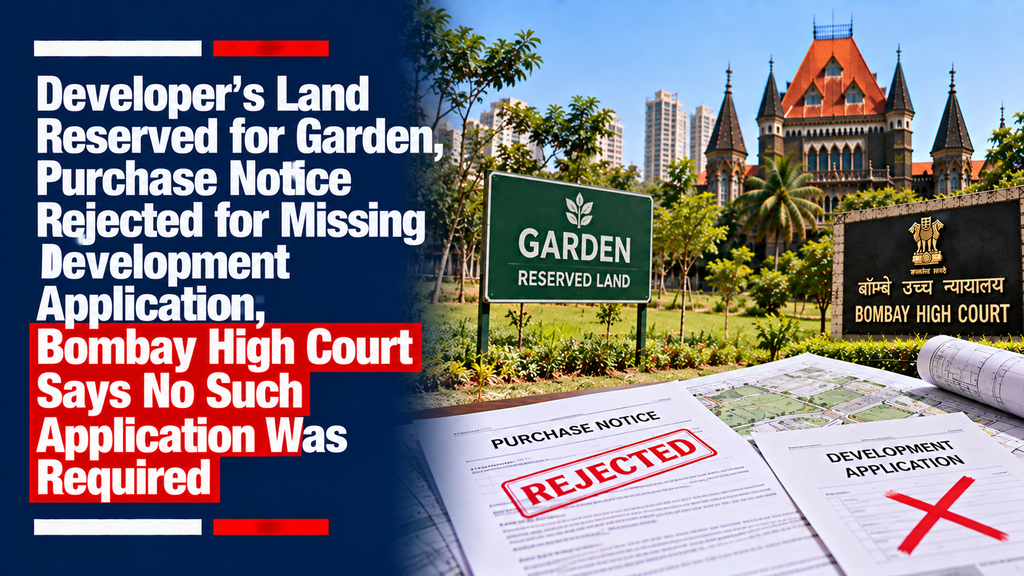
Developer’s Land Reserved for Garden, Purchase Notice Rejected for Missing Development Application; Bombay High Court Says No Such Application Was Required

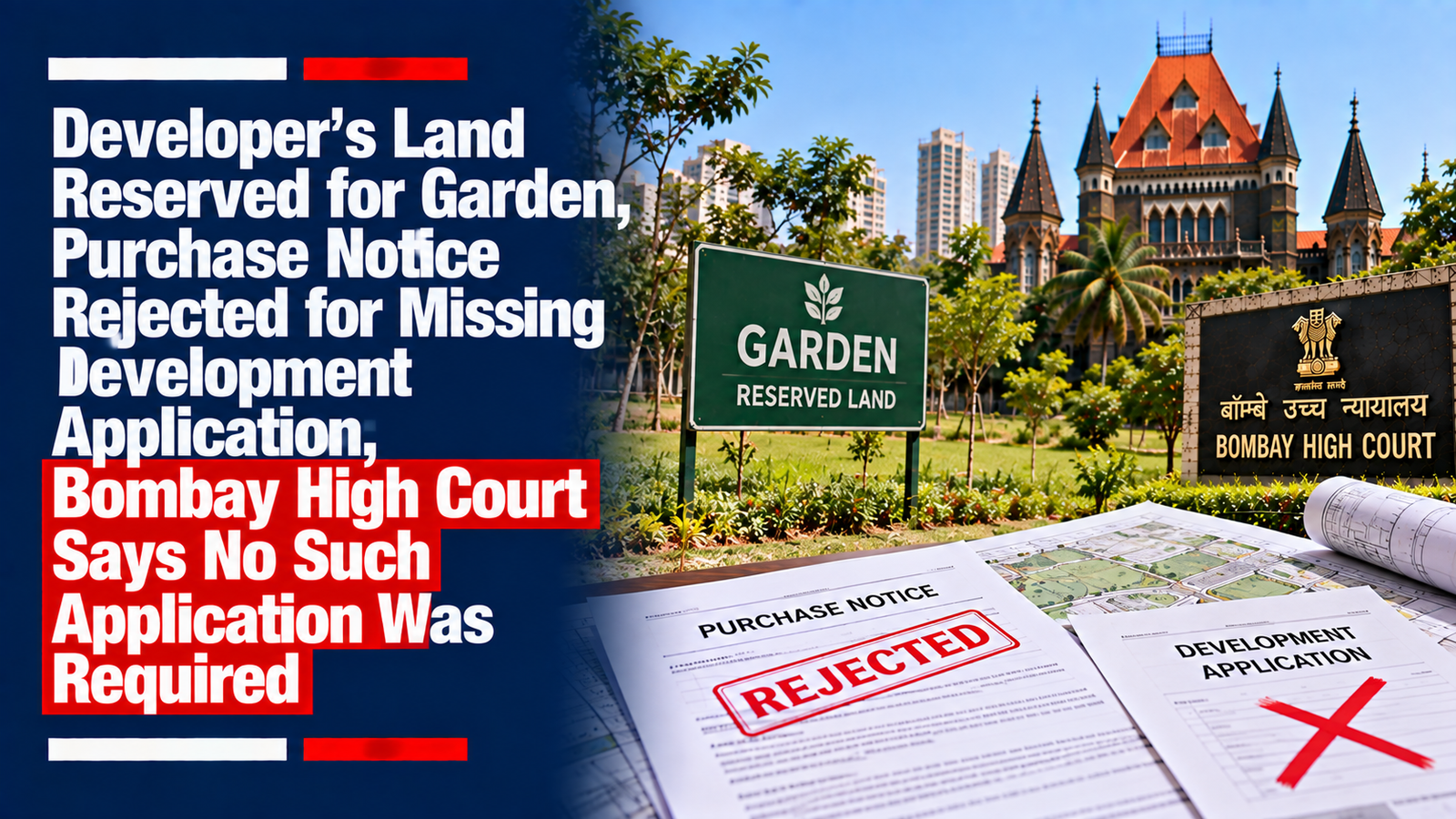
Government Rejects Purchase Notice for Want of Development Application; Bombay High Court Says Section 49 Does Not Require It in Every Case
Facts
Devi Construction LLP owned 2.10 hectares (21,000 sq. metres) of land bearing Bhumapan No. 107/B at Village Vadgaon. On 28 February 2024, Vadgaon Nagar Panchayat published a Draft Development Plan under the Maharashtra Regional and Town Planning Act, 1966 (“MRTP Act”), reserving 12,290 sq. metres of the property for Reservation No. 40 – “Garden.”
The developer objected to the reservation on 12 March 2024 and thereafter issued a Purchase Notice dated 15 March 2024 under Sections 49(1)(a) and 49(1)(e) of the MRTP Act, requiring the appropriate authority to purchase its interest in the reserved land.
However, the Director of Town Planning rejected the Purchase Notice on 9 September 2024, principally because it was not accompanied by an application made to the Planning Authority as contemplated under Section 49(2). Devi Construction challenged that rejection before the Bombay High Court.
Issues
The principal question was whether a Purchase Notice issued under Sections 49(1)(a) and 49(1)(e) could legally be rejected merely because the landowner had not first made a separate application to the Planning Authority and annexed that application under Section 49(2).
The broader issue was whether Section 49(2)’s documentary requirement applies to every Purchase Notice under Section 49(1) or only where an underlying planning application and corresponding decision actually exist.
Petitioner’s Arguments
Devi Construction argued that the Director of Town Planning had fundamentally misread Section 49.
According to the developer, an application to the Planning Authority becomes relevant particularly in the contingency under Section 49(1)(d)—where development permission has been refused or granted subject to conditions.
Its case, however, rested upon Sections 49(1)(a) and 49(1)(e). The latter specifically deals with a situation where, because of designation or allocation in a development plan, the owner claims that the property cannot be sold except at a price lower than what could reasonably have been obtained without the reservation.
The developer argued that the different contingencies under Section 49(1) are independent and mutually exclusive and that insisting upon a development application in every case would defeat the statutory remedy available to owners of reserved land.
It also invoked the constitutional protection of property under Article 300-A, arguing that Section 49 protects an owner against being deprived indefinitely of the beneficial use and value of property because of a planning reservation.
Respondents’ Arguments
The State maintained that Section 49(2) required the Purchase Notice to be accompanied by a copy of an application made to the Planning Authority and any order or decision passed upon it.
Since Devi Construction had not annexed such an application, the State argued that the Purchase Notice was defective and had correctly been rejected.
The State further argued that the developer should have filed a claim before the Municipal Council stating that it was unable to obtain a reasonable price for the property and should have enclosed that claim with the Purchase Notice.
Analysis of the Law
Section 49 creates several independent circumstances in which a landowner may require the appropriate authority to purchase an interest in land affected by planning restrictions.
Of particular relevance, Section 49(1)(a) applies where land is designated by a plan as subject to compulsory acquisition, while Section 49(1)(e) applies where designation or allocation causes an owner to claim that the property cannot be sold except at a lower price than would otherwise reasonably have been obtained.
Section 49(2), meanwhile, states that a Purchase Notice shall be accompanied by a copy of “any application” made to the Planning Authority and any order or decision upon it.
The High Court held that this did not mean that every landowner must first manufacture an application to the Planning Authority before invoking Section 49. The requirement applies where such an application has actually been made and an order or decision exists.
Precedent Analysis
The Court treated the issue as already settled by Aone Land Developers v. State of Maharashtra.
In Aone Land Developers, the Bombay High Court had held that the various contingencies in Section 49(1) are independent of one another. Section 49(2) cannot be interpreted as imposing a prior planning-application requirement upon every category under Section 49(1).
The Court particularly emphasised that Section 49(1)(e) creates an independent situation: where designation or reservation depresses the property’s sale value, the owner may issue a Purchase Notice without first applying for development permission.
The Bench also relied upon Gopal Kashinath Lad v. State of Maharashtra, where the Aurangabad Bench had followed Aone Land Developers and held that if no application to the Planning Authority exists, there is simply nothing that can be annexed under Section 49(2). Rejection of a Section 49(1)(e) Purchase Notice on that ground was held erroneous.
Court’s Reasoning
Applying these principles, the Bombay High Court found that Devi Construction had expressly invoked both Sections 49(1)(a) and 49(1)(e).
Neither of those situations necessarily required the developer to first make an application to the Planning Authority. Therefore, its Purchase Notice could not be rejected merely because no such application accompanied it.
The Court expressly held that where land is designated for compulsory acquisition under Section 49(1)(a), or where the owner claims that the designation has depressed its sale price under Section 49(1)(e), a prior application and decision of the Planning Authority are not prerequisites.
Accordingly, the Director of Town Planning’s sole reason for rejecting the Purchase Notice was legally incorrect.
Importantly, however, the High Court did not itself confirm the Purchase Notice or direct immediate acquisition of the property. Instead, it quashed the rejection and directed the Director of Town Planning to reconsider the Purchase Notice on its own merits, without insisting upon a Section 49(2) application.
Conclusion
The Bombay High Court allowed Devi Construction’s petition and quashed the 9 September 2024 order rejecting its Purchase Notice.
The Director of Town Planning was directed to decide the Purchase Notice dated 15 March 2024 afresh under Sections 49(1)(a) and 49(1)(e), without insisting upon a prior application under Section 49(2), and to complete that exercise within six weeks from uploading of the judgment.
The judgment clarifies an important distinction under the MRTP Act: a landowner invoking a Purchase Notice because the land is reserved or because reservation depresses its sale value need not first seek development permission merely to become eligible to issue that notice.
Case: Devi Construction LLP v. State of Maharashtra & Ors.
Court: Bombay High Court, Civil Appellate Jurisdiction
Case No.: Writ Petition No. 16064 of 2024
Coram: Justice R. I. Chagla & Justice Firdosh P. Pooniwalla
Reserved: 1 September 2026
Pronounced: 23 September 2026
Citation: 2026:BHC-AS:38879-DB
Result: Petition allowed; rejection of Purchase Notice quashed; fresh decision directed within six weeks without insisting on a Section 49(2) application.