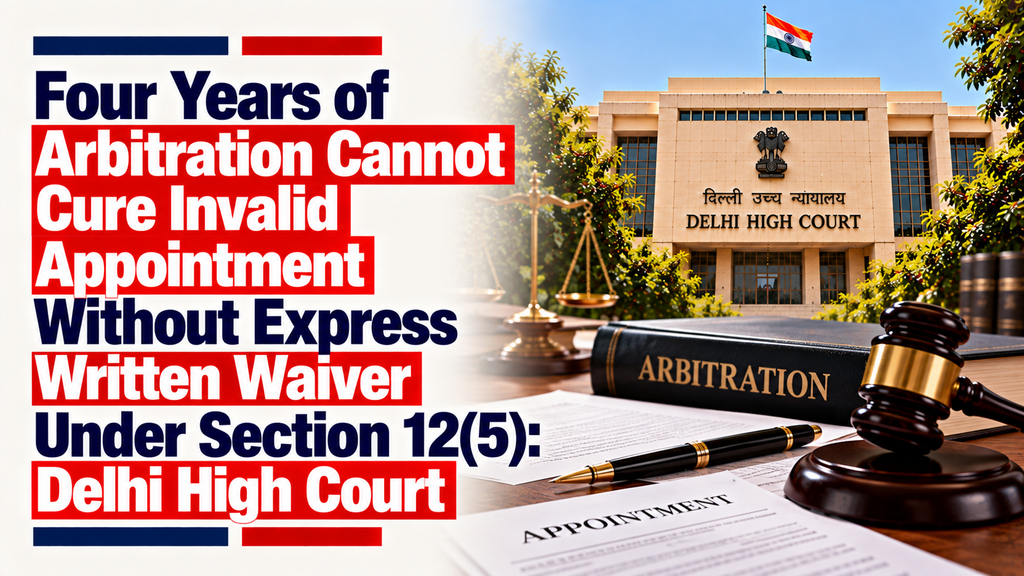
Four Years of Arbitration Cannot Cure Invalid Appointment Without Express Written Waiver Under Section 12(5): Delhi High Court

Party That Unilaterally Appointed Arbitrator Can Still Challenge His Appointment After Award: Delhi High Court Upholds Setting Aside of Arbitral Award
Facts
Airports Authority of India (AAI) awarded construction work to M/s Ahluwalia Contracts (India) Limited (ACIL) in January 2009, followed by a contract dated 2 February 2009. A dispute subsequently arose when AAI retrospectively imposed ₹1,45,50,192 as compensation in December 2015. AHLUWALIA CONTRACTS
After the contractual Dispute Resolution Board process failed to resolve the dispute, ACIL invoked arbitration in April 2019 and requested appointment of an independent arbitrator.
AAI itself appointed Shri S.C. Gupta, Chief Engineer (Retd.), CPWD, as the Sole Arbitrator on 13 May 2019. The arbitration continued for nearly four years, from 2019 to 2023. Significantly, neither party objected to the Arbitrator’s appointment or alleged bias during the proceedings. AHLUWALIA CONTRACTS
On 10 August 2023, the Arbitrator passed an award partly in ACIL’s favour and rejected AAI’s counterclaims. AAI challenged the award under Section 34, but did not plead invalidity of the Arbitrator’s appointment. Its challenge was directed to the merits. AHLUWALIA CONTRACTS
During the Section 34 hearing, however, the Single Judge suo motu raised the legality of the Sole Arbitrator’s appointment. On 20 July 2026, the Single Judge set aside the award on this ground.
ACIL therefore filed the present appeal under Section 37 of the Arbitration and Conciliation Act, 1996. AHLUWALIA CONTRACTS
Issues
The central question was:
Can a party that itself unilaterally appointed a Sole Arbitrator, participated before him for several years without objection, and did not challenge his appointment under Section 34 subsequently rely upon Section 12(5) to invalidate the award?
A connected issue was whether conduct, acquiescence and participation could constitute waiver of Section 12(5), or whether the statute mandatorily requires an express agreement in writing after the dispute has arisen.
Appellant’s Arguments
ACIL argued that AAI could not invalidate an arbitration mechanism that AAI itself had created.
It distinguished Bhadra International v. Airports Authority of India, arguing that the protection against unilateral appointments was intended for the party deprived of an equal role in constituting the Tribunal—not the very party that made the appointment.
ACIL emphasized that AAI:
- selected and appointed the Arbitrator;
- obtained his statutory disclosure;
- participated for nearly four years;
- referred its own counterclaims to him;
- never alleged bias or lack of independence; and
- never pleaded invalid appointment in its Section 34 petition.
Accordingly, ACIL argued that the Single Judge travelled beyond the Section 34 challenge by raising the issue suo motu. AHLUWALIA CONTRACTS
Respondent’s Arguments
AAI relied upon the mandatory character of Section 12(5).
It argued that participation or conduct cannot cure statutory ineligibility. If the Sole Arbitrator was legally ineligible, an award rendered by an improperly constituted Tribunal could not survive merely because the parties had participated before it.
AAI further argued that an objection concerning the Tribunal’s inherent jurisdiction could be considered even though it had not been expressly pleaded in the Section 34 petition. AHLUWALIA CONTRACTS
Analysis of the Law
The Division Bench held that Section 12(5) prescribes a very specific method of waiver.
Three requirements must coexist:
- the dispute must already have arisen;
- both parties must agree to waive Section 12(5); and
- the agreement must be express and in writing.
Consequently, waiver cannot be inferred from conduct, participation, acquiescence or even the fact that one of the parties itself appointed the arbitrator. AHLUWALIA CONTRACTS
The Court therefore drew an important distinction between ordinary waiver and the statutory waiver contemplated under Section 12(5).
Precedent Analysis
Bhadra International v. Airports Authority of India
The Supreme Court had held that even where a procedural order recorded that the parties had no objection to the Arbitrator, that was insufficient. Section 12(5) requires a conscious and unequivocal written agreement after the dispute has arisen.
Accordingly, participation alone cannot constitute waiver. AHLUWALIA CONTRACTS
Titagarh Rail Systems
The Delhi High Court had similarly held that following the contractual appointment mechanism does not itself establish waiver. Waiver must precede reliance upon a contractual mechanism that otherwise conflicts with Section 12(5). AHLUWALIA CONTRACTS
Mahavir Prasad Gupta and Sons
This precedent directly addressed ACIL’s argument that AAI itself had made the appointment.
The Court reiterated that the act of unilateral appointment and an express statutory waiver are legally distinct. A party’s appointment of the arbitrator cannot itself be treated as the written agreement required by Section 12(5). AHLUWALIA CONTRACTS AHLUWALIA CONTRACTS
Bharat Broadband Network Ltd. v. United Telecoms Ltd.
The Supreme Court had specifically held that an appointment letter does not amount to an “express agreement in writing.”
Both parties must consciously agree, with knowledge of the arbitrator’s ineligibility, that they nevertheless wish him to continue. AHLUWALIA CONTRACTS
Court’s Reasoning
The Court found that AAI appointed the Sole Arbitrator after disputes had arisen, but there was admittedly no subsequent express written agreement between ACIL and AAI waiving Section 12(5). AHLUWALIA CONTRACTS
AAI’s conduct did not cure this defect.
The Court held that none of the following could substitute the statutory written waiver:
appointment by AAI + four years’ participation + pleadings + counterclaims + failure to object + completion of arbitration.
The Court further rejected ACIL’s argument that Bhadra International protected only the party that did not make the unilateral appointment. The statutory requirement does not depend upon which party made the appointment. AHLUWALIA CONTRACTS
Importantly, the Court also held that the Single Judge could examine the issue even though AAI had not raised it in its Section 34 petition.
According to the Division Bench, where statutory ineligibility results in an inherent lack of jurisdiction of the Arbitral Tribunal, failure to object earlier does not transform an invalid appointment into a valid one. AHLUWALIA CONTRACTS
The Single Judge had therefore correctly set aside the award solely on the issue of the invalid unilateral appointment without examining the merits of the underlying claims.
Conclusion
The Delhi High Court dismissed ACIL’s Section 37 appeal and upheld the Single Judge’s decision setting aside the arbitral award.
The significant principle is that even the party that itself unilaterally appoints an ineligible arbitrator does not, merely by making that appointment and participating in the arbitration, waive Section 12(5). There must be an express written agreement between the parties after the dispute has arisen.
The Court consequently found no error in setting aside the award. AHLUWALIA CONTRACTS
Case Details
Case: M/s Ahluwalia Contracts (India) Limited v. Airports Authority of India
Court: Delhi High Court
Case No.: FAO(OS) (COMM) 246/2026
CNR: DLHC010430852026
Judges: Justice Anil Kshetrapal and Justice Vimal Kumar Yadav
Reserved: 10 September 2026
Pronounced: 25 September 2026 AHLUWALIA CONTRACTS
Result: Appeal dismissed; setting aside of the arbitral award due to invalid unilateral appointment upheld.