Government Assistant Convicted After ₹5,000 Bribe Money Recovered From His Home; Supreme Court Acquits Him, Says Recovery Without Proof of Demand Is Insufficient

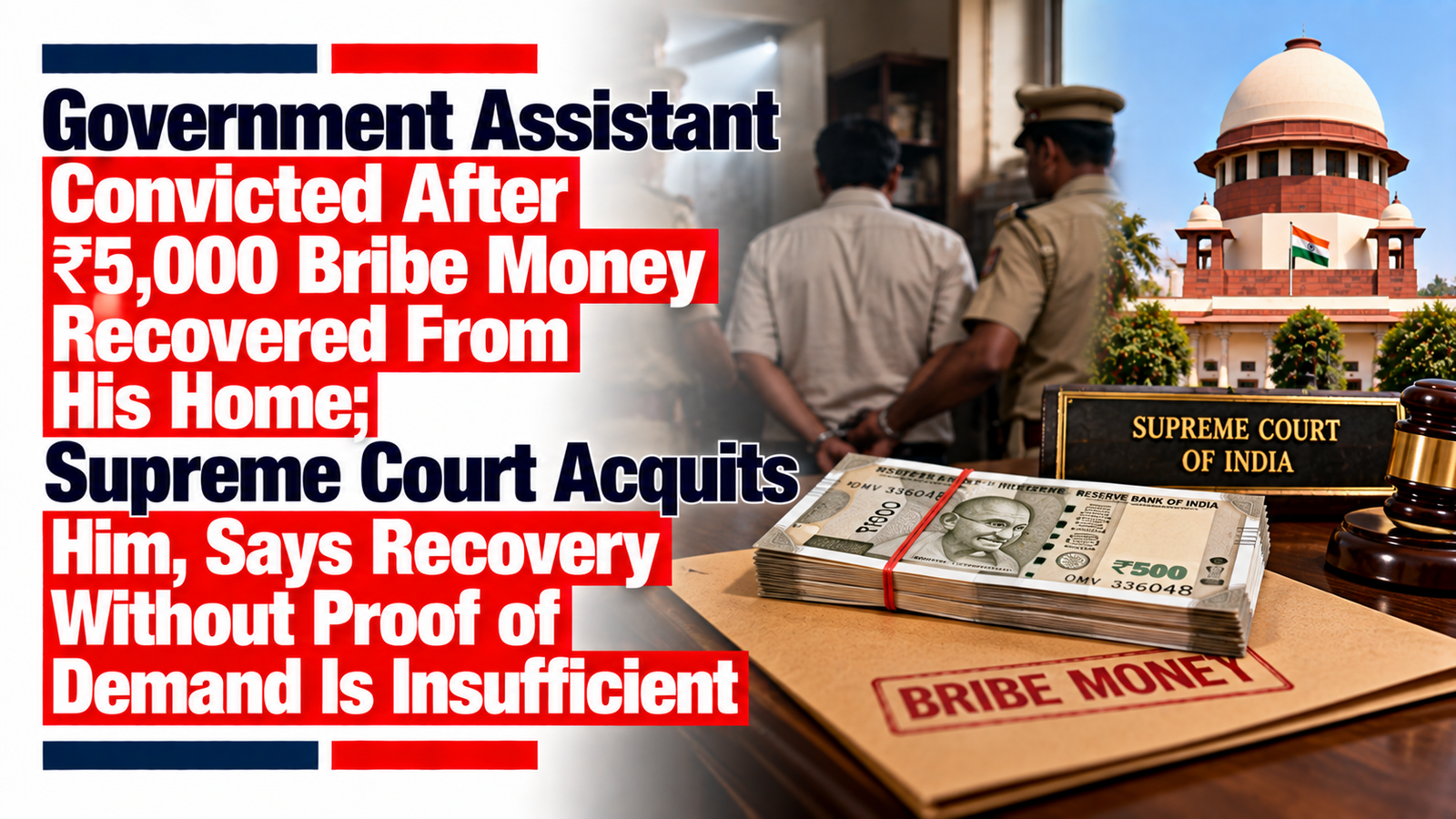
Public Servant Completes Four-Year Sentence but Pursues Appeal to Clear His Name; Supreme Court Finds Trap Evidence Uncorroborated and Sets Aside Corruption Conviction
Facts
Ajit Kumar, an Assistant in the District Education Office at Saraikella, Jharkhand, was prosecuted under Sections 7 and 13 of the Prevention of Corruption Act, 1988 on the allegation that he demanded Rs.5,000 from Durgapad Singh Munda, an orderly in a Government High School, for facilitating release of his unpaid salary.
The complainant approached the Vigilance Bureau on 19 April 2010. Police Inspector Shyamlal Champiya was deputed to verify the complaint and submitted a verification report on 19 May 2010 stating that the allegation was true. A vigilance case was thereafter registered.
On 20 May 2010, the Vigilance Bureau arranged a trap. Rs.5,000 in currency notes was treated with phenolphthalein and handed to the complainant. According to the complainant, he and Ajit Kumar went to Ajit Kumar’s residence, where the money was handed over and kept under the bed. The complainant and accused thereafter returned to the office and the vigilance team intervened.
The prosecution alleged that the vigilance team subsequently went to Ajit Kumar’s residence and recovered the pre-marked Rs.5,000. The currency-note numbers matched the pre-trap memorandum, and the phenolphthalein hand-wash solution allegedly turned pink.
The Special Judge, Anti-Corruption Bureau, West Singhbhum convicted Ajit Kumar under Sections 7 and 13(2) of the PC Act on 27 February 2021 and sentenced him to rigorous imprisonment for four years with a fine of Rs.10,000 for each offence, the sentences to run concurrently.
The Jharkhand High Court dismissed his appeal on 21 July 2022 and affirmed the conviction and sentence. By the time the matter reached the Supreme Court, Ajit Kumar had already undergone the imprisonment and paid the fine, but expressly pursued the appeal to clear his name.
Issues
Whether the prosecution proved beyond reasonable doubt the demand of illegal gratification by Ajit Kumar.
Whether acceptance of the alleged bribe was proved when no member of the trap team or independent witness witnessed the actual payment.
Whether recovery of tainted currency from the accused’s residence and a positive phenolphthalein test could, by themselves, sustain conviction under Sections 7 and 13 of the Prevention of Corruption Act.
Whether the material contradictions and inconsistencies in the testimony of the trap witnesses created reasonable doubt regarding the prosecution case.
Appellant’s Arguments
Ajit Kumar argued that proof of demand of illegal gratification is the sine qua non for an offence under Sections 7 and 13 of the PC Act and that the prosecution had failed to establish such demand beyond reasonable doubt.
He contended that the prosecution case regarding demand and acceptance rested substantially on the uncorroborated testimony of the complainant. The alleged payment took place inside his residence, outside the presence of the trap team and without any shadow or independent witness.
He argued that mere subsequent recovery of chemically treated currency notes from his residence could not establish either demand or voluntary acceptance of a bribe.
The defence also challenged the reliability of the phenolphthalein test and highlighted serious inconsistencies in the prosecution evidence concerning where the accused was apprehended, where the hand wash was conducted, where the transaction took place and how the recovery was effected.
The defence case suggested during cross-examination was that the complainant had borrowed money from Ajit Kumar because his salary had not been released and falsely implicated him when asked to repay it.
Respondent’s Arguments
The State of Jharkhand argued that the trial court had correctly appreciated the evidence and that the High Court had rightly affirmed the conviction.
It submitted that, when the evidence was read as a whole, both demand and acceptance of illegal gratification stood established and minor discrepancies in witness testimony were insufficient to dislodge the conviction.
The State also pointed out that Ajit Kumar had already served the sentence and argued that the appeal had effectively become academic.
Analysis of the Law
The Supreme Court reiterated that proof of demand and acceptance of illegal gratification is indispensable for sustaining conviction under Sections 7 and 13(1)(d) of the Prevention of Corruption Act.
Mere possession or recovery of tainted currency notes does not, by itself, establish the offence. Before the statutory consequences of recovery can operate against an accused, the prosecution must prove the foundational fact that the money was demanded and voluntarily accepted as illegal gratification.
The Court found the prosecution evidence particularly deficient because no witness other than the complainant witnessed the alleged demand or the actual handing over of Rs.5,000. The trap team was not present inside the residence where the alleged payment was said to have occurred.
The Court also noted substantial inconsistencies in the narration of the trap. Some witnesses suggested that the accused was apprehended at his residence, while others stated that he returned to his office and was apprehended there before being taken back to the residence for recovery.
Certain witnesses who had signed documents connected with the search and seizure admitted that they had not actually seen the relevant events and had signed papers on the directions of vigilance officials. This further weakened the corroborative value of the trap evidence.
The verification report itself was submitted almost a month after the initial complaint. The explanation that the complainant did not have money to arrange the trap did not explain why verification of the truthfulness of the complaint had been delayed.
Precedent Analysis
P. Satyanarayana Murthy v. State of A.P., (2015) 10 SCC 152, was applied for the proposition that proof of demand of illegal gratification is the gravamen of offences under Sections 7 and 13(1)(d). In the absence of proof of demand, mere acceptance or recovery of money cannot sustain conviction.
Neeraj Dutta v. State (Government of NCT of Delhi), (2023) 4 SCC 731, a Constitution Bench decision, was relied upon to reiterate that demand and acceptance of illegal gratification are facts in issue which the prosecution must prove. Demand may be proved by direct or circumstantial evidence, but it must nevertheless be established.
Aman Bhatia v. State, 2025 SCC OnLine SC 1013, was relied upon for the principle that mere recovery of tainted money is insufficient. The prosecution must prove beyond reasonable doubt that the public servant voluntarily accepted the money knowing it to be a bribe.
Jaswinder Singh v. State of Punjab, 2026 SCC OnLine SC 1952, was treated as closely analogous. There too, no witness saw the accused demand the bribe or saw the complainant hand over the money, and the Court held that neither demand nor acceptance had been proved.
Court’s Reasoning
After analysing the witness testimony, the Supreme Court observed that there were ‘inconsistencies galore’ in the prosecution’s narration of the trap operation.
The uniform and decisive deficiency was that none of the prosecution witnesses had actually seen Ajit Kumar demand the bribe on the day of the trap or witnessed the complainant hand over the money to him. On this crucial aspect, the prosecution was left with the uncorroborated testimony of the complainant.
The Court found the recovery evidence insufficient to cure this defect. Even if the marked notes were recovered from the residence and the hand-wash solution turned pink, those circumstances could not substitute for proof of the foundational requirements of demand and acceptance.
The testimony of purported independent witnesses also did not materially strengthen the prosecution. Some stated that they had remained outside the residence or had merely signed documents at the direction of vigilance officials without witnessing the recovery.
Applying the settled law in Satyanarayana Murthy, Neeraj Dutta, Aman Bhatia and Jaswinder Singh, the Court held that the prosecution failed to prove demand and acceptance of illegal gratification as facts in issue.
Accordingly, the charge under Sections 7 and 13 of the PC Act was not proved, much less proved beyond reasonable doubt. The fact that Ajit Kumar had already completed his sentence did not render his challenge meaningless, particularly as he had continued the proceedings to clear his name.
Conclusion
The Supreme Court allowed Ajit Kumar’s appeal and set aside both the Special Judge’s judgment dated 27 February 2021 and the Jharkhand High Court’s judgment dated 21 July 2022.
The Court declared that the charges against Ajit Kumar under Sections 7 and 13 of the Prevention of Corruption Act had not been proved and expressly cleared him of those charges.
The judgment reinforces that recovery of tainted currency and a positive phenolphthalein test cannot replace proof of demand and voluntary acceptance of illegal gratification.
Case Details
Case: Ajit Kumar v. State of Jharkhand
Citation: 2026 INSC 1084
Court: Supreme Court of India, Criminal Appellate Jurisdiction
Case Number: Criminal Appeal No. 4573 of 2026
Bench: Justice Ujjal Bhuyan and Justice Atul S. Chandurkar
Judgment by: Justice Ujjal Bhuyan
Date: 5 October 2026
Offences: Sections 7 and 13(2) read with Section 13(1)(d), Prevention of Corruption Act, 1988
Result: Appeal allowed; conviction and sentence set aside; Ajit Kumar cleared of the charges.