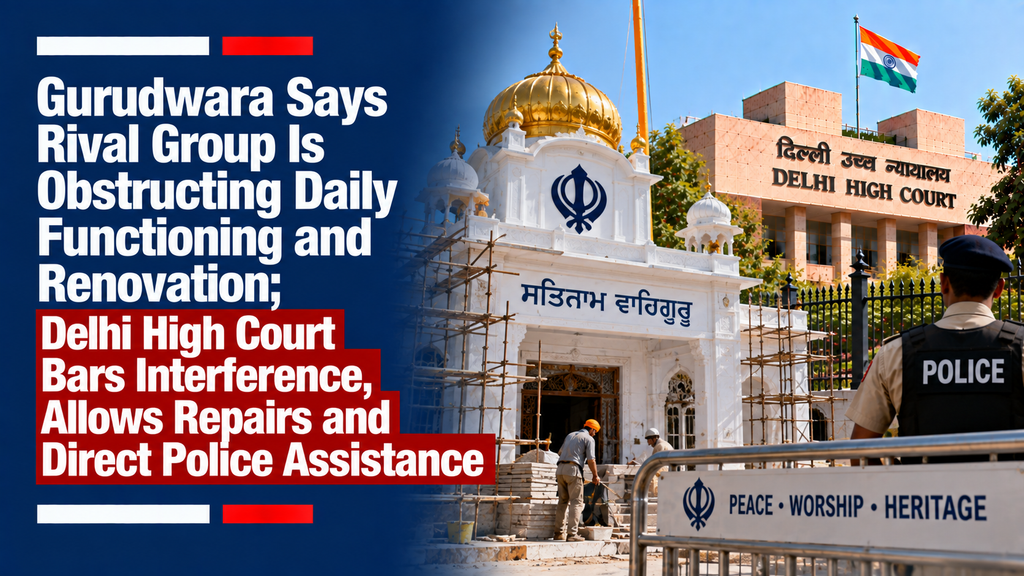
Gurudwara Says Rival Group Is Obstructing Daily Functioning and Renovation; Delhi High Court Bars Interference, Allows Repairs and Direct Police Assistance

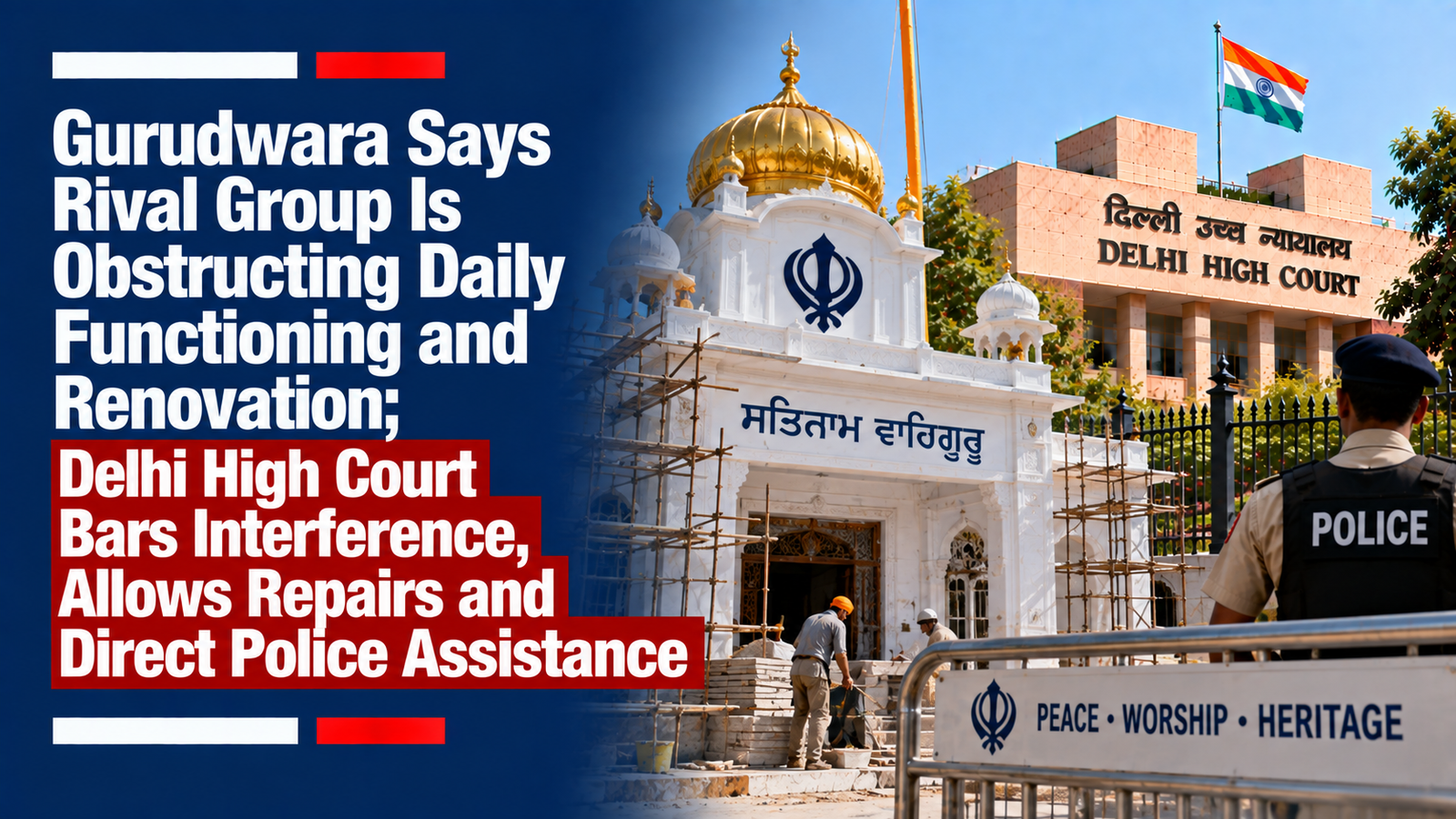
No Permission Required for Repair and Renovation of Gurudwara Without Changing Building Structure: Delhi High Court
Facts
The petitioner, Gurudwara Shri Guru Singh Sabha (Regd.), approached the Delhi High Court alleging wilful disobedience of an earlier order dated 21 August 2023 passed in a previous contempt proceeding.
The underlying dispute concerned the functioning of the Gurudwara at Preet Vihar. Earlier proceedings had referred to an SDM order directing that there should be no hindrance or obstruction in the functioning of the Gurudwara and that a disputed display board affixed by the respondents should be removed.
In the present contempt petition, the Gurudwara alleged that respondent nos. 1 to 12 were continuing to create disturbances in its day-to-day operations.
The respondents strongly denied causing any hindrance or disturbance.
During the hearing, the petitioner also placed photographs before the Court showing that the Gurudwara’s board was lying on the floor and claimed that it could not reinstall the board because of obstruction by the respondents.
The petitioner further produced photographs showing the condition of the Darbar Sahib, seeking permission to undertake renovation.
Petitioner’s Arguments
The Gurudwara maintained that despite earlier judicial directions, the respondents continued to interfere with its peaceful functioning.
It specifically complained that:
- the Gurudwara board could not be installed because of interference;
- renovation of the Darbar Sahib was required;
- the walls had deteriorated;
- the ceiling was damaged; and
- respondents were creating impediments in the Gurudwara’s ordinary operations.
The petitioner therefore sought effective directions ensuring that the institution could function and undertake necessary repairs without obstruction.
Respondents’ Arguments
Respondent nos. 1 to 12 categorically denied having caused any hindrance or disturbance to the smooth functioning and operations of the Gurudwara.
The High Court took this statement on record and held the respondents bound by it.
Analysis of the Law
1. Respondents Bound by Their Statement of Non-Interference
Instead of entering into a detailed factual determination as to every alleged past act of interference, the High Court recorded the respondents’ categorical statement that they were not obstructing the Gurudwara.
It then held them bound by that representation.
More importantly, the Court issued a clear prospective direction:
the respondents shall not create any obstruction or disturb the day-to-day functioning of the Gurudwara “in any manner whatsoever.”
Thus, the order converted the respondents’ stand before the Court into an enforceable obligation of non-interference.
2. Gurudwara Permitted to Reinstall Its Board
The petitioner showed the Court a photograph of the Gurudwara board lying on the floor.
It alleged that interference by the respondents had prevented the board from being affixed to the wall.
The High Court granted the petitioner express permission to install the Gurudwara board at an appropriate place and directed the respondents not to obstruct its installation.
3. Photographs Showed Actual Need for Renovation
The Court did not treat the renovation request as merely an unsupported assertion.
After examining the photographs placed on record, it specifically recorded that:
- paint had peeled off the walls of the Gurudwara; and
- there was damage to the ceiling of the Darbar Sahib.
These visible conditions formed the factual basis for permitting the repair work.
4. No Statutory Permission Required for These Repairs
The most significant legal proposition in the order concerns renovation.
The High Court expressly held:
“no permission is required from any statutory authority to carry out such renovation work.”
However, the permission was subject to an important limitation.
The petitioner could carry out repair and renovation without changing the structure of the Gurudwara building.
Accordingly, the ruling should not be read as dispensing with statutory permissions for structural alteration, reconstruction or other development that independently requires regulatory approval. The Court’s direction concerned the non-structural repair/renovation shown before it.
5. Direct Police Assistance Provided
The High Court also put in place an enforcement mechanism rather than leaving the Gurudwara to initiate fresh litigation if interference recurred.
The Court permitted the petitioner’s Authorised Representative to directly contact the concerned Beat Officer in the event of obstruction.
If any interference occurs in the smooth functioning of the Gurudwara, the authorised representative can inform the Beat Officer, who has been directed to ensure that:
“normalcy and order is restored in the working of the Gurudwara.”
This gives the Court’s non-interference direction an immediate practical enforcement mechanism.
Precedent Analysis
The present judgment does not turn upon an extensive discussion of reported precedents.
Rather, it arises from the continuing history of orders concerning the same Gurudwara dispute, particularly the Delhi High Court’s earlier order dated 21 August 2023 and the underlying SDM directions.
The Court’s approach was primarily remedial: it recorded the respondents’ statement, bound them to it, clarified the petitioner’s right to undertake non-structural repairs and provided a mechanism for police intervention if obstruction recurred.
Court’s Reasoning
The Court effectively separated the dispute into three practical issues.
First, regarding day-to-day functioning, the respondents themselves denied creating obstruction. They were therefore held bound by that statement and expressly restrained from future interference.
Second, regarding the Gurudwara board, the Court saw no reason why the petitioner should be prevented from installing it at an appropriate place and expressly prohibited obstruction.
Third, regarding renovation of the Darbar Sahib, the photographs showed peeling paint and ceiling damage. Since the proposed work was repair/renovation without structural alteration, the Court held that no statutory permission was required for such work.
Finally, recognising the petitioner’s apprehension of continuing interference, the Court authorised direct recourse to the local Beat Officer to restore order.
Conclusion
The Delhi High Court disposed of the contempt petition with protective directions in favour of the Gurudwara.
The Court directed that:
- respondent nos. 1 to 12 shall not obstruct or disturb the day-to-day functioning of the Gurudwara;
- the Gurudwara may install its board at an appropriate place, without obstruction from the respondents;
- necessary repair and renovation of the Darbar Sahib may be undertaken without statutory permission, provided the structure of the Gurudwara building is not changed; and
- in case of interference, the petitioner’s Authorised Representative may directly contact the Beat Officer, who must ensure restoration of normalcy and order.
The pending applications were also disposed of, and the next date of hearing fixed for 2 December 2026 was cancelled.
Case Details
Case: Gurudwara Shri Guru Singh Sabha (Regd.) Through Its General Secretary Ranjeet Singh v. Shailender Singh & Ors.
Court: Delhi High Court
Case No.: CONT.CAS(C) 99/2024 & connected applications
CNR: DLHC010016052024
Judge: Justice Mini Pushkarna
Date of Decision: 17 September 2026
Result: Contempt petition disposed of with directions against obstruction; Gurudwara permitted to reinstall its board and undertake non-structural renovation, with police assistance available in case of interference.