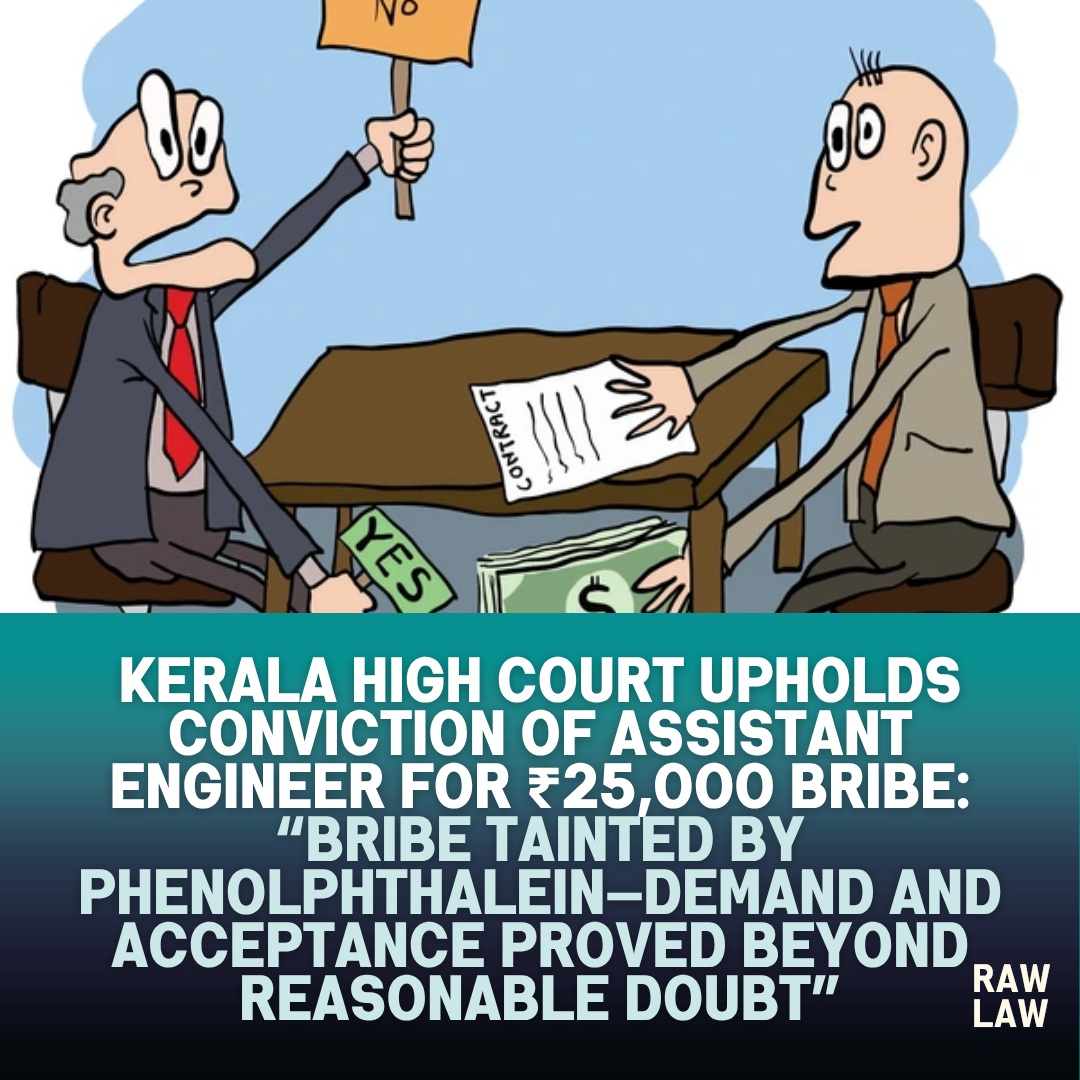
Kerala High Court Upholds Conviction of Assistant Engineer for ₹25,000 Bribe: “Bribe Tainted by Phenolphthalein—Demand and Acceptance Proved Beyond Reasonable Doubt”

Court’s Decision
The Kerala High Court, through Justice A. Badharudeen, upheld the conviction of an Assistant Engineer of the Kerala State Electricity Board (KSEB) for demanding and accepting a bribe of ₹25,000 from a contractor, affirming the findings of the trial court under Sections 7 and 13(1)(d) read with Section 13(2) of the Prevention of Corruption Act, 1988.
The Court observed that the prosecution conclusively proved both demand and acceptance of the bribe, supported by scientific and corroborative evidence, and dismissed the argument that the recovery was “planted” or “forced”. However, the sentence was slightly modified — imprisonment reduced from two years to one year while maintaining the fines imposed.
Justice Badharudeen emphatically stated:
“Proof of demand and acceptance of illegal gratification is a sine qua non for conviction under Sections 7 and 13(1)(d) of the Act. The prosecution has, through cogent oral and scientific evidence, proved both beyond reasonable doubt.”
Facts
The case arose from a vigilance trap conducted by the Vigilance and Anti-Corruption Bureau (VACB) following a complaint lodged by a contractor engaged in KSEB works. The complainant had completed a contract for installing a distribution transformer and associated line works, for which the final bill amounting to ₹3,07,469 was pending approval by the accused, who was serving as the Assistant Engineer in Electrical Section, Elanthoor.
According to the complaint, the accused demanded ₹25,000 as illegal gratification on 18 June 2013 for forwarding the bill to the higher authorities and ensuring its timely clearance. Unwilling to pay the bribe, the contractor approached the VACB, leading to a trap operation on 20 June 2013.
As per the prosecution, phenolphthalein-laced currency notes totaling ₹25,000 were handed over to the complainant, who met the accused in his office at around 2:45 p.m. The accused allegedly accepted the cash, placing it inside a drawer in his table.
The VACB officials immediately entered the office, conducted the phenolphthalein test, and recovered the tainted money from the drawer. The solution from the accused’s hands and the drawer tested positive for phenolphthalein, indicating contact with the tainted notes.
After investigation, a charge sheet was filed under Sections 7 and 13(1)(d) read with Section 13(2) of the Prevention of Corruption Act. The Vigilance Court, Thiruvananthapuram, convicted the accused and sentenced him to two years’ imprisonment with fines totaling ₹30,000. The present appeal challenged that conviction.
Issues
- Whether the prosecution proved the demand and acceptance of illegal gratification beyond reasonable doubt.
- Whether the trap proceedings and scientific evidence were free from procedural irregularities.
- Whether the recovery of tainted currency from the drawer could alone sustain conviction.
- Whether the sentence imposed required modification in view of mitigating factors.
Petitioner’s Arguments
The appellant contended that the trap was fabricated, and that the tainted notes were forcibly placed in his drawer without his knowledge. He argued that there was no concrete proof of demand, as the complainant’s testimony lacked corroboration and was contradicted by other witnesses.
It was also submitted that the accused had no authority to sanction the bill, which was to be approved by the Assistant Executive Engineer. Hence, there was no motive or necessity for him to demand a bribe.
Counsel further argued that the phenolphthalein test results were unreliable, as the detection solution was not preserved properly, and the accused’s hand wash did not conclusively prove handling of tainted notes. The defense stressed that no pre-trap verification was conducted to ensure genuineness of the complaint.
The appellant relied on the Supreme Court’s ruling in Neeraj Dutta v. State (2023 AIR SC 330) to argue that mere recovery of money, without proof of demand, cannot result in conviction.
Respondent’s Arguments
The Public Prosecutor, representing the State, argued that the prosecution had clearly established the twin requirements of demand and acceptance. The complainant’s testimony (PW1) was fully corroborated by independent witnesses (PW2 and PW3) and by the scientific evidence of the phenolphthalein test.
It was pointed out that the pre-trap verification report (Ext. P8) confirmed the genuineness of the complaint, and the trap mahazar (Ext. P9) recorded the procedural compliance in meticulous detail.
The prosecution emphasized that the accused’s right hand wash and the drawer wash both tested positive, corroborated by the forensic report (Ext. P23), proving that he had indeed handled the tainted notes.
The State further argued that the accused’s position as Assistant Engineer placed him in a pivotal role for forwarding and verifying bills, and hence, his demand for illegal gratification was not only plausible but proved through direct and circumstantial evidence.
It was contended that the presumption under Section 20 of the Prevention of Corruption Act applied once acceptance was proved, and the accused had failed to rebut it.
Analysis of the Law
Justice Badharudeen began by examining the principles under Sections 7 and 13 of the Prevention of Corruption Act, emphasizing that demand and acceptance are essential components of the offence.
Citing Neeraj Dutta v. State (AIR 2023 SC 330), the Court reaffirmed that:
“Proof of demand and acceptance can be established either by direct or circumstantial evidence. Mere recovery of tainted money, divorced from the circumstances of demand and voluntary acceptance, will not suffice.”
The Court further referred to State of Karnataka v. Chandrasha (2024 KHC 6658), which clarified that once acceptance of bribe is proved, the presumption under Section 20 arises automatically, shifting the burden on the accused to prove lawful receipt.
Applying these principles, the Court found that the complainant’s evidence (PW1), corroborated by independent witnesses (PW2, PW3) and the scientific evidence (Ext. P23), conclusively established both demand and acceptance.
It also noted that Section 20’s presumption was fully attracted, and the accused failed to provide any credible explanation or evidence to rebut it.
Precedent Analysis
The Court relied on three major precedents to reinforce its conclusion:
- Neeraj Dutta v. State (AIR 2023 SC 330) – Affirmed that demand and acceptance are essential ingredients for conviction under Sections 7 and 13, and can be proved by circumstantial evidence even if direct evidence is absent.
- State of Karnataka v. Chandrasha (2024 KHC 6658) – Clarified that Section 20’s presumption arises upon proof of acceptance and can only be rebutted by a satisfactory explanation from the accused.
- Sunil Kumar K. v. State of Kerala (2025 KHC Online 983) – Reiterated that proof of demand is the sine qua non and that phenolphthalein evidence corroborating oral testimony provides decisive proof of guilt.
By applying these rulings, the Court found the trial court’s conclusion flawless and well-supported by evidence.
Court’s Reasoning
Justice Badharudeen, in a detailed discussion, held that the prosecution’s evidence was consistent, credible, and legally sufficient.
He noted that PW1’s account of the demand on 18 June 2013 was corroborated by his complaint (Ext. P7) and pre-trap verification (Ext. P8). The sequence of events—meeting, demand, trap setup, and recovery—was clearly established.
The phenolphthalein tests confirmed the accused’s physical contact with the bribe money, and his conduct after the trap—showing visible nervousness—further supported guilt.
The Court dismissed the defense claim that the money was forcibly planted, holding that such a theory was inconsistent with the positive phenolphthalein results and witness testimony.
“The argument that the complainant forcibly placed the tainted notes is inherently improbable. The hand wash and drawer wash turning pink clearly establish handling of the tainted money by the accused.”
The Court also found no procedural lapses in the trap operation and concluded that the prosecution had proved demand, acceptance, and recovery beyond reasonable doubt.
Conclusion
The High Court upheld the conviction of the accused under Sections 7 and 13(1)(d) read with 13(2) of the Prevention of Corruption Act. However, considering the passage of 12 years since the incident and the limited bribe amount, the Court reduced the substantive imprisonment from two years to one year, keeping the fine intact.
“The conviction stands confirmed as the prosecution has proved the case beyond reasonable doubt. However, the sentence is modified in the interest of justice.”
The accused was directed to surrender before the trial court to serve the modified sentence.
Implications
This judgment reinforces key principles in anti-corruption jurisprudence:
- Demand and acceptance remain essential ingredients of the offence.
- Phenolphthalein test evidence, when corroborated by oral testimony, carries high evidentiary value.
- Once acceptance is proved, Section 20’s presumption applies automatically, shifting the burden on the accused.
The ruling also serves as a caution to public servants that even small bribes can result in conviction and career termination when backed by credible evidence.
FAQs
1. What is necessary to prove an offence under the Prevention of Corruption Act?
Proof of both demand and acceptance of illegal gratification is mandatory. Recovery alone cannot sustain conviction.
2. What role does the phenolphthalein test play in bribery cases?
It scientifically confirms handling of tainted notes and serves as strong corroborative evidence when supported by oral testimony.
3. Why was the sentence reduced?
The Court considered the passage of time since the offence and the limited bribe amount, balancing deterrence with proportionality.