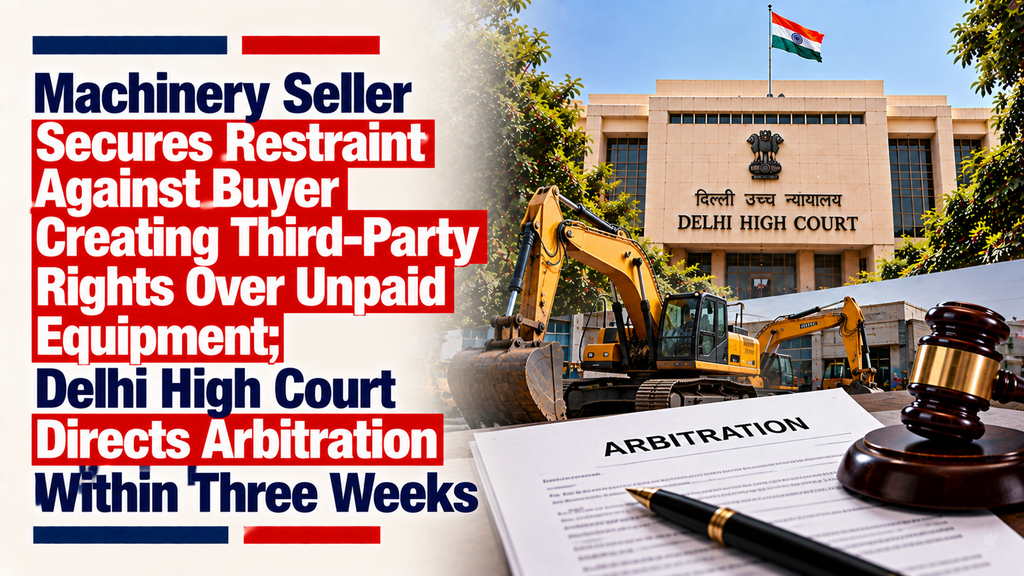
Machinery Seller Secures Restraint Against Buyer Creating Third-Party Rights Over Unpaid Equipment; Delhi High Court Directs Arbitration Within Three Weeks

Machinery Seller Gets Section 9 Protection Against Alienation of Equipment; Delhi High Court Says Interim Relief Cannot Continue Endlessly
Facts
The petition was filed by Liugong India Pvt. Ltd. against Crosslite Infra Pvt. Ltd. and others under Section 9 of the Arbitration and Conciliation Act, 1996. The matter was decided by Justice Om Prakash Shukla on 23 September 2026.
The dispute arose from an Agreement for Sale dated 12 April 2025 concerning machinery and equipment supplied by Liugong India to the respondents.
According to Liugong, the respondents had consistently failed to make the payments agreed under the sale agreement, while continuing to possess the machinery.
Liugong apprehended that the respondents could sell, alienate, encumber or create third-party rights over the machinery despite the outstanding dues.
Reliefs Sought by Liugong
Liugong sought several interim measures, including:
- restraint against transferring or creating third-party rights over the machinery;
- permission for its representatives to inspect machinery located at various mining sites;
- security or bank guarantees equivalent to the outstanding amount;
- appointment of its representative as Receiver to repossess the machinery with police assistance if required; and
- eventual permission to sell the machinery because it was a depreciating asset.
Earlier Interim Protection
On 27 April 2026, the Delhi High Court found that a prima facie case existed for interim protection.
It directed the respondents to ensure that:
no third-party rights were created in the machines, and no charge or encumbrance was created over them until the next hearing.
Thus, Liugong had already been enjoying protection over the machinery for several months by the time the present order was passed.
Arbitration Clause
The Agreement for Sale contained an arbitration clause in Clause 13.5.
It required the parties first to attempt an amicable settlement. If no settlement was achieved within 30 days, the dispute was to be referred to a sole arbitrator appointed by the parties under the Arbitration and Conciliation Act, 1996.
Importantly, Clause 13.5.5 provided:
“The Place of Arbitration shall be New Delhi.”
Analysis of the Law
Section 9 Protection Cannot Continue Endlessly
The central point of the order is the relationship between Section 9 court protection and commencement of arbitration.
The High Court noted that Liugong had been enjoying interim protection since April 2026.
It held that, in the circumstances, the petitioner could not be permitted to continue enjoying the interim protection “endlessly” without taking steps to constitute the Arbitral Tribunal.
Accordingly, the Court gave Liugong three weeks to take appropriate steps for constitution of the Arbitral Tribunal.
Section 9 Petition to Become Section 17 Application
The Court adopted a practical procedural mechanism.
Once the Arbitral Tribunal is constituted, the existing Section 9 petition will be treated as an application under Section 17 of the Arbitration Act and placed before the sole arbitrator for consideration.
This means that the interim dispute concerning preservation of the machinery will thereafter be determined by the arbitrator rather than remaining indefinitely before the High Court.
Existing Injunction Continues Until Arbitrator Decides
The High Court did not immediately remove the protection previously granted to Liugong.
The restraint imposed on 27 April 2026 will continue until the sole arbitrator considers the matter and passes appropriate orders.
However, the arbitrator is not bound to continue the High Court’s arrangement.
The Court expressly authorised the Arbitral Tribunal, after considering the case on merits, to:
continue, modify, vary or vacate the interim arrangement.
Automatic Vacation if Arbitration Is Not Commenced
The Court attached a significant consequence to its three-week deadline.
If Liugong fails to commence arbitral proceedings within three weeks, the interim protection granted by the High Court will automatically stand vacated.
Therefore, continuation of the restraint against alienation of the machinery was made conditional upon Liugong promptly pursuing arbitration.
Petitioner Did Not Obtain All Reliefs Sought
An important nuance is that Liugong had originally sought much broader relief, including:
repossession of the machinery, appointment of a Receiver, police protection, security/bank guarantees and permission eventually to sell the machinery.
The present order does not grant those substantive reliefs.
What continued was the earlier protective restraint preventing creation of third-party rights, charges or encumbrances over the machinery.
The remaining interim issues were left for consideration by the Arbitral Tribunal.
Precedent Analysis
The five-page order does not cite or analyse any reported precedent.
It is essentially a procedural Section 9 order based on:
- the existing arbitration agreement;
- the interim protection already operating since April 2026;
- the need to promptly constitute the Arbitral Tribunal; and
- transfer of responsibility for interim measures to the arbitrator under Section 17.
Accordingly, the order should not be overstated as laying down a universal three-week rule for commencement of arbitration after Section 9 protection. The three-week period was a direction issued on the facts of this particular dispute.
Court’s Reasoning
The Court balanced two considerations.
On one hand, the machinery needed continued protection because the Court had already found sufficient grounds to restrain its alienation or encumbrance.
On the other hand, Liugong could not continue enjoying a court-ordered injunction indefinitely while failing to move forward with the contractually agreed arbitral process.
The solution was therefore to:
continue the protection temporarily, require arbitration to commence within three weeks, and transfer the interim dispute to the Arbitral Tribunal under Section 17.
The arbitrator would then independently decide whether the restraint should continue.
Conclusion
The Delhi High Court disposed of the Section 9 petition by directing Liugong India to take steps for constitution of the Arbitral Tribunal within three weeks.
The existing restraint against creation of third-party rights or encumbrances over the machinery will continue until the arbitrator considers the matter.
Once constituted, the Section 9 petition will be treated as a Section 17 application before the arbitrator.
If Liugong fails to commence arbitration within three weeks, the interim protection will automatically stand vacated. The Court also clarified that none of its observations constituted an opinion on the merits of the underlying dispute.
Case: Liugong India Pvt. Ltd. v. Crosslite Infra Pvt. Ltd. & Ors.
Court: Delhi High Court
Case No.: O.M.P.(I) (COMM.) 181/2026
Judge: Justice Om Prakash Shukla
Date: 23 September 2026
Result: Existing protection against alienation or encumbrance of machinery continued subject to commencement of arbitration within three weeks; petition to thereafter operate as a Section 17 application before the arbitrator.