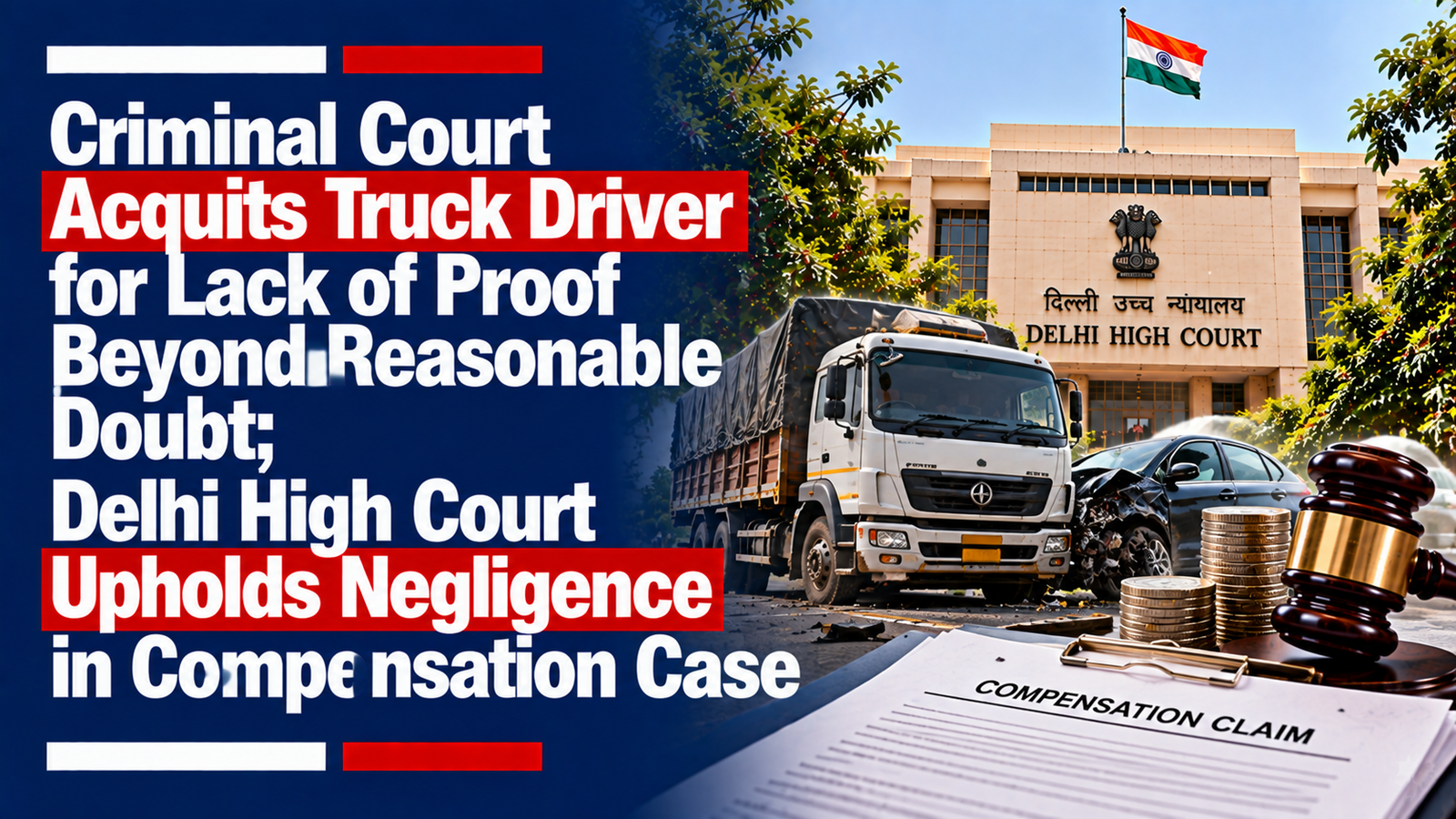
Criminal Court Acquits Truck Driver for Lack of Proof Beyond Reasonable Doubt; Delhi High Court Upholds Negligence in Compensation Case

Motor Accident Victim’s Disability Rises From 9% to 49% After AIIMS Assessment; Delhi High Court Accepts Medical Board Repor
Facts
These were cross-appeals arising from a Motor Accident Claims Tribunal award concerning a serious road accident involving Praveen Sharma and a truck owned by DS Constructions Ltd., now DSC Ltd. The judgment was reserved on 20 August 2026 and pronounced on 23 September 2026 by Justice Anish Dayal.
On 20 April 2006 at approximately 5:30 p.m. near Rajiv Chowk, Gurgaon, Praveen Sharma was riding a motorcycle with his elder brother Raman Sharma as pillion.
A truck bearing registration No. HR-55-B-6132 allegedly came at high speed and collided with their motorcycle.
Praveen suffered extremely serious injuries to his pelvis, bladder, intestine, urethra and rectal region.
The Tribunal awarded him ₹37.19 lakh with 9% interest per annum. Since the offending truck was uninsured, liability was imposed jointly upon its driver and owner.
The owner appealed challenging both negligence and quantum, while Praveen filed a cross-appeal seeking enhancement.
Appellant/Owner’s Arguments
The owner principally argued that negligence had not been proved.
It relied heavily upon the fact that the truck driver had been acquitted by the criminal court on 28 September 2011.
According to the owner, the Tribunal had relied upon the FIR and chargesheet to presume negligence, but that foundation was weakened once the criminal prosecution ended in acquittal.
The owner also questioned the evidence of Praveen’s brother, Raman Sharma, who claimed to have been the pillion rider.
Among other things, it argued that:
- Raman suffered no injury despite allegedly sitting behind Praveen;
- the MLC recorded that Praveen was brought by an “unknown person”;
- Raman’s office timings and location made his presence near Rajiv Chowk questionable; and
- there was no independent eyewitness to the accident.
On compensation, the owner particularly challenged the increase in medical disability from an original 9% to 49% and argued that the Tribunal’s assessment of the claimant’s loss of earning capacity was excessive.
Claimant’s Arguments
Praveen argued that the truck’s involvement itself was never disputed.
His brother’s presence was corroborated by the hospital admission documents, including a consent form bearing Raman Sharma’s signature.
He further submitted that criminal acquittal was irrelevant because criminal guilt must be proved beyond reasonable doubt, whereas negligence in MACT proceedings is determined on the preponderance of probabilities.
On compensation, he relied upon his extraordinary medical history, repeated surgeries, continuing disability and inability to earn.
Nature of the Injuries
The medical evidence was particularly significant.
Praveen was admitted immediately after the accident with profuse bleeding. His pulse and blood pressure were not recordable.
He was diagnosed with a ruptured urethra and rectum, underwent laparotomy, rectal repair and ileostomy, suffered pelvic fracture, and required 42 units of blood.
His condition remained serious for years.
The record showed repeated operations at Pushpanjali Hospital, City Hospital and Sir Ganga Ram Hospital. The medical-treatment chart reproduced on pages 13–14 of the judgment documents the extensive sequence of surgeries.
By the time of the High Court proceedings, counsel stated that Praveen had undergone approximately 26 surgeries.
Doctors also opined that his sexual and reproductive functions would remain compromised because of the pelvic and urethral injuries.
Analysis of the Law
Criminal Acquittal Does Not Decide MACT Negligence
This is the principal legal proposition emerging from the judgment.
The High Court held that the outcome of criminal proceedings does not govern determination of negligence before a Motor Accident Claims Tribunal because the two proceedings apply different standards of proof.
A criminal court asks whether guilt has been established beyond reasonable doubt.
A MACT determines civil negligence on the preponderance of probabilities.
Therefore, the truck driver’s criminal acquittal did not erase the material supporting negligence in the compensation proceedings.
FIR and Chargesheet Are Relevant Prima Facie Evidence
The Court relied substantially on the Supreme Court’s 2026 decision in Reena v. Managing Director, Karnataka State Road Transport Corporation.
The principles extracted were that police investigation records, including the FIR and final chargesheet, constitute valid prima facie evidence of rash and negligent driving in MACT proceedings, and a later criminal acquittal does not displace civil liability.
The Court reiterated:
“Criminal acquittals do not displace this prima facie civil liability.”
Owner’s Challenge to Pillion Rider Was Speculative
The Court rejected the attempt to discredit Raman Sharma’s presence based upon his office location and working hours.
It characterised those arguments as highly speculative and presumptive.
Similarly, the argument that Raman should necessarily have suffered injuries because he was sitting pillion was described as “highly assumptive and without any basis.”
Importantly, the truck owner had not led any evidence of its own, and the driver was not examined.
The offending vehicle’s involvement was also undisputed.
Absence of Independent Eyewitness Is Not Fatal
The High Court rejected the contention that negligence could not be proved without an independent eyewitness.
It observed that eyewitnesses frequently do not come forward in road accident cases.
The claimant and his brother had themselves provided relevant and corroborative testimony.
Relying on Anita Sharma v. New India Assurance Co. Ltd., the Court held that non-examination of the best eyewitness cannot prevent the Tribunal from determining negligence from the other material available.
The immediate FIR identifying the truck and the subsequent chargesheet further supported the claim.
Disability Increased From 9% to 49%
The original disability assessment was only 9% permanent disability in relation to both lower limbs.
During the appeal, however, the High Court referred Praveen to AIIMS.
In February 2024, the AIIMS Medical Board assessed temporary disability at 29.33% and recommended reassessment.
On 29 August 2025, JPN Apex Trauma Centre, AIIMS assessed his permanent physical disability at 49% in relation to both lower limbs and pelvis.
The owner challenged the dramatic increase from 9% to 49%.
The High Court rejected that challenge because no meaningful attempt had been made to challenge the expert assessment when the AIIMS reports were produced. Both certificates were from a government medical institution and were treated as persuasive.
49% Physical Disability but 80% Functional Disability
The Court made an important distinction between medical/physical disability and functional disability.
Praveen had not lost a limb. Nevertheless, the injuries affected virtually his entire reproductive and urinary region, seriously impairing his everyday functioning and capacity to work.
Considering:
- approximately 26 surgeries;
- prolonged hospitalisation;
- pelvic, rectal and urethral damage;
- permanent reproductive impairment;
- continuing treatment; and
- inability to earn,
the Court assessed his functional disability at 80%, despite the medical assessment being 49%.
Compensation Recalculated
Praveen was only 21 years old and pursuing the second year of B.Com when the accident occurred.
Although he claimed to be employed as a Senior Executive, he failed to prove the employment through his employer.
However, because he was pursuing graduation, the High Court applied the minimum wages of a graduate—₹4,031 per month—rather than ₹3,719 adopted by the Tribunal.
It then added 40% future prospects, applied a multiplier of 18, and calculated loss of future income at ₹9,75,110 based upon 80% functional disability.
₹10 Lakh for Attendant Charges
The Tribunal had awarded nothing separately for attendant expenses.
The High Court found this inappropriate given Praveen’s continuing condition and need for assistance.
It therefore awarded a lump sum ₹10 lakh towards nursing/attendant charges.
Pain and Suffering Increased
The Tribunal had awarded ₹1.50 lakh for pain and suffering.
Considering the number and seriousness of surgeries, the High Court enhanced this to ₹5 lakh.
The existing ₹11.50 lakh towards loss of amenities and marriage prospects was maintained.
Final Compensation
The High Court recalculated compensation as follows:
| Head | Delhi High Court |
| Medical treatment | ₹15,40,654 |
| Conveyance | ₹75,000 |
| Special diet | ₹75,000 |
| Attendant charges | ₹10,00,000 |
| Loss of future earnings | ₹9,75,110 |
| Pain and suffering | ₹5,00,000 |
| Loss of amenities and marriage prospects | ₹11,50,000 |
| Total | ₹53,16,000 |
The judgment’s table on page 27 records that the Tribunal’s stated figure of ₹37.19 lakh had itself been arithmetically incorrect; the correct Tribunal total was ₹37,93,958.
The High Court nevertheless quantified the enhancement at ₹15.97 lakh, taking the final award to ₹53.16 lakh.
Precedent Analysis
Reena v. Managing Director, KSRTC
Criminal acquittal does not determine civil negligence. FIR and chargesheet can constitute prima facie material in MACT proceedings because the standard is preponderance of probabilities.
ICICI Lombard General Insurance Co. Ltd. v. Rajani Sahoo
Reinforced the independent nature of civil motor accident liability and the evidentiary relevance of police investigation records.
Mathew Alexander v. Mohd. Shafi
Supported the proposition that criminal proceedings and MACT claims operate in distinct evidentiary spheres.
Anita Sharma v. New India Assurance Co. Ltd.
Absence or non-examination of an independent eyewitness does not prevent the Tribunal from determining negligence on the available material.
Pranay Sethi
Applied for 40% future prospects in calculating loss of future income.
Court’s Reasoning
The Court found no basis to disturb the finding of negligence merely because the truck driver had subsequently been acquitted in the criminal prosecution.
The truck’s involvement was undisputed, the FIR was promptly registered, a chargesheet followed, the claimant’s brother supported the account of the collision, and the owner produced no affirmative evidence to establish a contrary version.
On compensation, the Court considered the Tribunal’s award inadequate when viewed against the devastating long-term consequences of the accident. Although Praveen’s certified physical disability was 49%, its functional impact on his capacity to work and live independently was substantially greater, justifying an assessment of 80%.
Conclusion
The Delhi High Court rejected the truck owner’s challenge to negligence and substantially allowed the claimant’s plea for enhancement.
Compensation was fixed at ₹53.16 lakh with 9% interest, representing an enhancement of ₹15.97 lakh. The enhanced amount with interest from the date of filing of the claim petition was directed to be deposited within four weeks.
Case: DSC Ltd. (formerly D S Construction Ltd.) v. Praveen Sharma & Anr. with Praveen Sharma v. Darshan Singh & Anr.
Court: Delhi High Court
Case Nos.: MAC.APP. 1128/2017 & MAC.APP. 499/2018
Judge: Justice Anish Dayal
Reserved: 20 August 2026
Pronounced: 23 September 2026
Result: Negligence upheld despite driver’s criminal acquittal; compensation enhanced to ₹53.16 lakh with 9% interest.