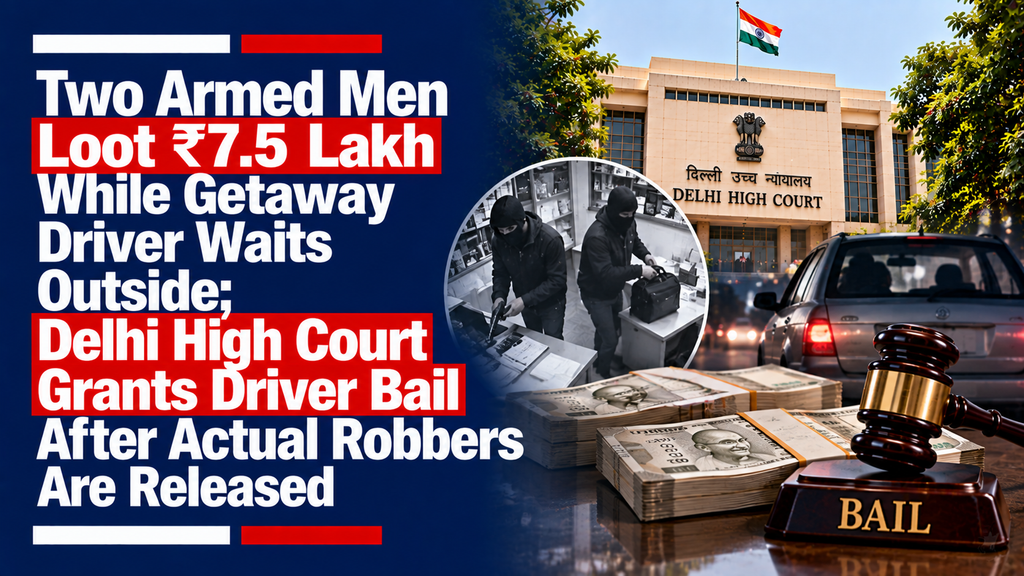
Two Armed Men Loot ₹7.5 Lakh While Getaway Driver Waits Outside; Delhi High Court Grants Driver Bail After Actual Robbers Are Released

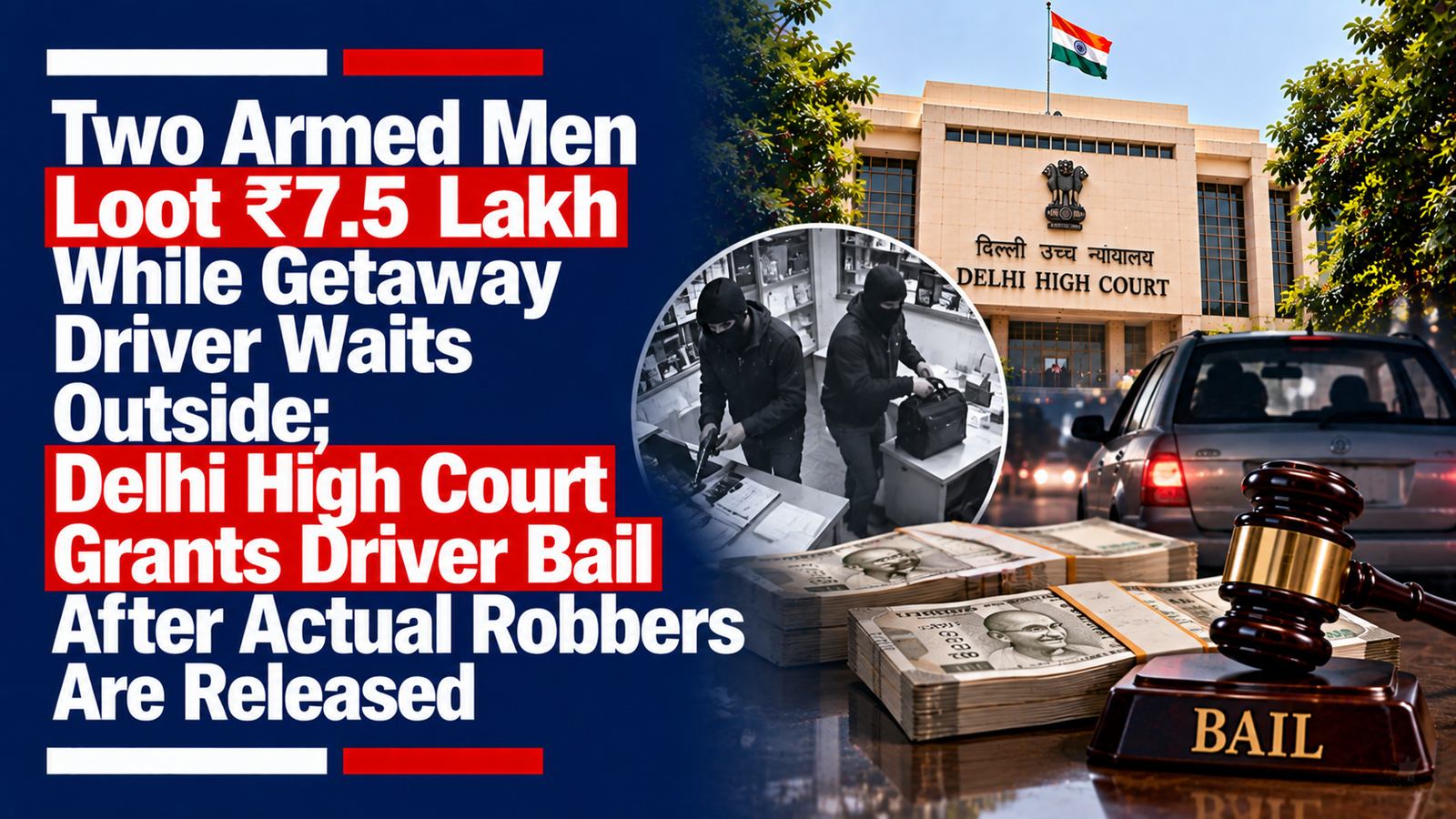
Firearms Recovered From Co-Accused, Not Alleged Getaway Driver; Delhi High Court Grants Bail in ₹7.5 Lakh Travel Agency Robbery
Facts
The applicant, Bhola Shankar @ Shankar Yadav, sought regular bail under Section 483 of the Bharatiya Nagarik Suraksha Sanhita in FIR No. 88/2025, registered at Police Station Vasant Kunj North for offences under Sections 311, 317(2) and 3(5) of the Bharatiya Nyaya Sanhita and Sections 25 and 27(2) of the Arms Act. The judgment was pronounced by Justice Mini Pushkarna on 24 September 2026.
The complainant operated a travel agency called Aapka Travels Pvt. Ltd. at Mahipalpur, Delhi.
On 14 February 2025, two masked men allegedly entered his shop and, at gunpoint, robbed Indian and foreign currency worth approximately ₹7.50 lakh.
The prosecution alleged that Bhola Shankar did not enter the shop. Instead, he was waiting outside in a car and allegedly drove the getaway vehicle in which the two robbers escaped.
Arrest of the Two Alleged Robbers
The next day, police apprehended co-accused Dipanshu and Gaurav Dhania.
From Dipanshu, police allegedly recovered a pistol, magazines, live ammunition, ₹15,000 and other articles.
From Gaurav Dhania, police allegedly recovered three country-made pistols, five live cartridges and ₹5,000.
The prosecution also alleged that one of the co-accused had fired a gunshot while escaping from the robbery.
Bhola Shankar was subsequently arrested. The prosecution claimed that ₹2 lakh of the allegedly looted money along with foreign currency was recovered at his instance from the residence of the sister of his girlfriend, who subsequently became his wife.
Applicant’s Arguments
The principal argument was parity.
Both alleged actual robbers were already on bail:
- Gaurav Dhania had been granted bail on 6 June 2025; and
- Dipanshu had been granted default bail on 26 September 2025.
The applicant contended that his role was comparatively lesser because he was alleged only to have driven the escape vehicle, whereas the other two accused allegedly entered the shop, carried firearms and committed the robbery.
He had also remained in custody for approximately one year and six months.
The defence further submitted that investigation was complete, the chargesheet had been filed, and continued incarceration therefore served no useful investigative purpose.
It was also pointed out that the applicant was 27 years old and had aged parents, a wife and two minor children.
Respondent’s Arguments
The State strongly opposed bail and described Bhola Shankar as the “master mind” and prime conspirator of the robbery.
It relied particularly upon:
- the disclosure statements of the co-accused;
- recovery of ₹2 lakh and foreign currency allegedly at the applicant’s instance;
- his alleged role in facilitating the robbery and escape;
- his previous involvement in Arms Act cases;
- the possibility of absconding because he was not a permanent resident of Delhi; and
- the risk of influencing witnesses or tampering with evidence.
The State disputed parity, pointing out that one co-accused had received default bail, while Gaurav was a first-time offender.
In contrast, multiple Arms Act FIRs were pending against Bhola Shankar.
Analysis of the Law
Parity With Co-Accused
The decisive consideration for the High Court was the comparative role of the three accused.
The Court expressly observed that the two persons who actually committed the robbery had already been granted bail.
Bhola Shankar’s alleged role, in comparison, was described by the Court as a “supporting role” because he allegedly drove the vehicle used by the co-accused to escape after the robbery.
Firearms Were Recovered From the Other Two Accused
The Court also considered the distribution of alleged roles and recoveries.
A gunshot was allegedly fired by one of the other accused during the robbery.
The firearms were also recovered from those co-accused:
one pistol from Gaurav Dhania and three pistols from Dipanshu.
The High Court therefore concluded that the two co-accused appeared to have a greater role in the robbery than the applicant.
Since those accused had already been released, this became a significant consideration favouring bail to Bhola Shankar.
Previous Criminal Cases Did Not Defeat Bail
The applicant’s criminal antecedents were specifically placed before the Court.
His nominal roll disclosed three pending FIRs, including Arms Act cases in Haryana. The State also submitted that four FIRs had previously been registered against him.
The defence explained that he had already been acquitted in one case and granted bail in the remaining three.
Despite the antecedents and the prosecution’s reliance on them, the High Court considered parity, comparative role and prolonged trial sufficiently significant to justify release.
The judgment should therefore not be read as laying down that criminal antecedents are irrelevant to bail. Rather, the Court weighed them against the specific circumstances of this case.
Prolonged Custody and Delay in Trial
The second significant factor was the progress of the trial.
The applicant had remained in custody since February 2025.
Yet, by September 2026, charges had still not been framed and arguments on charge were continuing.
The High Court concluded that there was every likelihood that the trial would “stretch over a period of time” and was unlikely to conclude in the near future.
Thus, continued pre-trial incarceration also weighed in favour of bail.
Precedent Analysis
The nine-page judgment does not discuss or rely upon any reported precedent.
The decision is primarily fact-specific and rests upon:
comparative role, parity with co-accused, duration of custody and likelihood of delay in completion of trial.
Therefore, the judgment is particularly useful on the proposition that parity should be assessed with reference to the actual comparative role attributed to each accused, rather than merely whether the co-accused obtained bail on precisely identical grounds.
Court’s Reasoning
The Court’s reasoning can be reduced to three central considerations.
First, the applicant was alleged to have a supporting role as the getaway driver, whereas the two co-accused allegedly entered the shop and actually committed the armed robbery.
Second, those two accused, who appeared to have the greater role, were already out on bail.
Third, the applicant had been incarcerated since February 2025, while even the stage of framing charges had not concluded, making an early completion of trial unlikely.
The Court therefore held that on parity, the applicant was also entitled to bail.
Bail Conditions
Bhola Shankar was directed to be released on a ₹50,000 personal bond with one surety of the same amount.
Among other conditions, he must:
- appear before the Trial Court on every date;
- disclose and update his residential address;
- keep his mobile number operational;
- report to the jurisdictional police station every Monday at 9:00 AM;
- not threaten, induce or influence witnesses or tamper with evidence; and
- not commit any offence while on bail.
Conclusion
The Delhi High Court allowed Bhola Shankar’s regular bail application.
The order is particularly notable because the State had characterised him as the mastermind and relied on alleged recovery of looted money and his previous criminal cases. Nevertheless, the Court found that his attributed role in the present offence was comparatively lesser than that of the two alleged armed robbers, both of whom were already on bail, and the trial was unlikely to conclude soon.
The Court clarified that its observations were only for deciding bail and would not influence the Trial Court on merits.
Case: Bhola Shankar v. State of GNCT Delhi
Court: Delhi High Court
Case No.: Bail Application No. 2000/2026
Judge: Justice Mini Pushkarna
Reserved: 23 September 2026
Pronounced: 24 September 2026
Result: Regular bail granted on parity, comparative role and likely delay in trial, subject to stringent conditions.