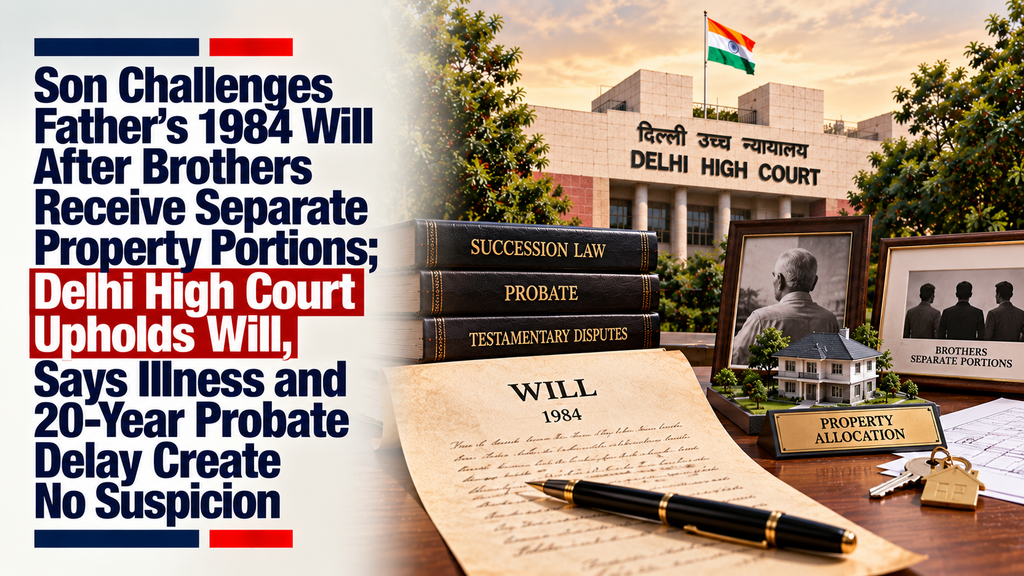
Son Challenges Father’s 1984 Will After Brothers Receive Separate Property Portions; Delhi High Court Upholds Will, Says Illness and 20-Year Probate Delay Create No Suspicion

No Medical Fitness Certificate When Hospitalised Father Executed Will; Delhi High Court Says Attesting Witness’s Evidence Can Still Prove Testamentary Capacity
Facts
The dispute concerned the Will of Manohar Lal Sharma, who was the absolute owner of a 280 sq. yard property at CB-17, Hari Nagar, Clock Tower, New Delhi. He died on 20 December 1984, leaving behind his widow, three sons and one daughter.
His sons Satish Kumar Sharma and Anoop Kumar Sharma sought probate of his last Will dated 9 November 1984.
Under the Will:
- the ground-floor portion marked green was given to Satish Kumar Sharma for life and thereafter to his children;
- the first floor was given to Anoop Kumar Sharma for life and thereafter to his children; and
- a 50 sq. yard ground-floor portion was given to Anil Kumar Parashar, with liberty to construct upwards.
All three sons were appointed executors.
One son, Anil Kumar Parashar, contested the Will. He alleged that:
- the Will was forged and fabricated;
- the testator had died intestate;
- the signatures of the testator and his wife were forged;
- the testator was mentally and physically incapable of executing a Will; and
- the distribution of the property was suspicious.
The daughter, however, gave a No Objection Certificate and did not contest probate.
The Probate Court granted probate on 2 September 2008, holding that the Will had been duly executed and that the testator possessed a sound disposing mind.
The son challenged that decision before the Delhi High Court under Section 299 of the Indian Succession Act, 1925.
Issues
The High Court essentially considered:
- Whether the Will dated 9 November 1984 was duly executed and attested in accordance with Section 63 of the Indian Succession Act.
- Whether execution of the Will while the testator was hospitalised, coupled with the absence of a medical fitness certificate, created suspicious circumstances.
- Whether the nearly 20-year delay in seeking probate undermined the genuineness of the Will.
- Whether exclusion of the widow and daughter and unequal distribution among the sons rendered the Will suspicious.
- Whether differences in the testator’s signatures established forgery.
- Whether the appellant should be permitted to introduce additional evidence and obtain handwriting comparison at the appellate stage.
Appellant’s Arguments
The appellant contended that the unregistered Will was false and fabricated.
He emphasised that the probate petition had been filed nearly 20 years after execution of the Will, arguing that such extraordinary delay itself raised serious suspicion.
He further argued that the testator was suffering from asthmatic ailments and was hospitalised when the Will was allegedly executed. No medical fitness certificate had been obtained.
According to him, this cast doubt upon the testator’s testamentary capacity.
Another alleged suspicious circumstance was the manner of distribution: the wife and daughter received no bequest, while different portions went to the three sons.
The appellant also questioned the signatures appearing on the Will and sought permission to summon old documents and bank records so that a handwriting expert could conduct comparison.
Respondents’ Arguments
The propounders relied heavily upon Capt. Uma Rani Kaushik, the surviving attesting witness.
She was serving as a military nurse at the Army Hospital, Delhi Cantt., where the testator was admitted when the Will was executed.
They argued that the delay in seeking probate was satisfactorily explained.
The testator’s widow remained alive until 29 February 2004, and the family had agreed not to formally seek probate during her lifetime so that she would not feel insecure about her residence.
Meanwhile, the brothers were already peacefully occupying their respective portions in accordance with the Will.
More importantly, the appellant himself had allegedly acknowledged the Will in earlier MCD mutation proceedings and a family settlement.
Analysis of the Law
Attesting Witness Asked by Advocate to Sign — Does It Invalidate the Will?
This was an interesting technical objection.
Capt. Uma Rani testified that an advocate prepared the Will and read it to the testator in her presence.
The sequence was:
Testator signed → wife Kamla Devi signed → Capt. Uma Rani signed.
The Will was additionally attested by a Notary Public who had been brought to the hospital.
The appellant argued that the nurse had stated that it was the advocate, rather than the testator, who asked her to sign.
The High Court rejected this objection.
Section 63(c) requires the attesting witness to sign the Will in the presence of the testator.
That requirement was satisfied.
Therefore:
The fact that the advocate asked the witness to append her signature did not invalidate the attestation when she had witnessed the testator sign and herself signed in his presence.
The surviving attesting witness was consequently competent to prove execution under Section 68 of the Evidence Act.
20-Year Delay in Probate Does Not Automatically Make Will Suspicious
The Will was executed in 1984, while probate proceedings were initiated approximately two decades later.
But the Court found a plausible explanation.
The widow survived until February 2004. The family had agreed not to initiate formal probate proceedings during her lifetime because the Will had not specifically provided a share to her and they did not want to cause anxiety or insecurity concerning her residence.
Moreover, the three brothers had already taken possession of their respective demarcated portions in accordance with the Will.
The Court reiterated an important proposition:
There is no fixed statutory period of limitation prescribed for filing a petition for grant of probate.
Accordingly, delay was a circumstance to be considered, but was not by itself sufficient to invalidate the Will.
Wife and Daughter Excluded From Will — Not Automatically Suspicious
The appellant argued that the Will was unnatural because no specific bequest was made to the testator’s widow or daughter.
The Court rejected the proposition that exclusion itself established suspicious circumstances.
On the facts, the daughter had herself furnished a No Objection Certificate, while the widow had actually been an attesting witness to the Will.
The Court therefore held that the absence of a bequest to them did not, by itself, render the testamentary distribution suspicious.
Appellant Had Earlier Acknowledged the Will
The Court considered the appellant’s own conduct particularly significant.
MCD records showed that separate mutation applications had been made by the three brothers.
More importantly, a family settlement dated 29 November 2002, signed by the brothers, acknowledged the Will.
The sister had also given a No Objection Certificate.
During cross-examination, however, the appellant resorted to broad denials—including denial of his own signatures on his:
- written statement;
- vakalatnama; and
- affidavits filed before the Court.
The High Court found that this conduct severely undermined the bona fides of his challenge.
Different Styles of Signature Do Not Establish Forgery by Themselves
The appellant attempted to compare the signature “Manohar Lal Sharma” on the Will with signatures appearing on other documents.
One document dated 15 December 1984 carried the signature “M L Sharma.”
Another 1964 sale deed allegedly contained “Manohar Lal.”
The High Court found these comparisons insufficient.
The 15 December 1984 document was signed in a confined space, while more than 20 years separated the 1964 sale deed from the Will.
These circumstances could not displace the direct testimony of the surviving attesting witness.
Physical Illness Is Not Testamentary Incapacity
The testator suffered from asthma and had been hospitalised.
But the High Court drew a clear distinction between:
physical illness or weakness, and
mental incapacity to make a Will.
A contemporaneous letter dated 15 December 1984—only five days before the testator’s death— indicated that he possessed a clear and sound disposing mind.
There was no evidence showing that asthma or physical weakness had impaired his understanding.
Accordingly:
Being physically weak or medically unwell does not, without more, establish absence of testamentary capacity.
No Medical Fitness Certificate — Not Fatal
The appellant emphasised that no doctor had issued a medical fitness certificate immediately before execution.
The surviving nurse testified that the concerned doctor had observed during morning rounds that the testator was stable.
The High Court held that, on these facts:
Absence of a medical fitness certificate was not by itself sufficient to displace positive and credible evidence regarding execution and the testator’s condition.
This is a fact-specific holding and should not be framed as saying that medical evidence can never become important in a disputed Will.
Additional Evidence and Handwriting Expert Rejected
The appellant complained that he had not been permitted to establish forgery through a handwriting expert.
The record told a different story.
The Probate Court had repeatedly given him opportunities to obtain admitted signatures and relevant records.
Despite being granted a specific opportunity in January 2008, he failed to take the necessary steps. Costs were imposed, a final opportunity was given, and another application was eventually dismissed on 4 August 2008 as an attempt to prolong the proceedings.
Crucially, the appellant never challenged that order, and it attained finality.
The High Court therefore rejected his application under Order XLI Rule 27 CPC for additional evidence.
He could not use the appellate stage to introduce evidence that, despite repeated opportunities, he had failed to properly produce before the Probate Court.
Precedent Analysis
Renu Jain & Ors. v. Kamla Vati Jain & Ors.
The appellant relied upon this judgment to challenge proper attestation.
The High Court distinguished it.
In Renu Jain, the attesting witness had neither seen the testator sign nor seen the other attesting witness sign.
Here, Capt. Uma Rani specifically testified that the testator signed in her presence, followed by Kamla Devi and then herself.
Thus, the evidentiary defect present in Renu Jain did not exist here.
Court’s Reasoning
The High Court considered the circumstances cumulatively rather than treating any isolated fact as automatically fatal.
The evidentiary picture was:
Will executed in hospital → surviving independent attesting nurse directly proves execution → wife herself attests Will → Notary present → family subsequently acts consistently with Will → brothers occupy demarcated portions → family settlement acknowledges Will → daughter gives NOC → appellant later denies even his own signatures → no evidence demonstrating mental incapacity.
Against this evidence, neither:
- hospitalisation,
- asthma,
- absence of a medical fitness certificate,
- different signature styles,
- exclusion of some heirs, nor
- delay in seeking probate
was sufficient to establish that the Will was fabricated or surrounded by unexplained suspicious circumstances.
Conclusion
The Delhi High Court found no infirmity in the Probate Court’s judgment granting probate.
The appellant’s application to introduce additional evidence was dismissed.
The appeal itself was consequently dismissed, and the Probate Court’s judgment upholding the Will dated 9 November 1984 was affirmed.
Case Details
Case: Anil Prashar v. State & Ors.
Court: Delhi High Court
Case No.: FAO 148/2009 & CM APPL. 6208/2009
Judge: Justice Manoj Kumar Ohri
Reserved: 23 July 2026
Pronounced: 18 September 2026
Result: Appeal dismissed; probate of the father’s 1984 Will upheld; application for additional evidence also dismissed.