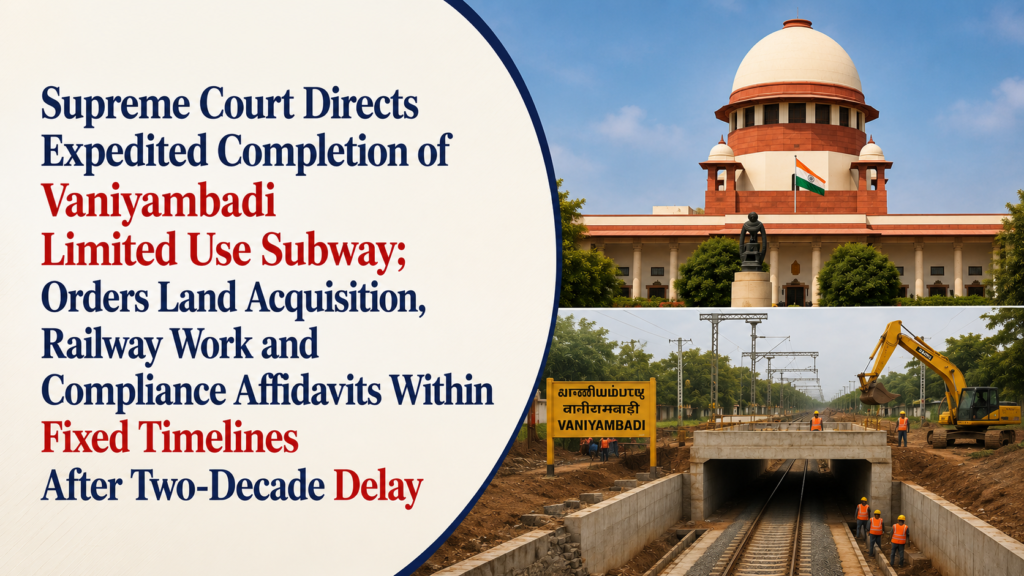
Supreme Court Directs Expedited Completion of Vaniyambadi Limited Use Subway; Orders Land Acquisition, Railway Work and Compliance Affidavits Within Fixed Timelines After Two-Decade Delay

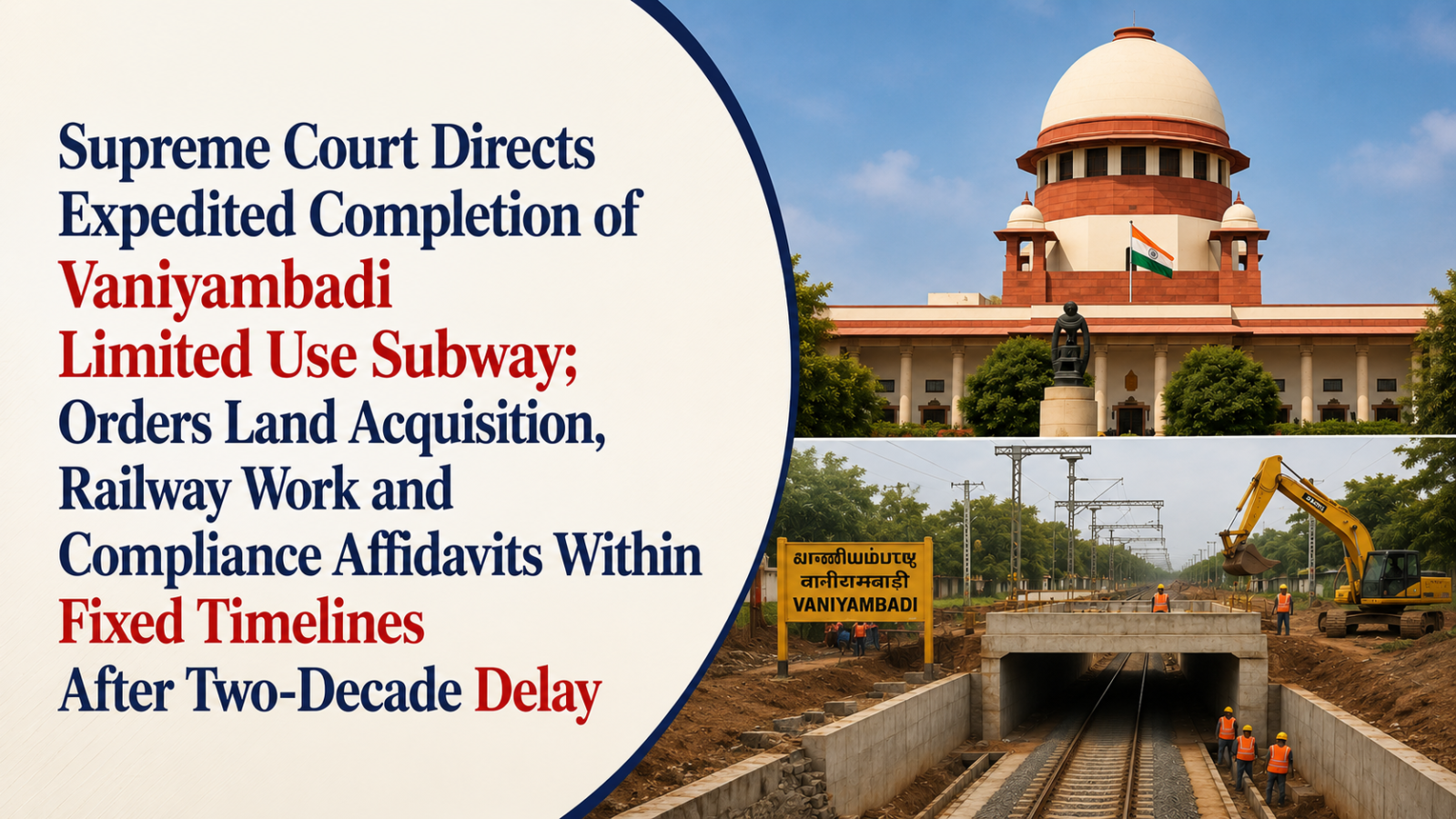
Supreme Court Directs Tamil Nadu and Southern Railway to Expedite Vaniyambadi Subway; Compliance Affidavits Required Within Eight Months
Facts
The appellant, Madurai Farooq Ahmed, approached the Supreme Court against the Madras High Court’s judgment dated 25 July 2025, which had disposed of his writ petition seeking expedited construction of a Limited Use Subway (LUS) in place of Level Crossing No. 81 at Vaniyambadi, without fixing a definite completion schedule.
Level Crossing No. 81 lies between Vaniyambadi and Kethandapatti Railway Stations in Tirupattur District, Tamil Nadu. The railway line divides the eastern and western parts of Vaniyambadi Town, and the crossing is used by a substantial number of residents and commuters.
The project had a long history. In 2007, the Tamil Nadu Government initially sanctioned construction of a Road Over Bridge (ROB) at an estimated cost of ₹13 crore on a cost-sharing basis with Southern Railway. The proposal later became impractical because it required substantial land acquisition in a heavily built-up area and involved much higher expenditure. A Road Under Bridge (RUB) was therefore considered instead.
The appellant had earlier approached the Madras High Court in 2018 seeking either commencement of construction or reopening of the level crossing. During that litigation, the crossing was reopened, and the writ petition was ultimately disposed of in July 2023.
In 2019, the State formally changed the project from an ROB to an RUB. Land acquisition proceedings were subsequently initiated under the Tamil Nadu Highways Act, 2001.
Following further examination and joint inspection by the State Highways Department and Southern Railway, the project was modified yet again—from an RUB to a Limited Use Subway. The revised alignment reduced the proposed acquisition area to approximately 5,009 square metres. The State Government formally approved this change by Government Order dated 15 May 2025.
The appellant then filed W.P. No. 21364 of 2025 before the Madras High Court seeking a direction for time-bound completion of the LUS.
The High Court noted that land acquisition remained pending and declined to keep the writ petition alive merely to continuously monitor construction. It therefore disposed of the petition without fixing a firm completion schedule.
The appellant challenged that approach before the Supreme Court.
Issues
The principal issues before the Supreme Court were:
- Whether, despite the project having remained pending for almost two decades, the Court should issue concrete directions for its expedited completion.
- Whether the State Government should be directed to complete the pending land acquisition and statutory approvals within a specified framework.
- Whether Southern Railway should be bound by its statement that its portion of the LUS could be completed within six months from award of the contract, subject to land being made available.
- Whether the Supreme Court should continuously monitor the construction or instead dispose of the appeal after recording assurances and requiring compliance affidavits.
Appellant’s Arguments
The appellant appeared in person and sought a meaningful direction ensuring that the long-pending project did not remain indefinitely stalled.
His essential grievance was that although the project had progressed through multiple versions—from ROB to RUB and finally LUS—residents of Vaniyambadi still lacked the promised grade-separated crossing.
He therefore sought expedition and a concrete completion framework rather than disposal of the proceedings without any enforceable direction.
The Court noted that the appellant had consistently pursued the issue over several years before different public authorities and courts, not for personal benefit but for the benefit of the residents and commuters of Vaniyambadi.
Respondents’ Arguments / Position
During the Supreme Court proceedings, the respondents placed on record updated material showing that the project had moved beyond the stage of mere consideration.
The State Government informed the Court that land acquisition proceedings under the 2025 Government Order were being pursued and that steps had also begun for preparing designs, drawings and detailed quantity estimates for the LUS.
Southern Railway filed an affidavit stating that:
- a tender had already been floated for its portion of the LUS;
- seven bidders had participated;
- the tender process was expected to be finalised by the second week of August 2026; and
- after award of the contract, and subject to the State making the necessary land available, its portion could be completed within six months from the date of award.
The State also informed the Court that land acquisition, designs, estimates and approvals for its portion were progressing simultaneously.
Analysis of the Law
1. Court can record administrative assurances and make them enforceable
By the time the matter reached final hearing, the controversy had materially changed.
The project was no longer merely under conceptual consideration. Tendering, land acquisition, designs and approvals were underway.
The Supreme Court therefore considered it appropriate to take the specific statements and assurances of the authorities on record and require them to be complied with.
This enabled the Court to secure accountability without keeping the proceedings indefinitely pending.
2. Continuous judicial monitoring was unnecessary once concrete timelines existed
The Court agreed, in substance, that continuous monitoring was not required merely because a public infrastructure project remained incomplete.
However, unlike simply disposing of the matter without operative directions, it converted the respondents’ commitments into concrete obligations.
The Court expressly held that no useful purpose would be served by keeping the appeal pending solely for continuous monitoring once definite statements and assurances had been placed before it.
3. State must complete land acquisition with utmost expedition
The Supreme Court directed the State authorities to complete pending land acquisition proceedings and all other processes falling within their domain with utmost expedition.
The State was specifically required to ensure that the necessary land was made available to Southern Railway without avoidable delay, so that Railway construction was not impeded.
Thus, the Court recognised that availability of land was the essential dependency for timely execution.
4. Southern Railway bound to six-month construction timeline
Southern Railway was directed to finalise the tender process within the time represented before the Court.
Upon award of the contract and availability of the requisite land, it was directed to ensure that the portion falling within its domain was completed within six months from the contract award date.
5. State’s parallel work must continue simultaneously
The Court did not permit the State to wait until the Railway portion was completed.
It directed the State authorities simultaneously to proceed with:
- designs;
- estimates;
- administrative approvals; and
- all remaining steps concerning the Highways portion.
The object was to ensure that the overall project did not face another avoidable sequential delay.
6. Compliance affidavits create post-judgment accountability
The Supreme Court required both the State authorities and Southern Railway to file separate compliance affidavits after completing their respective portions and, in any event, within eight months from the judgment.
The Registry was directed to place those affidavits before the Court when filed.
This mechanism allowed the appeal itself to be disposed of while preserving accountability for implementation.
Precedent Analysis
The judgment does not turn upon an elaborate discussion of earlier precedents. Its focus is primarily remedial and administrative, based upon the subsequent progress of the project and the concrete assurances given by the State and Southern Railway.
The Court’s approach reflects the distinction between:
- indefinite judicial supervision of an infrastructure project; and
- issuing targeted directions where governmental authorities themselves place specific implementation commitments before the Court.
Rather than retaining the litigation for day-to-day monitoring, the Supreme Court adopted a time-bound compliance model: record the assurances, direct expedition, prescribe a six-month Railway construction period after award and land availability, and require compliance affidavits within eight months.
Court’s Reasoning
The Supreme Court was influenced principally by the fact that the project had remained under consideration in different forms for almost 20 years but had finally reached an implementation stage.
The Court found that the State had initiated land acquisition and design processes, while Southern Railway had already floated a tender and received seven bids.
These developments materially reduced the need for continuing litigation.
However, rather than merely dismissing the matter as premature or administrative, the Court gave operative force to the assurances made before it.
It directed:
- expedited completion of State land acquisition;
- immediate availability of land to Southern Railway;
- timely finalisation of the Railway tender;
- completion of Railway work within six months from award, once land was available;
- simultaneous completion of State designs and approvals; and
- compliance affidavits within eight months.
The Court also specifically appreciated the appellant’s sustained pursuit of the matter.
It observed that while many proceedings labelled as public interest litigation may not genuinely advance a public cause, this case was different. The appellant demonstrated how a vigilant citizen could, through sustained and responsible engagement, draw attention to an issue affecting the wider community.
Conclusion
The Supreme Court disposed of the appeal with binding implementation directions.
It directed the Tamil Nadu authorities to expeditiously complete pending land acquisition and approvals and ensure that the necessary land was provided to Southern Railway without avoidable delay.
Southern Railway was directed to finalise the tender process and, after award of the contract and availability of land, complete its portion of the Limited Use Subway within six months.
Both sets of authorities were further directed to file compliance affidavits within eight months from the date of judgment, detailing the steps taken and work completed.
The Court declined to keep the appeal pending for continuous monitoring but made clear that the statements and assurances placed before it were required to be duly complied with.
Case Details
Case: Madurai Farooq Ahmed v. The Principal Secretary to Government & Ors.
Court: Supreme Court of India
Case Number: Civil Appeal of 2026 arising out of SLP (C) No. 31444 of 2025
Judges: Justice Vikram Nath and Justice Sandeep Mehta
Date: 21 August 2026
Result: Appeal disposed of with directions for expedited land acquisition and project execution; Southern Railway’s portion to be completed within six months after contract award and land availability; compliance affidavits required within eight months