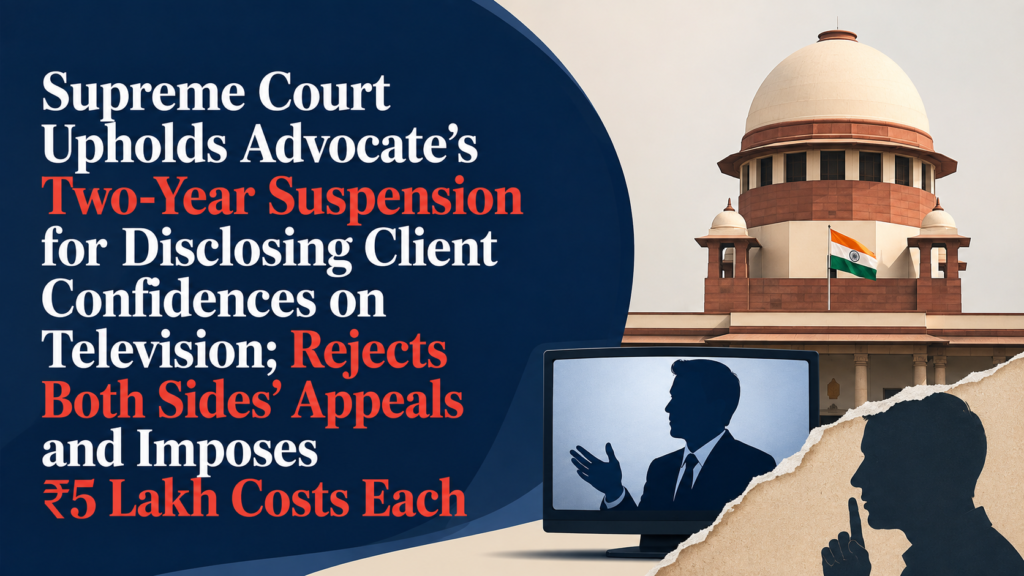
Supreme Court Upholds Advocate’s Two-Year Suspension for Disclosing Client Confidences on Television; Rejects Both Sides’ Appeals and Imposes ₹5 Lakh Costs Each

Supreme Court Upholds Two-Year Suspension of Advocate for Revealing Former Client’s Confidential Communications on Television; Rejects Pleas for Exoneration and Harsher Punishment
Facts
The dispute arose from disciplinary proceedings against advocate Rizwan Siddiquee, who had earlier represented Rehana Khan during part of 2013 and 2014. The appellant alleged that she had approached him after accusing a senior police official of attempting to sexually assault her and had shared confidential details of her personal life and material relating to those allegations.
A legal notice dated 15 July 2014 was sent to the police official through the respondent advocate’s office. The appellant claimed that the notice had been issued without her authority, whereas the advocate maintained that it had been based on a draft supplied by her and dispatched on her instructions.
On 24 July 2014, the appellant lodged an FIR against the police official under Sections 376(2), 376C, 354 and 354D IPC. Significantly, the respondent advocate was also named in the FIR as a person allegedly acting under the influence of that police official.
Shortly thereafter, the appellant appeared before electronic media on 28 July 2014 with her face covered and discussed her case.
On 5 August 2014, the respondent advocate gave interviews broadcast on Aaj Tak and Zee News. During those broadcasts, material concerning conversations between him and the appellant, as well as alleged messaging exchanges, was shown.
The appellant subsequently filed a complaint under Section 35 of the Advocates Act, 1961 before the Bar Council of Maharashtra and Goa alleging professional misconduct.
The matter ultimately reached the Bar Council of India as B.C.I. Transfer Case No. 177 of 2018.
By order dated 11 August 2025, the Bar Council of India held that the advocate had committed professional misconduct by:
- issuing the legal notice without authority;
- disclosing confidential information leading to the appellant’s identification in the media; and
- making derogatory public remarks concerning her.
The Bar Council directed that his name be removed from the roll of advocates for two years, restrained him from practising during that period, imposed ₹3 lakh payable to the appellant, and directed another ₹2 lakh to be deposited in the Bar Council of India Welfare Fund.
Both sides challenged that order.
The appellant sought enhancement of punishment to permanent removal from the roll and ₹2 crore compensation, while the respondent advocate sought complete exoneration.
Issues
The Supreme Court identified two principal questions:
- Whether the Bar Council of India’s finding of professional misconduct against the advocate was legally sustainable.
- Whether the punishment imposed—two-year removal from the roll, monetary payment and welfare fund contribution—was so inadequate that it required enhancement.
A subsidiary issue raised by the advocate was whether the disciplinary order was vitiated because it had allegedly been passed ex parte without proper notice of the final hearing.
Appellant’s Arguments
The appellant argued that the respondent advocate had been entrusted with confidential and sensitive information during the subsistence of their professional relationship and had thereafter acted against her interests.
She alleged that he had:
- coordinated with the opposing police official;
- placed confidential material in the public domain;
- participated in television interviews concerning her case;
- disclosed personal information obtained during the lawyer-client relationship; and
- publicly characterised her complaint as a false rape case and accused her of seeking publicity.
She further alleged that the advocate had remained in telephonic contact with the opposing party and had personally met him during the subsistence of the professional engagement, which according to her demonstrated collusion and bad faith.
The appellant contended that the disclosures had caused irreversible harm to her dignity, privacy, mental peace and social standing.
She therefore sought:
- permanent removal of the advocate from the roll; and
- ₹2 crore compensation.
Respondent’s Arguments
The respondent advocate denied professional misconduct.
He maintained that the appellant had approached him only for sending a legal notice regarding alleged dereliction of duty by the police official and that the draft notice had been supplied by her through an earlier advocate.
He further claimed that he had advised the appellant that her allegations did not disclose rape or another sexual offence and that she had later pursued a more serious criminal complaint after disregarding his advice.
According to him, the appellant sought publicity and wanted to sensationalise the matter.
Regarding the media disclosures, the advocate argued that:
- he had himself been named in the FIR;
- media attention caused serious professional embarrassment;
- he had not voluntarily disclosed confidential information;
- material broadcast by television channels had been supplied by him to the police, not to journalists;
- the appellant had already appeared before the media; and
- by the time of his television interview he was no longer acting as her advocate.
He also challenged the disciplinary proceedings on principles of natural justice, arguing that the final order had been passed ex parte without notice being served at his correct updated address.
Analysis of the Law
1. Natural justice objection was rejected
The Supreme Court first rejected the advocate’s contention that he had been denied a reasonable opportunity of hearing.
The Court found that he had:
- entered appearance;
- filed a written statement;
- been represented through counsel; and
- participated in recording of evidence.
He was aware throughout that disciplinary proceedings were pending against him.
The Supreme Court therefore regarded the subsequent plea of non-service of notice for the final hearing as flimsy and an afterthought.
2. Advocate-client confidentiality survives breakdown of relationship
The central principle emerging from the judgment is that an advocate’s duty of confidentiality does not cease merely because the client later becomes hostile or accuses the advocate of wrongdoing.
The Court found it undisputed that the advocate had appeared on television and discussed:
- his professional relationship with the appellant;
- matters communicated by her;
- conversations between them; and
- messaging exchanges shown during the broadcast.
The advocate did not deny giving the interview; he sought to justify it on the basis that he had been accused by the appellant and was merely defending himself.
The Supreme Court rejected that justification.
It held in substance that:
an advocate’s professional obligations are not conditional upon the client continuing to behave favourably toward the advocate.
A former client becoming an adversary does not permit the advocate to weaponise confidential information received during the professional relationship.
3. Advocate cannot answer client’s accusations through media disclosure
The Court acknowledged that an advocate who believes himself to have been falsely accused is not remediless.
He may:
- place his version before the investigating authorities; or
- pursue legal remedies such as defamation.
But he cannot respond by taking confidential lawyer-client communications to television channels.
The Court specifically held that the advocate could not disclose privileged communications, play recorded conversations with a former client, describe her complaint as false, and accuse her publicly of seeking publicity.
4. Media disclosure alone was sufficient to sustain misconduct
Importantly, the Supreme Court did not consider it necessary to finally resolve every disputed allegation concerning the legal notice or alleged collusion.
It found that the admitted television interview and disclosure of confidential information were by themselves sufficient to sustain the finding of professional misconduct.
The misconduct finding was therefore described as unassailable.
Precedent Analysis
The judgment does not substantially turn upon a detailed line of cited precedents. Instead, the Supreme Court applies foundational principles governing the fiduciary and ethical obligations of advocates, particularly confidentiality arising from the lawyer-client relationship.
The Court treats confidentiality as a continuing professional obligation that cannot be overridden simply because:
- the professional relationship has ended;
- the client has accused the advocate;
- the advocate wishes to defend his reputation publicly; or
- the former client has herself spoken to the media.
The judgment therefore reinforces the professional principle that information received by an advocate in confidence cannot subsequently be used against the client merely because the relationship has deteriorated.
Court’s Reasoning
The Supreme Court adopted a notably critical view of the conduct of both parties.
As regards the advocate, the Court considered the television interview decisive. Once a professional relationship existed and confidential information had been shared, he could not publicly disclose or deploy that information against his former client.
His argument that he was merely responding to accusations did not excuse the breach because other legal remedies were available.
Thus, the professional misconduct finding and punishment imposed by the Bar Council of India were sustained.
However, the Court was equally unwilling to enhance the punishment at the appellant’s instance.
It found that she too had not approached the Court with complete candour.
The record showed that:
- during the professional engagement, she and the respondent had discussed ways of “trapping” the police official;
- she herself had appeared before the electronic media on 28 July 2014 and spoken about the case; and
- the police official had been discharged by the trial court on 4 December 2015, and she never challenged that discharge order.
The Court therefore held that a party seeking enhancement of punishment must herself approach the Court with clean hands.
Because the appellant had been less than candid regarding material aspects of the controversy, the Court refused to increase the advocate’s punishment.
Conclusion
The Supreme Court upheld the Bar Council of India’s disciplinary order dated 11 August 2025.
It held that an advocate cannot disclose confidential or privileged communications received from a client merely because that client subsequently becomes hostile or makes accusations against the advocate.
The advocate’s television interview and disclosure of material concerning his former client were sufficient to constitute professional misconduct.
Accordingly:
- the advocate’s transferred case challenging the misconduct finding was dismissed;
- his civil appeal seeking exoneration was dismissed;
- the appellant’s appeal seeking permanent removal and enhanced compensation was also dismissed; and
- the original Bar Council punishment remained intact.
The Supreme Court strongly criticised the conduct of both parties for prolonging the dispute for approximately eleven years and consuming judicial and disciplinary resources.
It imposed ₹5 lakh costs on each party, payable to the Supreme Court Legal Services Committee within four weeks, failing which the amounts were to be recovered in accordance with law.
Case Details
Case: Rehana Khan v. Rizwan Siddiquee
Court: Supreme Court of India
Case Number: Civil Appeal No. 12256 of 2025 with Transferred Case (Civil) No. 30 of 2026 and Civil Appeal No. 7959 of 2026 @ Diary No. 7049 of 2026
Judges: Justice Vikram Nath, Justice Sandeep Mehta and Justice Vijay Bishnoi
Date: 21 August 2026
Result: All proceedings dismissed; Bar Council’s two-year suspension and monetary directions upheld; appellant’s enhancement plea rejected; ₹5 lakh costs imposed separately on both parties