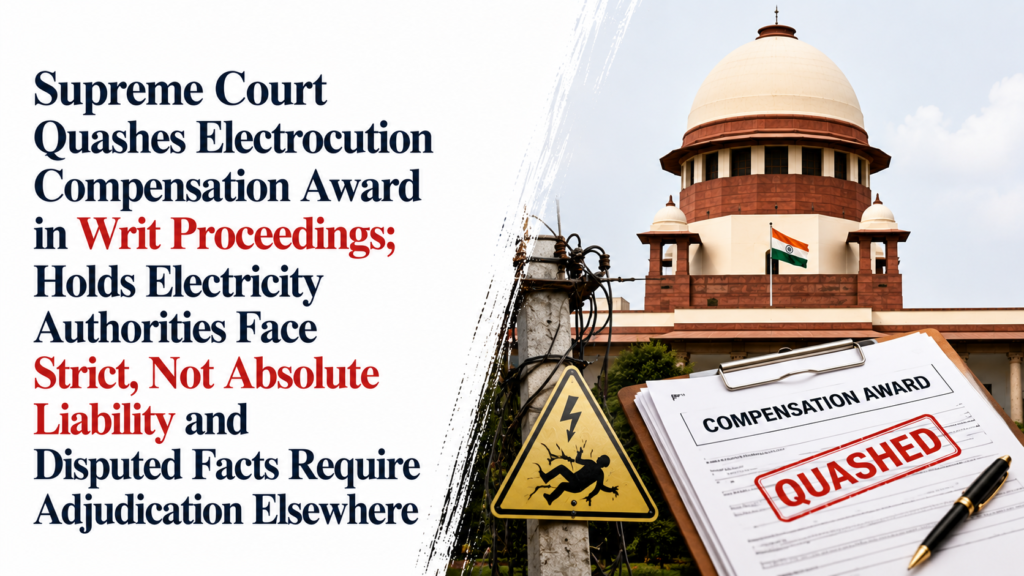
Supreme Court Quashes Electrocution Compensation Award in Writ Proceedings; Holds Electricity Authorities Face Strict, Not Absolute Liability and Disputed Facts Require Adjudication Elsewhere

Supreme Court Sets Aside Karnataka High Court Electrocution Awards; Says Article 226 Is Inappropriate Where Victim’s Negligence and Electricity Authority’s Fault Are Disputed
Facts
The appeals were filed by Karnataka Power Transmission Corporation Limited (KPTCL) challenging Karnataka High Court orders imposing liability upon it and directing payment of compensation in two electrocution cases.
In the first case, Rekha’s husband, N. Subramanya, died by electrocution on 22 February 2018. An FIR was registered on the same day. Rekha subsequently filed a writ petition seeking compensation.
KPTCL opposed the petition on the grounds of maintainability, absence of negligence on its part and the existence of disputed questions of fact. Both the Single Judge and Division Bench rejected these objections and held that a writ petition seeking compensation for a tortious act of the State was maintainable without first requiring the claimant to approach a civil court.
Using the compensation framework under the Motor Vehicles Act, 1988, the High Court awarded ₹25,52,500 with 6% interest, payable after three months from the judgment.
The second case concerned Muizz Ahmad Shariff, who jumped onto the roof of a neighbouring building to retrieve a cricket ball and came into contact with a 66 KV electricity line, suffering severe injuries. The Single Judge awarded him ₹44,32,050, which was affirmed by the Division Bench.
KPTCL challenged the High Court’s decisions before the Supreme Court.
Issues
The Supreme Court identified two principal questions:
- Whether writ petitions under Article 226 were maintainable for awarding compensation in these electrocution cases, particularly when material facts were disputed; and
- What legal standard and yardstick should govern liability and compensation in electrocution cases.
The Court additionally examined whether electricity authorities are governed by absolute liability or strict liability, and whether the Motor Vehicles Act multiplier method can be imported into electrocution compensation cases.
Petitioner’s Arguments
KPTCL contended that the writ petitions were not maintainable because liability depended upon several seriously disputed factual questions which could not properly be resolved on affidavits under Article 226.
In the first case, the disputed questions included whether use of an aluminium ladder in a coffee plantation, resulting in contact with an 11 KV line, amounted to negligence on the victim’s part; whether the plantation owner was negligent in providing the ladder; whether the backup relays were functioning satisfactorily; and whether KPTCL was even responsible for maintaining the particular line involved.
In the second case, disputes included whether the statutorily required distance of four metres between the electrical line and building had been maintained; whether an undertaking executed by the building owner shifted liability upon him; and whether negligence could properly be attributed to KPTCL.
KPTCL therefore contended that these issues required evidence and adjudication before an appropriate forum rather than summary determination in writ proceedings.
Respondent’s Arguments
The respondents defended the compensation awards on the basis that transmission of high-voltage electricity is inherently hazardous.
Their case, as accepted by the High Court, proceeded substantially on the proposition that the electricity authority bore absolute liability for harm caused through such dangerous activity.
On this reasoning, questions concerning negligence, contributory fault or other disputed factual circumstances would not materially affect liability because absolute liability admits of no exceptions.
The High Court had also treated writ jurisdiction as available for compensating victims of tortious acts attributable to State instrumentalities rather than compelling them to first pursue private-law remedies before a civil court.
Analysis of the Law
Maintainability of Writ Petition Under Article 226
The Supreme Court reiterated that the existence of an alternative remedy does not automatically oust the High Court’s jurisdiction under Article 226.
However, writ jurisdiction is discretionary. Where adjudication involves substantial disputed questions of fact, particularly questions requiring oral and documentary evidence, the High Court may properly decline to exercise that jurisdiction.
In electrocution cases specifically, the Court relied upon Chairman, Grid Corporation of Orissa Ltd. v. Sukamani Das.
That decision establishes that where negligence and the circumstances leading to electrocution are disputed, compensation should not ordinarily be determined merely on affidavits in writ proceedings. The claimant should instead approach the civil court or appropriate forum where evidence can be properly tested.
Absolute Liability vs Strict Liability
The Supreme Court then examined the High Court’s conclusion that absolute liability applied.
The Court explained that absolute liability is an exceptional doctrine applicable to enterprises engaged in inherently hazardous or dangerous activities. It admits no exceptions and imposes liability irrespective of the precautions taken by the enterprise.
The doctrine was developed by the Supreme Court in the Oleum Gas Leak case, M.C. Mehta v. Union of India, involving an industrial unit carrying on inherently hazardous operations.
The Court distinguished this from strict liability under Rylands v. Fletcher.
Strict liability may arise without proof of negligence because the emphasis is on the hazardous nature of the activity rather than the manner in which it was performed. However, unlike absolute liability, strict liability is subject to recognised exceptions.
Electricity Transmission Attracts Strict Liability
The Supreme Court categorically held that strict liability, rather than absolute liability, is the appropriate standard for electrocution cases involving electricity authorities.
Electricity transmission is undoubtedly an inherently dangerous activity. Therefore, authorities undertaking such activity should ordinarily bear the risk of resulting harm and compensate injured persons irrespective of proof of fault.
However, the liability is not absolute. The electricity authority remains entitled to establish that one of the recognised exceptions to strict liability applies.
Exceptions to Strict Liability
Relying upon Kaushnuma Begum v. New India Assurance Co. Ltd., the Court identified recognised exceptions including:
- consent of the plaintiff;
- common benefit;
- act of a stranger;
- exercise of statutory authority;
- act of God or vis major;
- default of the plaintiff; and
- remoteness of consequences.
This distinction was critical because the disputed facts in the present cases could potentially bring the incidents within one or more exceptions.
For example, whether the victim negligently used an aluminium ladder near an 11 KV line, or whether another victim voluntarily jumped onto a neighbouring roof and contacted a 66 KV line, could not simply be disregarded once the correct standard was recognised as strict rather than absolute liability.
Motor Vehicles Act Multiplier Cannot Be Automatically Applied
The Supreme Court also disapproved the High Court’s use of the Motor Vehicles Act multiplier method for calculating compensation in electrocution cases.
Relying upon Raman v. Uttar Haryana Bijli Vitran Nigam Ltd., the Court held that the multiplier method applicable to motor accident claims cannot be applied mutatis mutandis to electrocution cases.
The Electricity Act, 2003 does not prescribe a general methodology for quantifying compensation. Although Section 57 contemplates compensation in certain situations, it does not provide a formula for its computation.
Accordingly, compensation in electrocution cases must ultimately be just, reasonable and fair, considering the victim’s income and other relevant claims and circumstances.
Precedent Analysis
Radha Krishan Industries v. State of Himachal Pradesh, (2021) 6 SCC 771
The Court relied upon Radha Krishan Industries for the general principles governing Article 226 jurisdiction. An alternative remedy does not extinguish the High Court’s power, but writ jurisdiction remains discretionary. The existence of disputed factual questions may justify refusal to entertain a writ petition.
Chairman, Grid Corporation of Orissa Ltd. v. Sukamani Das, (1999) 7 SCC 298
This was particularly significant to the maintainability issue.
The Court had previously held that the mere fact that a person died after coming into contact with an electricity transmission line does not, by itself, justify awarding compensation through Article 226 where negligence and surrounding circumstances are disputed. Such questions ordinarily require evidence before a civil court.
M.C. Mehta v. Union of India, (1987) 1 SCC 395
The Constitution Bench’s Oleum Gas Leak decision was examined for the doctrine of absolute liability. It imposes a non-delegable obligation upon enterprises conducting hazardous or inherently dangerous industrial activities and does not recognise the traditional exceptions associated with Rylands v. Fletcher.
M.P. Electricity Board v. Shail Kumari, (2002) 2 SCC 162
The Court considered Shail Kumari, which recognises the enhanced duty imposed upon electricity suppliers because electricity transmitted at dangerous voltage presents foreseeable risk to human life.
The liability recognised there was strict liability, operating irrespective of whether ordinary negligence could be established.
Union of India v. Prabhakaran Vijaya Kumar, (2008) 9 SCC 527
The Court relied upon this decision to explain that strict liability focuses upon the hazardous character of the activity rather than fault. The judgment also recognised electricity as one of the categories to which the Rylands v. Fletcher principle can apply.
Kaushnuma Begum v. New India Assurance Co. Ltd., (2001) 2 SCC 9
This decision was relied upon for the recognised exceptions to strict liability, including the victim’s own default, act of a stranger, statutory authority and vis major.
Raman v. Uttar Haryana Bijli Vitran Nigam Ltd., (2014) 15 SCC 1
The Court relied upon Raman to hold that the Motor Vehicles Act multiplier method cannot automatically be transplanted into electrocution cases for determining compensation.
Court’s Reasoning
The Supreme Court found that the Karnataka High Court’s fundamental error lay in treating KPTCL’s liability as absolute.
Once strict liability was identified as the correct doctrine, the disputed factual questions became legally material because strict liability recognises exceptions.
The circumstances of the accidents—including the aluminium ladder coming into contact with an 11 KV line, responsibility for maintaining the relevant line, compliance with statutory distance requirements, the building owner’s undertaking and the injured person’s act of jumping onto a neighbouring roof—could potentially affect the ultimate determination of liability.
Those questions could not appropriately be resolved through affidavits in writ jurisdiction.
The Court therefore held that the writ petitions seeking compensation were not maintainable in the circumstances of these cases.
At the same time, the Supreme Court did not extinguish the victims’ compensation claims. It expressly preserved their liberty to pursue whatever alternative remedies were available against KPTCL before the appropriate forum.
Conclusion
The Supreme Court allowed both appeals.
It quashed and set aside the judgments of the Karnataka High Court’s Single Judge and Division Bench awarding compensation in writ proceedings.
The Court held that:
- the existence of genuinely disputed factual questions made Article 226 inappropriate in these cases;
- electrocution claims against electricity authorities are governed by strict liability, not absolute liability;
- strict liability remains subject to recognised exceptions;
- the Motor Vehicles Act multiplier method cannot automatically be applied to quantify electrocution compensation; and
- compensation must ultimately be just, reasonable and fair based upon relevant circumstances.
Importantly, the ₹5 lakh interim compensation already paid pursuant to the Supreme Court’s earlier order cannot be recovered from the respondents. Nor will that amount prejudice or determine the compensation that may ultimately be awarded in appropriate proceedings.
The respondents were granted liberty to pursue appropriate remedies before the competent forum, and the Supreme Court directed that such proceedings, if instituted, be decided expeditiously and uninfluenced by observations in this judgment.
Case Details
Case: Karnataka Power Transmission Corporation Limited v. Rekha & Ors.
Court: Supreme Court of India
Case Number: Civil Appeals arising out of SLP (C) Nos. 24849 and 24854 of 2025; 2026 INSC 847
Judge: Justice Sanjay Karol and Justice Nongmeikapam Kotiswar Singh
Date: 12 August 2026
Result: Appeals allowed; Karnataka High Court compensation awards set aside; writ petitions held inappropriate due to disputed facts; claimants permitted to pursue alternative remedies; interim compensation already paid protected from recovery