Supreme Court Quashes Excise Demand Against Vehicle Body Builders; Upholds Full Chassis Valuation but Rejects Extended Limitation as Department Already Knew Relevant Facts

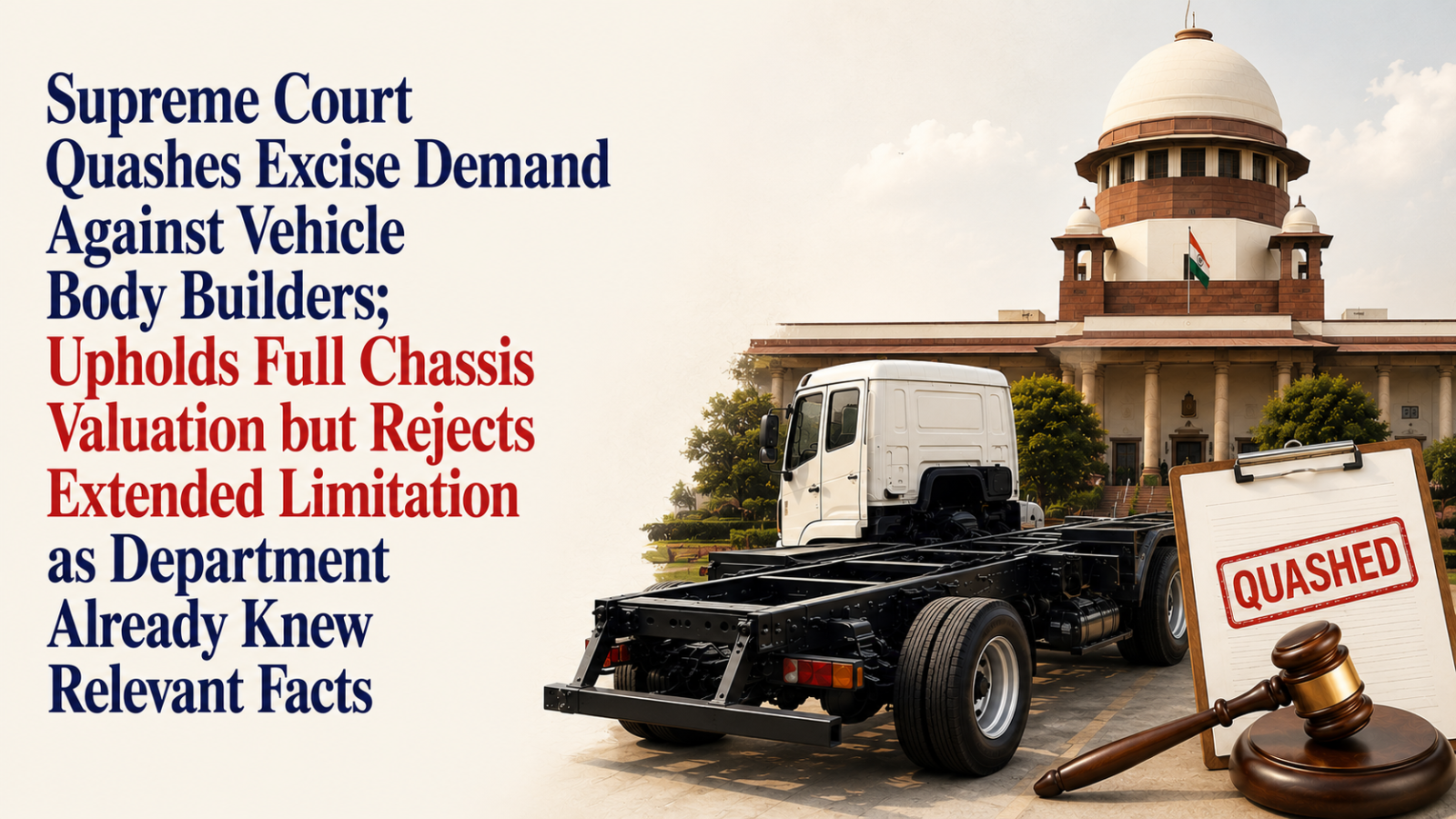
Excise Department Cannot Use Extended Limitation to Cure Delayed Action: Supreme Court Quashes Demand Where Chassis Valuation Was Already Within Department’s Knowledge
Facts
The appeals arose from a dispute concerning Audi Automobiles and other assessees engaged in body building of motor vehicles on a job-work basis. Manufacturers supplied chassis to the appellants, upon which vehicle bodies were constructed and the completed vehicles returned to the manufacturers. The principal issue before the Supreme Court ultimately concerned whether the Central Excise Department could invoke the extended limitation period under the proviso to Section 11A of the Central Excise Act, 1944.
When manufacturers cleared chassis to the appellants for body building, excise duty was paid on a valuation calculated under Rule 8 of the Central Excise Valuation (Determination of Price of Excisable Goods) Rules, 2000, namely 110% of the chassis’ manufacturing cost.
After completing the vehicle body, the appellants calculated excise duty by taking into account the actual manufacturing cost of the chassis, directly received raw materials, job-work charges and the job worker’s profit, while availing CENVAT credit for duty already paid on the chassis. However, they did not add the additional 10% component included in the chassis valuation under Rule 8, treating that amount as representing the manufacturer’s profit margin.
The controversy therefore concerned whether this additional 10% formed part of the assessable value of the completed body-built vehicle and, importantly, whether the Department could recover the resulting differential duty by invoking the extended limitation period.
The demand related to 1 November 2004 to 31 March 2007, while the show-cause notice was issued only on 30 April 2008, beyond the ordinary one-year limitation period then prescribed under Section 11A(1).
Issues
The Supreme Court considered principally:
- Whether the additional 10% component forming part of the chassis’ Rule 8 valuation had to be included while calculating the assessable value of the completed body-built motor vehicle.
- Whether the appellants’ failure to include that component amounted to wilful suppression or misstatement permitting invocation of the extended limitation period under the proviso to Section 11A.
- Whether facts already known to the Department could subsequently be characterised as suppression by the assessee.
- Whether the Department’s demand, though substantively correct on valuation, was nevertheless unenforceable because the ordinary limitation period had expired.
- Whether the appeals before the Supreme Court were maintainable under Section 35L of the Central Excise Act.
Petitioner’s/Appellants’ Arguments
The appellants contended that the law governing valuation of goods manufactured on a job-work basis had remained uncertain or “in flux” following the decisions in Ujagar Prints II and Ujagar Prints III, and that the controversy was settled only subsequently by the Larger Bench of CESTAT in Eicher Motors Ltd. v. Commissioner of Central Excise, Indore.
Their substantive valuation argument was that Ujagar Prints required inclusion of the raw-material value, processing charges and job worker’s profits, but did not require the manufacturer’s own profit to be added because such profit was a post-manufacturing component.
They relied upon Pawan Biscuits Co. Pvt. Ltd. v. CCE and General Engineering Works v. CCE in support of their valuation position.
On limitation, their case was essentially that there was no wilful suppression or misrepresentation warranting recourse to the extended period under Section 11A.
Respondent’s Arguments
The Revenue initially raised a preliminary objection to maintainability, contending that the appeals did not fall within Section 35L because the controversy did not involve the rate of excise duty or valuation of goods for assessment. It relied upon SAIL v. Directorate General of Anti-Dumping & Allied Duties and Commissioner of Customs v. Motorola (India) Ltd.
The Supreme Court rejected this objection. It held that the limitation controversy was inextricably connected with valuation, since the allegation concerned failure to include the complete assessable value of the chassis. The Court also declined to send the parties to the jurisdictional High Court after the appeals had remained pending before the Supreme Court for almost a decade.
On merits, the Department maintained that the additional 10% forming part of the statutory valuation of the chassis under Rule 8 necessarily had to be carried forward into the assessable value of the completed motor vehicle.
Analysis of the Law
Valuation
The Supreme Court agreed with the Revenue on the substantive valuation question.
The chassis had already been cleared by the manufacturer at 110% of its manufacturing cost. Consequently, that complete statutory value constituted the value of the intermediate product supplied to the job worker.
The Court held that when the job worker returned the completed body-built vehicle, the assessable value could not be calculated by removing the additional 10% already embedded in the statutory value of the chassis.
Accordingly, the assessee was required to include the additional 10% component while determining the assessable value of the completed vehicle. The Supreme Court also rejected the contention that the legal position had remained uncertain, holding that the Constitution Bench principles already squarely governed the issue.
Extended Limitation Under Section 11A
The assessee nevertheless succeeded on limitation.
The Supreme Court emphasised that invocation of the extended period under Section 11A requires the statutory ingredients of fraud, collusion, wilful misstatement or wilful suppression, or contravention accompanied by an intent to evade payment of duty.
Mere omission or an incorrect assessment does not automatically constitute wilful suppression.
Most importantly, the Department already knew that the manufacturers had cleared the chassis on a valuation equal to 110% of manufacturing cost. The relevant factual position was therefore already within Revenue’s knowledge.
The Department should consequently have initiated proceedings within the ordinary limitation period rather than subsequently characterising the assessee’s conduct as suppression to invoke the extended period.
Precedent Analysis
The Supreme Court considered several important authorities.
Ujagar Prints II and Ujagar Prints III
These Constitution Bench decisions governed valuation of goods manufactured on a job-work basis. The Court held that their principles squarely covered the present controversy and rejected the appellants’ argument that the law remained unsettled until CESTAT’s Larger Bench decision in Eicher Motors.
Pawan Biscuits Co. Pvt. Ltd. v. CCE
The Court noted that Pawan Biscuits required inclusion of the cost of raw materials supplied by the principal together with the job worker’s manufacturing cost and profit, while excluding the principal manufacturer’s post-manufacturing expenses and profits.
However, the Supreme Court found that case factually distinguishable because the present dispute involved the statutory Rule 8 value already attached to the chassis.
General Engineering Works v. CCE
This decision concerned whether the value of scrap generated during job work had to be included in the assessable value. The Court considered its factual context materially different from the present chassis-valuation dispute.
Larsen & Toubro Ltd. v. CCE
The Supreme Court relied upon Larsen & Toubro for the proposition that invocation of an extended limitation period carries serious consequences and the reasons permitting such extension must be specifically alleged in the show-cause notice.
Continental Foundation Joint Venture Holding v. CCE
This authority was particularly important. The Court reiterated that “misstatement” and “suppression” under Section 11A must be wilful, thereby importing an intention to evade duty. Likewise, statutory contravention must be accompanied by the requisite intent to evade payment.
The Court applied the further principle that where relevant facts are already known to both parties, a party’s omission to act upon those facts cannot automatically be treated as suppression.
Court’s Reasoning
The Supreme Court drew an important distinction between liability on merits and enforceability through limitation.
On valuation, the Revenue was correct. Since the manufacturer had paid duty on the chassis valued at 110% of manufacturing cost, the job worker could not remove that additional 10% while determining the assessable value of the completed body-built vehicle.
However, being correct on valuation did not automatically entitle the Department to recover duty after expiration of the ordinary statutory limitation period.
The Department already knew the valuation at which the manufacturers had cleared the chassis. Therefore, if it considered the job workers’ subsequent computation incorrect, it ought to have initiated proceedings within the normal limitation period.
The Supreme Court held unequivocally that because the relevant facts were already known to the Department, the omission could not justify invocation of the extended limitation period.
Thus, while the appellants’ substantive liability to include the full chassis value was “unassailable,” the particular demand could not be recovered because limitation had run against the Revenue.
Conclusion
The Supreme Court allowed the appeals and set aside the Tribunal’s order as well as the orders of the original and appellate authorities.
It clarified that the appellants were legally required to include the entire cost/value upon which excise duty had been paid by the manufacturer when the chassis was supplied for body building.
However, the demand covering 1 November 2004 to 31 March 2007 could not be recovered because the show-cause notice dated 30 April 2008 was beyond the ordinary one-year limitation period, and the statutory conditions for invoking the extended period were not satisfied.
The judgment therefore establishes an important distinction: an assessee may be wrong on the substantive tax computation, yet Revenue cannot revive a time-barred demand merely by alleging suppression where the relevant facts were already within the Department’s knowledge.
Case Details
Case: Audi Automobiles & Ors. v. Commissioner of Central Excise and Service Tax, Indore
Court: Supreme Court of India
Case Number: Civil Appeal Nos. 10504–10506 of 2017; 2026 INSC 858
Judge: Justice J.B. Pardiwala and Justice K. Vinod Chandran
Date: 13 August 2026
Result: Appeals allowed; excise valuation principle upheld, but the demand and underlying orders were set aside as the extended limitation period under Section 11A could not be invoked.