Supreme Court Restores PNB’s ₹54.90 Lakh Recovery Order; Holds Interest Maintained Separately in NPA Suspense Account Remains Part of Debt Payable by Borrower

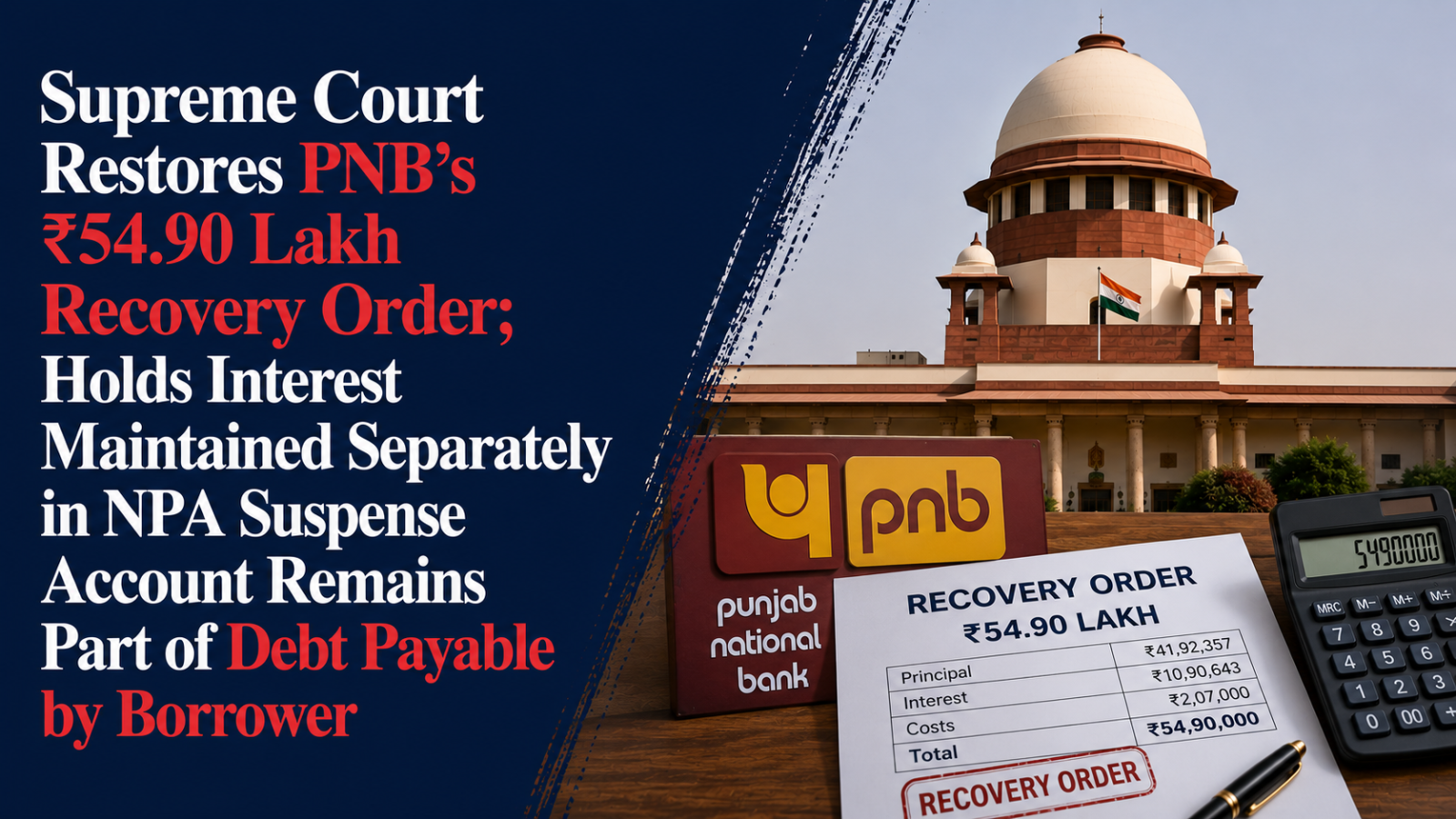
Supreme Court Restores DRAT Order After Orissa High Court Ignored NPA Suspense Interest; PNB Entitled to Recover ₹54.90 Lakh Plus 9% Interest
Facts
The appeals arose from a loan transaction between Punjab National Bank (PNB), through its predecessor United Bank of India, and M/s Shree Jyoti Education and Management Trust World, a charitable trust.
United Bank of India sanctioned a ₹5 crore loan on 27 June 2011 to the Trust for construction of a college building. The managing trustee, Tara Prasad Satpathy, along with other trustees, stood as guarantors. The loan was disbursed over approximately two years.
On 22 June 2017, the Bank informed the Trust that ₹1,27,33,669 remained outstanding. The loan account was classified as a Non-Performing Asset (NPA) on 30 June 2017.
United Bank of India thereafter filed O.A. No. 258 of 2018 before the DRT, Cuttack, claiming ₹75,56,680 as on 4 May 2018 along with future interest. This comprised ₹64,25,915 reflected in the loan account and ₹11,30,765 towards interest calculated from 30 June 2017 to 5 May 2018.
After United Bank of India merged with PNB, PNB issued a certificate dated 24 December 2020 stating that the Trust had paid ₹93,31,842 after its account became an NPA and that, as on 13 October 2020, the outstanding loan amount stood at ₹31.99 lakh.
The DRT, by judgment dated 5 February 2021, held that only ₹1,83,268, together with pendente lite and future simple interest at 10%, remained payable after accounting for payments made by the Trust.
PNB appealed to the DRAT, Kolkata. On 1 September 2023, the DRAT partly allowed the appeal and determined the Trust’s liability at ₹54,90,413, together with pendente lite and future simple interest at 9% from 5 February 2018 until realization.
The Trust challenged the DRAT order before the Orissa High Court. Relying principally on PNB’s 24 December 2020 certificate showing ₹31.99 lakh outstanding, the High Court deducted subsequent payments of ₹2,43,321.98 and directed the Trust to pay only ₹29,55,678.02 as full and final settlement, after which its loan account was to be closed.
PNB’s application seeking recall or modification of that order was also dismissed. PNB therefore approached the Supreme Court.
Issues
The principal issues before the Supreme Court were:
- Whether the Orissa High Court was justified in treating the ₹31.99 lakh figure in PNB’s certificate dated 24 December 2020 as the complete outstanding liability;
- Whether interest accruing after classification of the loan account as an NPA, and maintained separately in a suspense account, continued to form part of the debt recoverable by the Bank;
- Whether the Trust could rely upon its own alternative calculations to contend that substantially lower amounts—or even a refund—were due; and
- Whether the DRAT’s determination of ₹54,90,413 plus 9% pendente lite and future interest ought to be restored.
Petitioner’s Arguments
PNB contended that the High Court had fundamentally misunderstood the accounting treatment applicable to an NPA account.
The ₹31.99 lakh figure appearing in the Bank’s certificate did not represent the Trust’s complete liability. Once the account became an NPA, the Bank ceased reflecting accruing interest in the ordinary loan account and instead maintained such interest in a separate suspense account in accordance with the applicable banking accounting system.
PNB therefore argued that the High Court could not simply deduct subsequent payments from ₹31.99 lakh and treat the resulting ₹29.55 lakh as full and final settlement.
The Bank relied upon its statement of account and affidavit showing that, as of the NPA classification date, the principal together with interest stood at ₹1,25,30,842, and that the ₹75,56,680 claimed before the DRT consisted of ₹64,25,915 reflected in the loan account plus ₹11,30,765 in the separate interest suspense account.
PNB further relied upon the statutory definition of “debt” to contend that interest is expressly included within the recoverable liability.
Respondent’s Arguments
The Trust and its trustees principally relied upon PNB’s own certificate dated 24 December 2020, which stated that the outstanding loan amount as of 13 October 2020 was ₹31.99 lakh.
They contended that after deducting subsequent payments totalling ₹2,43,321.98, only ₹29,55,678.02 remained payable.
The Trust also advanced alternative calculations suggesting that the principal outstanding was ₹64,25,915 and, at one stage, went further by contending that it had actually made an excess payment of ₹57,12,857, which PNB should refund.
The Supreme Court noted, however, that these positions were inconsistent with the Trust’s earlier stand before the DRT, where it had admitted liability of approximately ₹32.63 lakh while disputing the Bank’s higher calculation.
Analysis of the Law
Interest in an NPA Suspense Account Remains Recoverable Debt
The Supreme Court accepted PNB’s explanation of the accounting mechanism applicable after an account becomes an NPA.
As on 30 June 2017, the outstanding principal together with interest calculated up to that date was ₹1,25,30,842.
From 1 July 2017 onwards, however, interest was maintained separately in a suspense account rather than being reflected in the loan account statement.
Therefore, when the Bank’s 24 December 2020 certificate mentioned ₹31.99 lakh as the outstanding loan amount, that figure had to be understood in the context of this accounting system. It did not include the separately maintained interest component.
The High Court’s calculation was consequently unsustainable because it ignored an entire component of the recoverable debt.
“Debt” Includes Interest
The Supreme Court relied upon Section 2(g) of the Recovery of Debts and Bankruptcy Act, 1993, which defines “debt” broadly to include any liability claimed as due from a person by a bank or financial institution, inclusive of interest.
The Court therefore held that there could be no dispute that the interest component formed part of the debt owed to PNB.
The Court further referred to Section 19(20) of the 1993 Act, under which the DRT may direct payment of interest from the date on which the amount is found due until realization or actual payment.
Courts Cannot Reopen Banking Interest Merely Because It Appears Excessive
The Court also referred to Section 21A of the Banking Regulation Act, 1949.
That provision stipulates that a transaction between a banking company and its debtor cannot be reopened by a court merely on the ground that the rate of interest charged by the bank is excessive.
This reinforced the statutory recognition of contractual and properly accounted banking interest as part of the recoverable liability.
Capitalisation of Interest
The Supreme Court relied upon the Constitution Bench judgment in Central Bank of India v. Ravindra, (2002) 1 SCC 367.
It reiterated that, subject to the contractual terms, established banking practice and RBI directives, interest may be charged at periodical rests and capitalised. Once lawfully capitalised, the unpaid principal together with capitalised interest is capable of constituting the principal sum adjudged on the date of the suit.
The judgment therefore reinforces the distinction between the accounting treatment of interest and the legal enforceability of that interest. Merely because accrued interest is shifted to a separate suspense account after NPA classification does not mean that the borrower is discharged from liability to pay it.
Precedent Analysis
Central Bank of India v. Ravindra, (2002) 1 SCC 367
The Constitution Bench held that banks must demonstrate that interest and compound interest have been charged consistently with contractual stipulations and RBI directives.
Statements of account should disclose debit entries, interest rates and the periods for which interest has been charged.
Importantly, subject to the applicable contract and banking practice, interest charged at periodical rests may be capitalised, and the unpaid principal together with capitalised interest can constitute the principal sum adjudged.
Union of India v. Association of Unified Telecom Service Providers of India, (2020) 3 SCC 525
The Supreme Court noted that the three-Judge Bench in this case had subsequently applied the principle recognised in Central Bank of India v. Ravindra.
The precedents therefore supported PNB’s case that properly accrued and accounted interest cannot simply be ignored while determining the borrower’s total debt.
Court’s Reasoning
The Supreme Court found that the Orissa High Court had oversimplified the calculation of the Trust’s liability.
The High Court treated the ₹31.99 lakh figure in PNB’s 2020 certificate as though it represented the entire debt and merely deducted later payments from it.
That approach failed to appreciate that, following NPA classification, the Bank’s accounting system maintained accruing interest in a separate suspense account. The ₹31.99 lakh figure therefore did not represent the complete outstanding liability.
The Court was also critical of the Trust’s shifting positions.
Before the DRT, the Trust had contended that it owed ₹32,63,899.65 rather than the larger amount claimed by the Bank. Before the High Court, however, it relied upon the Bank’s certificate to contend that only ₹29,55,678.02 remained payable.
Before the Supreme Court, it produced another self-serving calculation claiming that it had actually overpaid ₹57,12,857 and was entitled to a refund.
The Supreme Court described this last calculation as “patently erroneous and mischievous.”
The Court ultimately held that PNB was entitled to claim both the outstanding loan amount and the interest maintained in the separate suspense account.
Since PNB itself had accepted the DRAT order without challenge, that determination governed the recovery.
Conclusion
The Supreme Court allowed PNB’s appeals and set aside both Orissa High Court orders dated 11 January 2024 and 14 May 2024.
It restored the DRAT, Kolkata order dated 1 September 2023, under which the Trust was liable for a decretal amount of ₹54,90,413, together with pendente lite and future simple interest at 9% per annum from 5 February 2018 until realization.
PNB was permitted to recover its dues through appropriate proceedings, subject to giving credit for any amounts subsequently paid by the Trust and its trustees.
The judgment therefore establishes that interest does not cease to form part of a bank’s recoverable debt merely because, after NPA classification, it is maintained separately in a suspense account rather than appearing in the ordinary loan account statement.
Case Details
Case: Punjab National Bank v. M/s Shree Jyoti Education and Management Trust World & Others
Court: Supreme Court of India
Case Number: Civil Appeals arising out of SLP (C) Nos. 27363–27364 of 2024; 2026 INSC 836
Judge: Justice Sanjay Kumar and Justice Sanjeev Sachdeva
Date: 12 August 2026
Result: Appeals allowed; Orissa High Court orders reducing liability to ₹29,55,678.02 set aside; DRAT order restoring liability of ₹54,90,413 with 9% interest upheld and restored