

Court’s decision
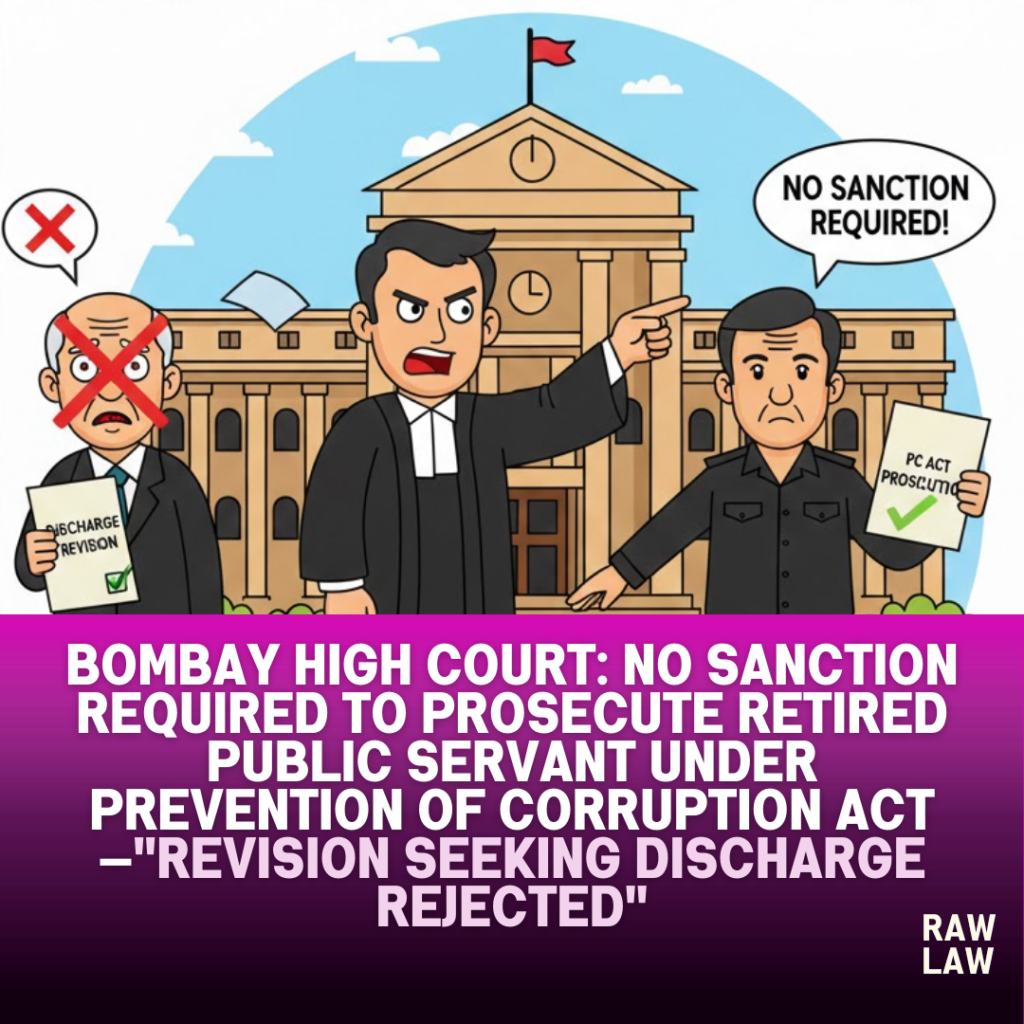
The Bombay High Court (Aurangabad Bench) dismissed a Criminal Revision Application filed by a former Chief Executive Officer of Zilla Parishad, Jalna, challenging rejection of his discharge application in a corruption and misappropriation case. The Court held that sanction under Section 19 of the Prevention of Corruption Act, 1988 is not required when the accused public servant had already retired before the court took cognizance. It further ruled that refusal of sanction by the Government after retirement does not invalidate prosecution. The interim stay operating since 2008 was vacated, and the trial court was directed to conclude the trial within one year.
Facts
The applicant, who served as Chief Executive Officer of Zilla Parishad, Jalna between August 1997 and October 1998, was accused of irregularities and misappropriation in connection with Rural Water Supply Department works. Crime No.141/2000 was registered for offences under Sections 120B, 408, 409, 465, 109 of the Indian Penal Code and Sections 13(1)(d) and 13(2) of the Prevention of Corruption Act.
The applicant retired on 30 April 2003. A charge-sheet was filed on 18 January 2005. The prosecution noted that sanction for prosecution was being sought. Subsequently, the Government rejected sanction on 7 December 2007.
The applicant sought quashing of prosecution and discharge on the ground that sanction was mandatory and had been refused. The Special Judge rejected the application on 8 February 2008, prompting the present revision.
Issues
The High Court examined:
- Whether sanction under Section 19 of the Prevention of Corruption Act is mandatory when the accused public servant had retired before cognizance.
- Whether refusal of sanction by the Government bars prosecution of a retired public servant.
- Whether sanction under Section 197 of the Code of Criminal Procedure is necessary for IPC offences alleged against the applicant.
- Whether exoneration in departmental proceedings justifies quashing of criminal prosecution.
Applicant’s arguments
The applicant contended that refusal of sanction by the Government rendered prosecution unsustainable. It was argued that Section 19 of the Prevention of Corruption Act mandates prior sanction before cognizance. Reliance was placed on judicial precedents emphasizing protection to public servants from harassment.
It was further submitted that protection under Section 197 CrPC extends even after retirement. The applicant argued that having been exonerated in departmental inquiry, continuation of criminal prosecution was unjustified. Advanced age (83 years) was also cited as a ground for quashing proceedings.
Respondent’s arguments
The State argued that sanction under Section 19 is required only when the accused is a serving public servant on the date of cognizance. Once a public servant retires, the protective umbrella of Section 19 ceases. The prosecution relied upon binding Supreme Court precedents clarifying that sanction is unnecessary for retired officials.
Regarding IPC offences, the State contended that criminal conspiracy, cheating, breach of trust, and forgery cannot be treated as acts done in discharge of official duty and thus do not attract Section 197 protection.
Analysis of the law
The Court analyzed Section 19 of the Prevention of Corruption Act and the settled jurisprudence that sanction is a protection available only to a serving public servant removable by the competent authority.
Relying on authoritative decisions including S.A. Venkataramani and State of Punjab v. Labh Singh, the Court reiterated that sanction is not required if the accused had retired before cognizance.
The Court also considered Section 197 CrPC and clarified that offences such as criminal conspiracy, breach of trust, and forgery cannot be regarded as acts performed in discharge of official duty. Official position may provide opportunity but does not transform criminal acts into official acts.
On departmental exoneration, the Court relied upon precedent holding that criminal proceedings are independent and not automatically nullified by disciplinary findings.
Precedent analysis
S.A. Venkataramani v. State (1958) – Held sanction is unnecessary when the accused is no longer a public servant at the time of cognizance.
State of Punjab v. Labh Singh (2014) – Clarified that sanction under the Prevention of Corruption Act is not required if the public servant has retired before cognizance.
Station House Officer, CBI v. B.A. Srinivasan (2019) – Observed that protection available during service does not extend after retirement.
Parkash Singh Badal v. State of Punjab (2007) – Held that offences like cheating and conspiracy cannot be treated as acts done in discharge of official duty.
State of NCT of Delhi v. Ajay Kumar Tyagi (2012) – Held exoneration in departmental proceedings does not automatically quash criminal prosecution.
The Court distinguished authorities cited by the applicant as factually inapplicable.
Court’s reasoning
The High Court found that the applicant had retired in 2003 and the charge-sheet was filed in 2005. Therefore, at the stage of cognizance, he was not a serving public servant. The statutory bar under Section 19 did not apply.
The refusal of sanction by the Government was held legally irrelevant since sanction itself was unnecessary post-retirement.
Regarding IPC offences, the Court held that alleged acts of conspiracy and misappropriation cannot be shielded under Section 197.
On departmental exoneration, the Court clarified that criminal prosecution is based on independent investigation and cannot be quashed solely due to findings in disciplinary proceedings.
The argument based on age was rejected, particularly noting that trial had remained stayed for 18 years due to interim orders obtained by the applicant.
Conclusion
The Criminal Revision Application was dismissed as devoid of merit. The High Court vacated the interim stay and directed the trial court to conclude proceedings within one year, considering both the prolonged delay and the age of the accused.
Implications
This judgment reinforces that retirement does not create a procedural shield under the Prevention of Corruption Act. It clarifies that sanction protection is limited to serving public servants. The ruling also underscores that criminal misconduct allegations involving conspiracy and breach of trust cannot be camouflaged as official acts.
For anti-corruption prosecutions, the decision strengthens the principle that retirement cannot be used to stall criminal accountability.
Case Law References
S.A. Venkataramani v. State (1958) – Sanction unnecessary after retirement.
State of Punjab v. Labh Singh (2014) – No sanction required if retired before cognizance.
Station House Officer, CBI v. B.A. Srinivasan (2019) – Protection does not extend post-retirement.
Parkash Singh Badal v. State of Punjab (2007) – IPC offences not protected under Section 197.
State of NCT of Delhi v. Ajay Kumar Tyagi (2012) – Departmental exoneration does not bar criminal prosecution.
FAQs
1. Is sanction required to prosecute a retired public servant under the Prevention of Corruption Act?
No. If the public servant has retired before the court takes cognizance, sanction under Section 19 is not required.
2. Does refusal of sanction after retirement bar prosecution?
No. Once the accused has retired, sanction is legally unnecessary, and refusal of sanction does not invalidate prosecution.
3. Can criminal proceedings be quashed if the accused was exonerated in departmental inquiry?
Generally no. Criminal proceedings are independent and require evaluation based on evidence in the criminal case.


