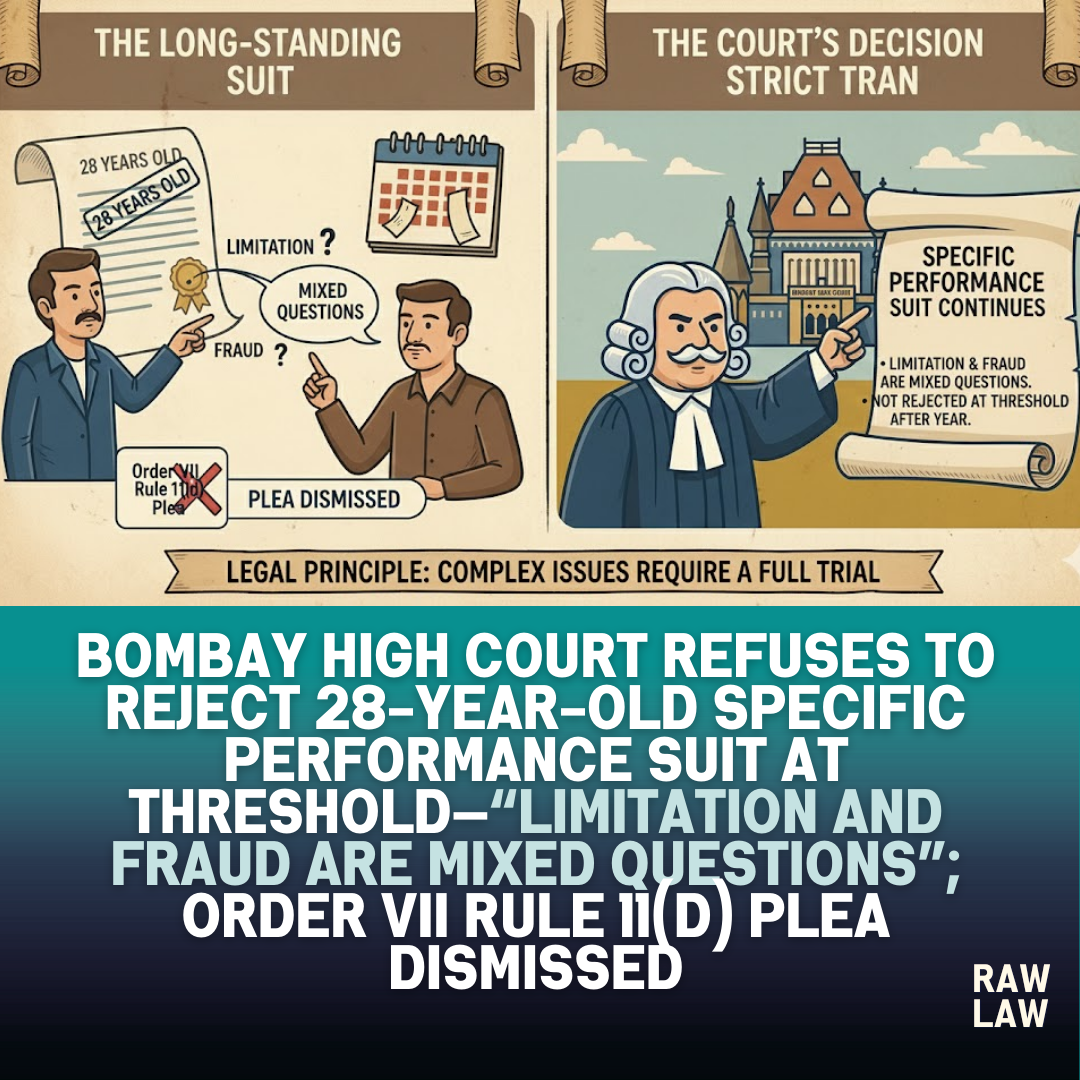
Bombay High Court refuses to reject 28-year-old specific performance suit at threshold—“Limitation and fraud are mixed questions”; Order VII Rule 11(d) plea dismissed

1. Court’s decision
The Bombay High Court (Nagpur Bench) dismissed a Civil Revision Application filed under Section 115 of the Code of Civil Procedure challenging the trial court’s refusal to reject a plaint under Order VII Rule 11(d).
The defendant had sought rejection of the suit as being barred by limitation and lacking cause of action in a dispute concerning agreements dated 06 October 1995 and 21 November 1995, and a subsequent sale deed dated 24 October 2020.
The High Court held that, on a meaningful reading of the plaint alone, the suit could not be said to be barred by limitation at the threshold, particularly in view of allegations of fraud and plea of knowledge in 2021. It reiterated that limitation and fraud are mixed questions of fact and law requiring trial.
2. Facts
The plaintiff filed Special Civil Suit No. 459 of 2023 seeking:
- Declaration that the sale deed dated 24 October 2020, executed in favour of defendant no.8 through court execution proceedings, was void and not binding to the extent of the suit property.
- Declaration that agreements dated 06 October 1995 and 21 November 1995 subsisted and their unilateral cancellation was illegal.
- Specific performance of the said agreements.
The impugned sale deed arose from execution of a compromise decree in an earlier suit of 2017. The plaintiff had already raised objections under Order XXI Rules 97 and 98 in execution proceedings, which were revived by the High Court in a First Appeal.
Defendant no.8 filed an application under Order VII Rule 11(d) seeking rejection of the plaint on grounds of limitation and absence of cause of action. The trial court rejected that application on 20 December 2024.
3. Issues
The High Court examined:
- Whether the suit for specific performance based on 1995 agreements was barred under Article 54 of the Limitation Act.
- Whether the plaint failed to disclose any cause of action.
- Whether parallel proceedings in execution barred the suit.
- Whether the plaint deserved rejection under Order VII Rule 11(d) CPC.
4. Petitioner’s arguments
The revision applicant argued that the primary relief was specific performance, governed by Article 54 of the Limitation Act, which prescribes a three-year limitation from the date fixed for performance.
Referring to Clause 3 of the agreement dated 06 October 1995, it was contended that performance was to be completed within six months. Therefore, a suit filed nearly 28 years later was hopelessly time-barred.
Reliance was placed on Section 16 of the Specific Relief Act and Explanation (ii), asserting that absence of specific averments regarding readiness and willingness also attracted statutory bar.
It was further argued that the plaintiff’s cause of action was illusory and that filing both objections in execution and a civil suit amounted to abuse of process.
5. Respondent’s arguments
The plaintiff contended that the suit was within limitation as knowledge of unilateral cancellation arose only on 01 July 2021.
The plaint specifically alleged fraud, collusion and connivance in obtaining the compromise decree and execution sale deed of 2020.
It was argued that limitation in cases involving fraud begins from the date of knowledge, and that limitation is a mixed question of fact and law.
The plaintiff also contended that the reliefs in execution proceedings were distinct from declaratory and specific performance reliefs sought in the civil suit.
6. Analysis of the law
The Court relied heavily on the Supreme Court’s judgment in Dahiben v. Arvindbhai Kalyanji Bhanusali, reiterating that:
- Order VII Rule 11 is a threshold remedy.
- Only plaint averments are to be examined.
- Defence cannot be considered.
- Rejection is warranted only if the bar is apparent on the face of the plaint.
The Court emphasised that the plaintiff had pleaded knowledge of cancellation in 2021 and alleged fraud. Therefore, limitation could not be conclusively determined without evidence.
7. Precedent analysis
The Court distinguished decisions relied upon by the applicant where specific performance suits were filed decades after a fixed date of performance without any pleaded fraud or continuing cause.
It also relied upon the Supreme Court’s recent decision in Karam Singh v. Amarjit Singh (2025 SCC OnLine SC 2240), holding that where multiple reliefs are sought and at least one is within limitation, the plaint cannot be rejected under Order VII Rule 11(d).
The Court reaffirmed that rejection cannot be partial and that the plaint must be read as a whole.
8. Court’s reasoning
The Court observed that:
- The suit challenged a 2020 sale deed and was filed in 2023.
- Fraud allegations were specific and required trial.
- Knowledge of cancellation in 2021 was pleaded.
- Limitation in such circumstances was not purely a legal question.
The Court declined to interpret contractual clauses conclusively at the Order VII Rule 11 stage.
It held that interpretation of agreements dated 06 October 1995 and 21 November 1995 required evidence and could not be decided summarily.
On parallel proceedings, the Court accepted that remedies under Order XXI Rules 97–98 and declaratory/specific performance reliefs are distinct.
9. Conclusion
The High Court found no perversity in the trial court’s order rejecting the application under Order VII Rule 11(d).
The Civil Revision Application was dismissed. The interim arrangement permitting adjournments before the trial court was continued for six weeks to enable the applicant to approach the Supreme Court.
10. Implications
This judgment reinforces critical principles in civil procedural law:
- Limitation involving fraud and knowledge is rarely suitable for summary rejection.
- Courts must read the plaint holistically.
- Multiple reliefs shield the plaint from rejection if any survives limitation scrutiny.
- Contract interpretation generally requires trial.
For real estate and specific performance litigation, the ruling underscores judicial reluctance to terminate suits at threshold where fraud is pleaded and factual disputes abound.
Case Law References
Dahiben v. Arvindbhai Kalyanji Bhanusali (2020) 7 SCC 366 – Laid down guiding principles for rejection of plaint under Order VII Rule 11 CPC.
Karam Singh v. Amarjit Singh (2025 SCC OnLine SC 2240) – Held that where multiple reliefs are claimed, and at least one is within limitation, plaint cannot be rejected under Order VII Rule 11(d).
FAQs
1. Can a specific performance suit filed decades later be rejected outright as time-barred?
Not automatically. If the plaint pleads fraud or knowledge of cancellation at a later date, limitation becomes a mixed question of fact and law requiring trial.
2. Can a plaint be rejected if one of several reliefs is barred by limitation?
No. If at least one relief is within limitation, the plaint cannot be rejected under Order VII Rule 11(d).
3. Are fraud allegations sufficient to avoid rejection at threshold?
If specifically pleaded with material particulars, fraud allegations typically require evidence and prevent summary rejection.