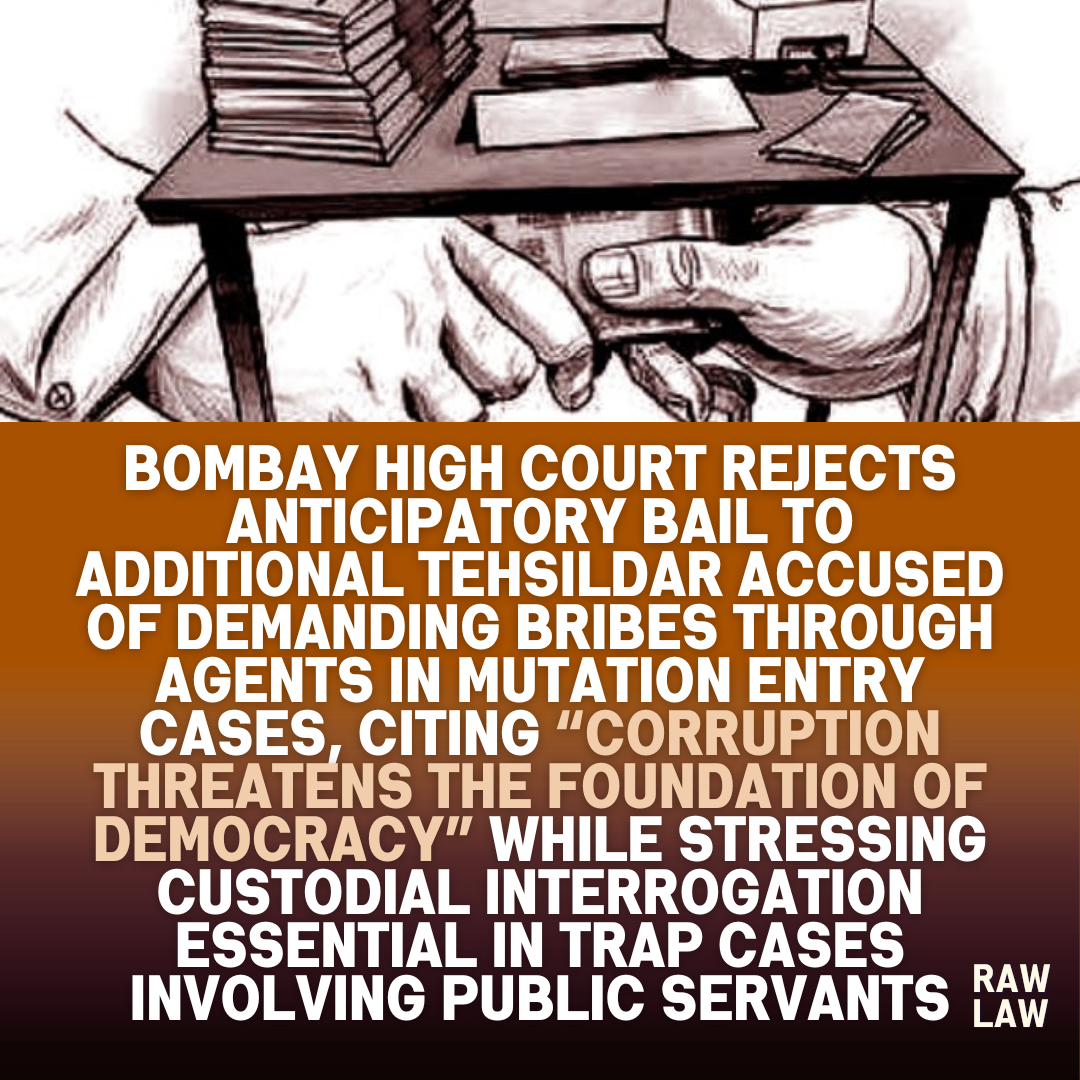
Bombay High Court Rejects Anticipatory Bail to Additional Tehsildar Accused of Demanding Bribes through Agents in Mutation Entry Cases, Citing “Corruption Threatens the Foundation of Democracy” While Stressing Custodial Interrogation Essential in Trap Cases Involving Public Servants

Court’s Decision
The Bombay High Court rejected the anticipatory bail application of the Additional Tehsildar accused under the Prevention of Corruption Act for allegedly demanding bribes through agents for mutation entries in revenue records. The Court held that custodial interrogation was necessary to unearth the applicant’s nexus with private persons used as agents for collecting bribes, observing that corruption threatens democracy and must be combated rigorously.
Facts
The applicant, an Additional Tehsildar, sought pre-arrest bail after an FIR was lodged against him under Sections 12 and 7(a) of the Prevention of Corruption Act. The complainant alleged that bribes of ₹60,000 per file (totaling ₹3,00,000 for five files) were demanded through private persons, including a clerk and an individual named Chavan acting on behalf of the applicant. The complainant, having purchased a plot, faced discrepancies in the mutation entries and lodged a complaint with the ACB, leading to a successful trap panchanama on 15 May 2025, where the bribe was allegedly accepted by the applicant’s agents.
Issues
- Whether custodial interrogation was necessary in a corruption trap case involving a public servant.
- Whether the absence of sanction under Section 17A of the PC Act could be a ground for granting anticipatory bail.
- Whether the allegations were prima facie sufficient to deny pre-arrest bail.
Petitioner’s Arguments
The applicant argued the FIR was filed with malicious intent to falsely implicate him due to the rejection of the complainant’s mutation correction request on 25 March 2025. He contended there was neither a demand nor acceptance of the bribe by him and that private persons were acting independently without his instructions. The petitioner also highlighted delays in the FIR and argued that multiple failed verification traps indicated false implication. Reliance was placed on prior decisions, and an affidavit with the rejection order of the complainant’s file was filed to show the motive of false implication.
Respondent’s Arguments
The State opposed the bail, arguing that CCTV footage and call records established a clear link between the applicant and his agents who collected bribes on his behalf. The prosecution pointed out previous cases involving the applicant under the PC Act and ongoing disproportionate assets inquiries against him. It was submitted that custodial interrogation was essential to unravel the larger nexus, including patterns of bribe collection, modus operandi, and involvement of others in the alleged corruption network.
Analysis of the Law
The Court emphasized the seriousness of corruption allegations, relying on the Supreme Court’s observation in Subramanian Swamy v. Manmohan Singh that corruption threatens constitutional governance. The Court held that the requirement under Section 17A of the PC Act for sanction to prosecute does not apply to trap cases, citing CBI v. Santosh Karnani, and clarified that requiring prior approval in trap cases would defeat the purpose of anti-corruption laws.
Precedent Analysis
- CBI v. Santosh Karnani (2023): Held that prior sanction under Section 17A is not required in trap cases.
- Balasaheb Waman Wankhede v. State of Maharashtra: Clarified that the protection under Section 17A does not apply where bribes are collected through middlemen at the behest of the public servant.
- Anil Sharma v. CBI: Stressed the need for custodial interrogation in corruption cases for effective investigation.
- Subramanian Swamy v. Manmohan Singh (2012): Stressed interpreting anti-corruption laws to strengthen the fight against corruption.
- Sumitha Pradeep v. Arun Kumar C.K. (2022): Laid parameters for granting anticipatory bail in corruption cases, used for assessing the present case.
Court’s Reasoning
The Court noted that the trap panchanama was successful, CCTV footage corroborated allegations of bribe acceptance through agents, and that the applicant’s conduct was suspicious, including unexplained possession of pre-trap panchanama documents. The presence of previous cases and ongoing investigations against the applicant indicated habitual misconduct. The Court rejected the plea that the FIR was delayed, finding the timeline reasonable. It concluded that custodial interrogation was necessary, as granting anticipatory bail would hamper effective investigation in a corruption trap case.
Conclusion
The anticipatory bail application was rejected. The Court held that custodial interrogation was necessary to investigate the applicant’s links with private agents and uncover the extent of corruption. The Court observed that any protection under Section 17A of the PC Act does not apply to trap cases and emphasized that the cancer of corruption must be eradicated to preserve democracy and the rule of law.
Implications
This judgment reinforces that:
- Courts will not grant anticipatory bail in corruption trap cases involving public servants, emphasizing custodial interrogation.
- Section 17A’s protection does not shield public servants from investigation in trap cases.
- Courts will adopt a strict approach in corruption matters, consistent with the objective of anti-corruption statutes.
Brief on Cases Referred and Their Application
- CBI v. Santosh Karnani (2023): Used to reject the argument that prior sanction under Section 17A is needed before investigation in trap cases.
- Balasaheb Waman Wankhede v. State of Maharashtra: Applied to show Section 17A protection is not available where bribe is routed through agents.
- Anil Sharma v. CBI: Cited to justify the necessity of custodial interrogation.
- Subramanian Swamy v. Manmohan Singh (2012): Quoted for the principle that corruption undermines democracy.
- Sumitha Pradeep v. Arun Kumar C.K. (2022): Provided parameters on anticipatory bail in corruption cases, supporting rejection of the application.
FAQs
Q1: Does prior sanction under Section 17A of the Prevention of Corruption Act apply to trap cases involving public servants?
No, as held in this case and CBI v. Santosh Karnani, prior sanction is not required for investigation in trap cases under Section 17A.
Q2: Why was anticipatory bail rejected in this corruption case?
The bail was rejected due to evidence from CCTV footage, trap panchanama, and prior conduct showing a prima facie case, necessitating custodial interrogation for effective investigation.
Q3: What principle did the court apply regarding corruption cases in this judgment?
The Court emphasized that corruption threatens democracy, quoting Subramanian Swamy v. Manmohan Singh, and that anti-corruption laws must be interpreted strictly to combat corruption.