

Court’s decision
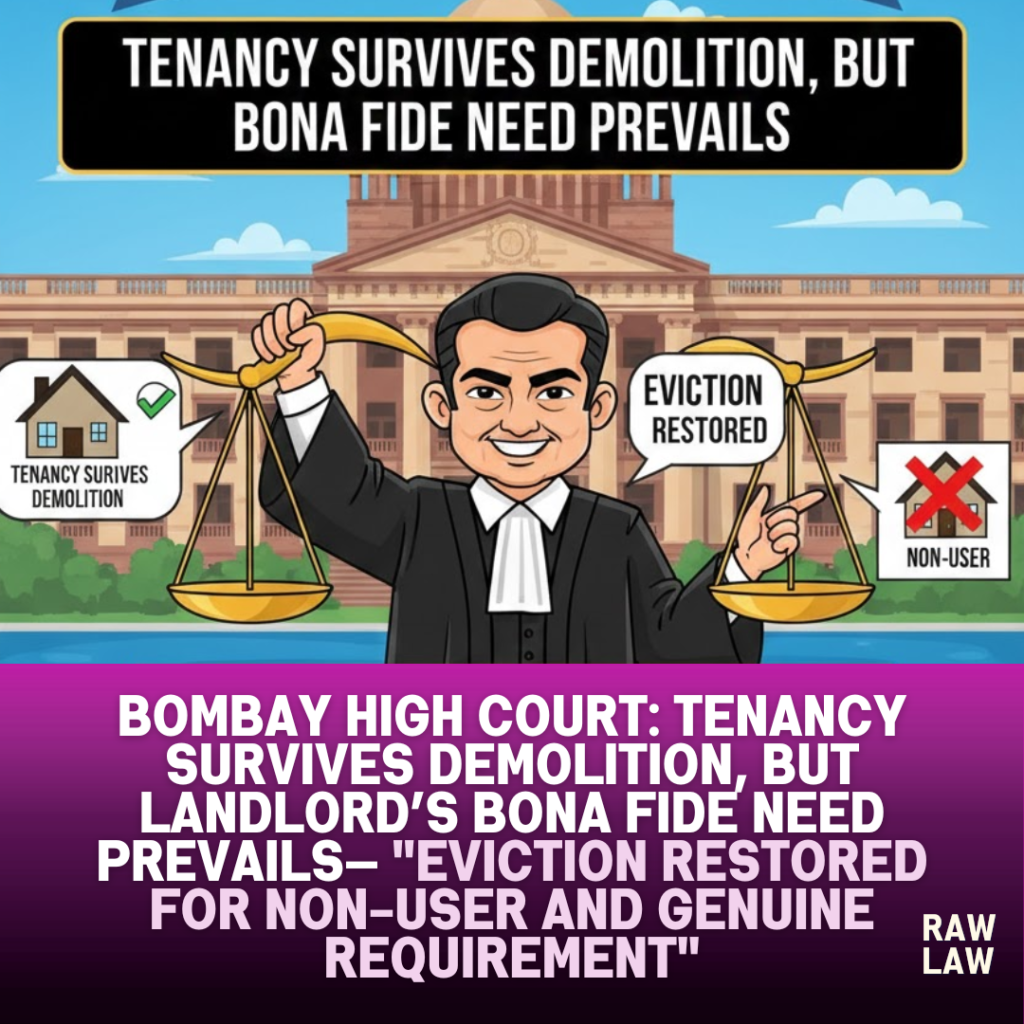
The Bombay High Court (Kolhapur Bench) restored a decree of eviction in favour of the landlord, holding that demolition of the suit premises during pendency of appeal does not extinguish tenancy rights, but equally does not defeat a landlord’s bona fide requirement under Section 16(1)(g) of the Maharashtra Rent Control Act, 1999.
Setting aside the appellate court’s judgment, the High Court confirmed eviction on the grounds of bona fide requirement and non-user, while declining to interfere with findings on arrears of rent. The tenant’s request for stay was rejected.
Facts
The revision arose from a landlord-tenant dispute concerning ground-floor premises in Sangli, let out as a godown at a monthly rent of Rs.104.25. The landlord filed a suit for eviction under Sections 16(1)(g) and 16(1)(n) of the Maharashtra Rent Control Act, alleging bona fide requirement and non-user without reasonable cause.
The landlord, having retired from service in 2009, sought possession to start a hardware store or hotel business. It was further alleged that the premises were kept locked for several years and had fallen into a dilapidated condition. A municipal notice regarding dangerous structure was also received.
The Trial Court decreed eviction. However, the Appellate Court reversed the decree, primarily holding that since the premises were demolished during pendency of appeal, the ground of bona fide requirement no longer survived.
Issues
The core issue before the High Court was whether tenancy rights survive demolition of the structure and, if so, whether the landlord’s bona fide requirement must still be assessed on merits.
Additionally, the Court examined whether non-user without reasonable cause was established and whether the appellate court erred in upsetting the Trial Court’s findings.
Petitioner’s arguments
The landlord contended that tenancy survives demolition of the superstructure, as both land and building together constitute the subject matter of tenancy. It was argued that once bona fide requirement is established on the date of suit, subsequent developments cannot eclipse it unless the requirement is completely extinguished.
The landlord relied on evidence showing that the tenant had alternative premises measuring 865 sq. ft. given on licence to a bank, demonstrating absence of hardship. It was further submitted that the tenant had kept the suit premises locked for 16–17 years and failed to justify non-user.
Respondent’s arguments
The tenant argued that once the building was demolished, no subject matter survived for eviction. It was contended that the landlord’s pleadings themselves admitted dilapidation, and therefore non-user was justified due to unsafe condition.
The tenant relied upon Supreme Court precedent to argue that destruction of superstructure does not automatically terminate tenancy but insisted that the landlord’s requirement was no longer genuine in absence of existing structure.
Analysis of the law
The High Court examined the Supreme Court decision in Shaha Ratansi Khimji and Sons v. Kumbhar Sons Hotel Private Limited, which held that tenancy in respect of a building includes both land and superstructure. Destruction of the building alone does not determine tenancy if the land continues to exist.
The Court also relied on Abdul Khuddus v. H.M. Chandiramani, reiterating that statutory tenants are governed by rent legislation and not by the Transfer of Property Act.
On bona fide requirement, the Court referred to Gaya Prasad v. Pradeep Srivastava, Shakuntala Bai v. Narayan Das, and D. Sasi Kumar v. Soundararajan, affirming that the crucial date for assessing requirement is the date of institution of proceedings, and subsequent developments must completely eclipse the need to defeat eviction.
Precedent analysis
In Shaha Ratansi Khimji, the Supreme Court clarified that tenancy comprises both land and building, and demolition does not extinguish tenancy rights.
In Gaya Prasad, the Court held that bona fide requirement must be judged as on the date of filing of suit and cannot be defeated merely due to delay or subsequent events.
In Prativa Devi v. T.V. Krishnan and Raghunath G. Panhale v. Chaganlal Sundarji & Co., it was reiterated that the landlord is the best judge of his requirement and the court cannot dictate terms.
Applying these principles, the High Court concluded that demolition did not nullify the landlord’s pleaded requirement.
Court’s reasoning
The High Court first held that tenancy survives demolition since the land remains. Therefore, rights and liabilities under the Maharashtra Rent Control Act continue.
Secondly, the Court found that the landlord had entered the witness box and consistently asserted his intention to start business post-retirement. His evidence remained unshaken.
On non-user, the Court observed that the tenant’s own evidence contradicted its argument. While claiming dilapidation as reasonable cause, the tenant simultaneously asserted continued need and convenience of the premises as godown. This contradiction weakened the tenant’s defence.
On comparative hardship, evidence showed that the tenant had let out a spacious owned premises to a bank, indicating financial strength and alternative accommodation.
The appellate court’s appreciation of evidence was found perverse and contrary to settled law.
Conclusion
The Bombay High Court partly allowed the Civil Revision Application, quashed the appellate court’s judgment, and restored the decree of eviction on the grounds of bona fide requirement and non-user. The dismissal of cross-objection concerning arrears was maintained. The request for stay was rejected.
Implications
This judgment clarifies two critical principles under rent control law:
- Demolition of tenanted premises does not extinguish tenancy rights.
- Bona fide requirement must be assessed as on the date of suit and is not automatically defeated by subsequent demolition.
The ruling reinforces that tenants cannot rely on dilapidation as a shield while simultaneously asserting need for the same premises. It also reiterates judicial deference to a landlord’s genuine post-retirement business plans.
Case law references
- Shaha Ratansi Khimji and Sons v. Kumbhar Sons Hotel Private Limited (2014) 14 SCC 1
Held that tenancy comprises both land and building; destruction of superstructure does not end tenancy. - Abdul Khuddus v. H.M. Chandiramani (2021) 15 SCC 474
Statutory tenancy governed exclusively by rent legislation. - Gaya Prasad v. Pradeep Srivastava (2001) 2 SCC 604
Bona fide requirement assessed on date of suit. - Prativa Devi v. T.V. Krishnan (1996) 5 SCC 353
Landlord is best judge of requirement.
FAQs
1. Does demolition of a rented building end tenancy?
No. If the land continues to exist, tenancy survives under rent control law.
2. When is bona fide requirement assessed?
It is assessed as on the date of filing the eviction suit.
3. Can dilapidation justify non-user by tenant?
Only if genuinely proven. Contradictory evidence may defeat such defence.


