Delhi High Court Acquits POCSO Convict; Holds Doubtful Age Proof, Material Contradictions and Unreliable Prosecution Evidence Entitle Accused to Benefit of Doubt

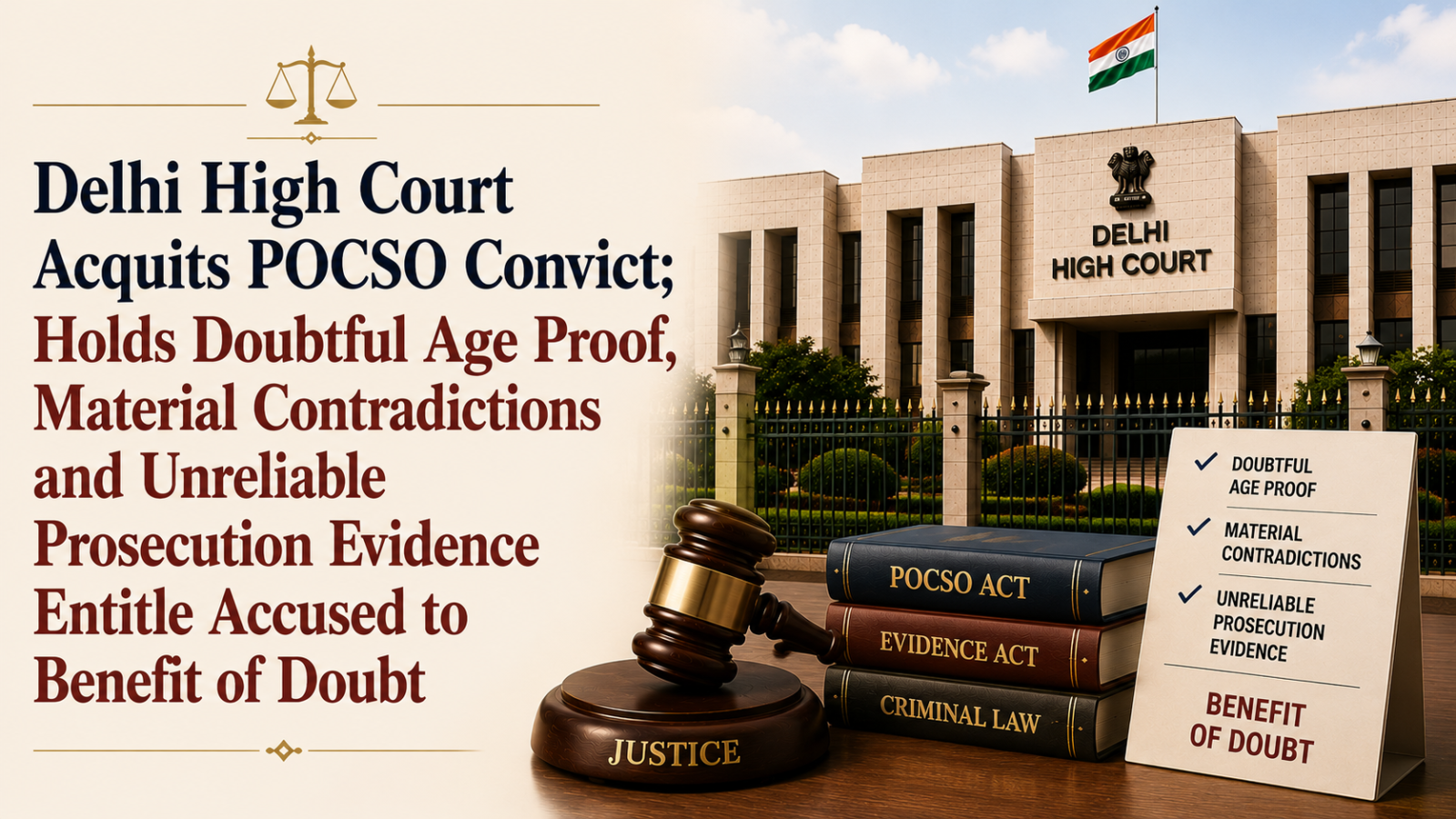
Delhi High Court Acquits POCSO Convict; Holds Prosecution Failed to Prove Victim Was a Minor Beyond Reasonable Doubt
Facts
The prosecution alleged that the appellant repeatedly threatened a 16-year-old girl, forced her into a relationship, took her to his uncle’s house on multiple occasions, sexually assaulted her at knife point, and criminally intimidated her with threats to kill her family. The allegations came to light after the accused allegedly stabbed the victim’s leg on 10 July 2016, following which the victim disclosed the alleged sexual assaults to her mother. An FIR was registered, and the trial court convicted the appellant under Section 6 of the Protection of Children from Sexual Offences Act, 2012 (POCSO Act), Sections 376(2)(n) and 506 IPC, sentencing him to twelve years’ rigorous imprisonment. The appellant challenged the conviction before the Delhi High Court.
Issues
- Whether the prosecution proved that the victim was below eighteen years of age so as to attract the provisions of the POCSO Act.
- Whether the prosecution established beyond reasonable doubt that the appellant committed repeated rape and criminal intimidation.
- Whether the conviction could be sustained in light of the inconsistencies in the prosecution evidence and surrounding circumstances.
Appellant’s Arguments
The appellant argued that the prosecution failed to establish the victim’s age through reliable evidence, as the school admission register contained material corrections and was unsupported by any birth certificate. It was further contended that there was considerable delay in reporting the alleged sexual assaults, no scientific evidence corroborated the prosecution case, and the victim’s brother, who was allegedly present during crucial events, was not examined.
The appellant also pointed to significant inconsistencies between the FIR, the statement under Section 164 CrPC and the victim’s deposition before the trial court regarding the manner of the alleged assaults, the use of weapons, threats and surrounding circumstances. According to the defence, the victim had wanted to marry the appellant, but after he refused, he was falsely implicated.
Respondent’s Arguments
The State contended that the victim had consistently implicated the appellant in repeated sexual assaults and criminal intimidation. It argued that the trial court had correctly appreciated the oral and documentary evidence and that no infirmity existed warranting appellate interference. The prosecution maintained that the conviction under the POCSO Act and the IPC was fully justified on the evidence led during trial.
Analysis of the Law
The High Court observed that, for an offence under the POCSO Act, the prosecution must first establish beyond reasonable doubt that the victim was a “child” within the meaning of the Act. Where the prosecution relies upon school records to prove age, such records must be reliable and free from suspicious alterations. In the present case, the Court found that the admission register contained corrections made using correction fluid, without authentication, and was unsupported by any contemporaneous birth certificate.
The Court further reiterated that conviction for rape may be based upon the sole testimony of the prosecutrix if it is wholly reliable. However, where the evidence contains material inconsistencies affecting the core prosecution story, the accused is entitled to the benefit of reasonable doubt.
Precedent Analysis
The Court relied upon Moidu K. v. State of Kerala to reiterate that non-compliance with Section 232 CrPC does not automatically vitiate a criminal trial unless prejudice to the accused is demonstrated.
The Court also applied settled principles governing appreciation of evidence in sexual offence prosecutions, namely that while minor discrepancies may be ignored, material inconsistencies affecting the substratum of the prosecution case cannot be overlooked and must receive due weight while determining guilt beyond reasonable doubt.
Court’s Reasoning
The Court found that the prosecution failed to satisfactorily prove the victim’s age. The school admission register, relied upon to establish minority, contained unauthenticated corrections, and no birth certificate or other contemporaneous document had been produced. Further, the mother’s own testimony regarding the birth years of her children was inconsistent with the recorded date of birth.
The Court also found multiple inconsistencies between the FIR, the Section 164 CrPC statement and the victim’s deposition before the trial court regarding the number of incidents, the use of knife and gun, alleged photographs, kidnapping, threats and other material facts. The Court considered the victim’s conduct in repeatedly accompanying the appellant to a nearby house, despite the presence of neighbouring houses and a market, without raising alarm or promptly disclosing the incidents, as another circumstance creating doubt. It also found the medical evidence unsatisfactory and not fully supportive of the prosecution version.
Considering the cumulative effect of these infirmities, the Court held that the prosecution failed to establish guilt beyond reasonable doubt.
Conclusion
The Delhi High Court allowed the appeal and set aside the appellant’s conviction and sentence under Section 6 of the POCSO Act and Sections 376 and 506 IPC. The Court held that the prosecution failed to reliably establish the victim’s age, and the material inconsistencies in the prosecution evidence created reasonable doubt regarding the allegations. The appellant was therefore acquitted by extending the benefit of doubt.
Case Details
Case: M. Narshima @ Rohan v. State (NCT of Delhi) & Anr.
Court: High Court of Delhi
Case Number: CRL.A. 1081/2024
Judge: Hon’ble Ms. Justice Chandrasekharan Sudha
Date: 05 August 2026
Result: Appeal allowed; conviction and sentence under Section 6 of the POCSO Act and Sections 376(2)(n) and 506 IPC set aside; appellant acquitted.