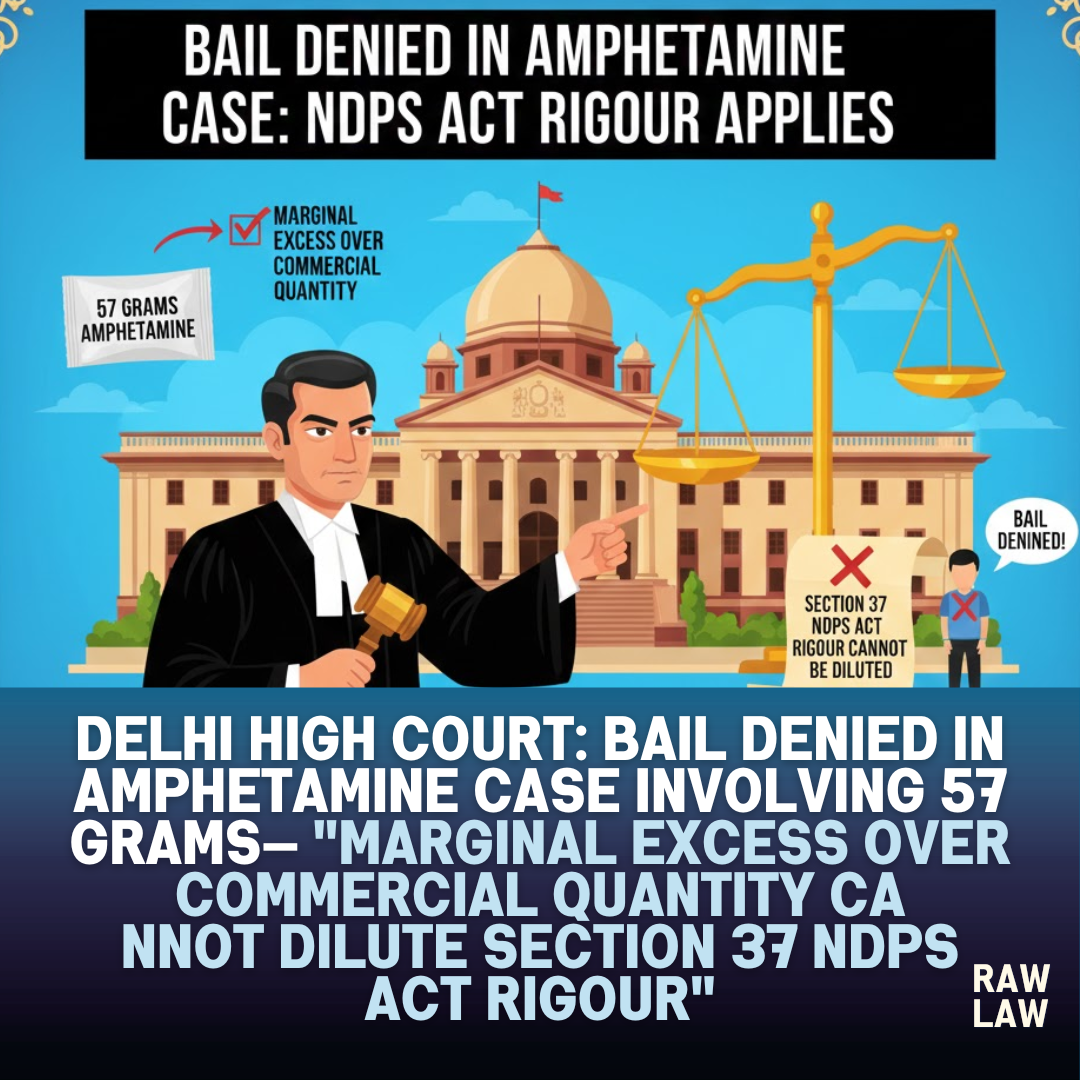
Delhi High Court: Bail denied in amphetamine case involving 57 grams— “Marginal excess over commercial quantity cannot dilute Section 37 NDPS Act rigour”

Court’s decision
The Delhi High Court refused regular bail to an accused apprehended with 57 grams of amphetamine, holding that the recovery constituted commercial quantity under the Narcotic Drugs and Psychotropic Substances Act, 1985. The Court ruled that the marginal excess of 7 grams above the 50-gram commercial threshold could not justify dilution of the statutory embargo under Section 37 of the NDPS Act.
Finding that the twin conditions under Section 37 were not satisfied and that the prosecution case disclosed prima facie involvement in a drug manufacturing syndicate, the Court dismissed the bail application.
Facts
The prosecution case originated from a fire incident reported on 1 November 2024 at a premises in Mahavir Enclave, Dabri, New Delhi. Upon inspection, police discovered that the fire resulted from a chemical explosion and unearthed a clandestine laboratory allegedly being used for manufacturing amphetamine.
During search, 70 grams of amphetamine and large quantities of chemical raw materials were recovered. Subsequently, a foreign national tenant was apprehended and 80 grams of amphetamine was recovered from him.
In his disclosure statement, the co-accused implicated the present applicant as an accomplice involved in sale of drugs. On 9 November 2024, the applicant was apprehended, and 57 grams of amphetamine was allegedly recovered from a sling bag carried by her. She remained in custody for over one year before seeking regular bail.
Issues
The principal issue before the Court was whether the applicant was entitled to regular bail despite recovery of commercial quantity of amphetamine, thereby attracting the stringent bar under Section 37 of the NDPS Act.
The Court also considered whether the marginal difference of 7 grams above the commercial quantity threshold and alleged procedural irregularities in weighing could justify relaxation of statutory restrictions.
Additionally, the Court examined whether prolonged incarceration of approximately one year and two months warranted bail.
Petitioner’s arguments
The applicant contended that the alleged 57 grams included the weight of the polythene pouch, and that the prosecution failed to ascertain the net weight of the contraband. It was argued that if the weight of the polythene were excluded, the quantity might fall below the commercial threshold of 50 grams.
The applicant further submitted that no independent witnesses were joined during recovery and no videography was conducted, casting doubt on the seizure process.
Reliance was placed on High Court decisions to argue that where recovered quantity marginally exceeds commercial threshold, courts may relax Section 37 rigours. The applicant also emphasized prolonged custody and slow trial progress, noting that none of the 40 listed witnesses had been examined.
Respondent’s arguments
The State opposed bail, asserting that recovery of 57 grams of amphetamine clearly constituted commercial quantity under the NDPS Act, thereby triggering Section 37 restrictions.
It was submitted that the co-accused’s disclosure statement indicated the applicant’s role in an organized drug syndicate engaged in manufacturing and supply. The prosecution further relied on status report stating that the weight of identical polythene pouches used for sampling was negligible.
The State emphasized binding Supreme Court precedents mandating strict adherence to Section 37 and cautioning against dilution based solely on marginal quantity or length of custody.
Analysis of the law
The Court examined Section 37 of the NDPS Act, which imposes twin conditions for grant of bail in cases involving commercial quantity: the Court must be satisfied that there are reasonable grounds for believing that the accused is not guilty and is unlikely to commit any offence while on bail.
Relying on Union of India v. Ram Samujh, Union of India v. Ajay Kumar Singh, and Union of India v. Vigin K. Varghese, the Court reiterated that these conditions are mandatory and not empty formalities.
The Court observed that the alleged recovery exceeded the commercial quantity threshold and that, at the bail stage, disputed factual aspects such as exact weight or procedural lapses could not be conclusively adjudicated.
Precedent analysis
In Union of India v. Ram Samujh, the Supreme Court emphasized that liberal approach in bail matters under NDPS Act is impermissible where commercial quantity is involved.
In Union of India v. Ajay Kumar Singh, the Court reiterated that Section 37 creates a statutory embargo and must be strictly complied with.
In Union of India v. Vigin K. Varghese, the Supreme Court clarified that long incarceration or anticipated delay in trial cannot override Section 37 unless twin conditions are satisfied.
The Delhi High Court applied these precedents to hold that neither marginal excess quantity nor custody period justified bail.
Court’s reasoning
The Court noted that 57 grams of amphetamine was allegedly recovered from the applicant, exceeding the 50-gram commercial threshold.
With respect to the argument that the weight included the polythene pouch, the Court observed that the difference between commercial quantity and recovered quantity was only 7 grams and that there was no material to presume that the pouch weight would reduce net quantity below threshold.
The Court further held that allegations regarding absence of independent witnesses or videography were matters for trial and insufficient to satisfy Section 37’s twin conditions at this stage.
Regarding custody, the Court observed that charges had already been framed and trial had commenced, and therefore, no inordinate delay was demonstrated.
Conclusion
The Delhi High Court dismissed the bail application, holding that the statutory embargo under Section 37 of the NDPS Act squarely applied and that the applicant failed to satisfy the mandatory twin conditions for bail in commercial quantity cases.
Implications
This judgment reaffirms the strict approach adopted by courts in NDPS cases involving commercial quantity. It clarifies that marginal excess over the statutory threshold cannot be a ground to dilute Section 37 rigours.
The ruling also reinforces that long incarceration, absence of independent witnesses, or alleged procedural irregularities in weighing cannot independently justify bail unless the Court is satisfied about the accused’s innocence and non-propensity to reoffend.
The decision strengthens prosecutorial leverage in organized narcotics cases and underscores the high threshold for bail under the NDPS Act.
Case law references
- Union of India v. Ram Samujh (1999) 9 SCC 429
Held that liberal bail approach is impermissible in NDPS cases involving commercial quantity. - Union of India v. Ajay Kumar Singh (2023 SCC OnLine SC 346)
Reiterated mandatory nature of twin conditions under Section 37 NDPS Act. - Union of India v. Vigin K. Varghese (2025 SCC OnLine SC 2440)
Clarified that long incarceration alone cannot override Section 37 restrictions.
FAQs
1. What is ‘commercial quantity’ under the NDPS Act?
Commercial quantity refers to the threshold amount notified under the NDPS Act for each drug. For amphetamine, 50 grams constitutes commercial quantity.
2. Can marginal excess over commercial quantity be ignored for bail?
Generally no. Courts strictly apply Section 37 once commercial quantity threshold is crossed.
3. Does long custody guarantee bail in NDPS cases?
Not automatically. Unless the twin conditions under Section 37 are satisfied, long incarceration alone is insufficient.