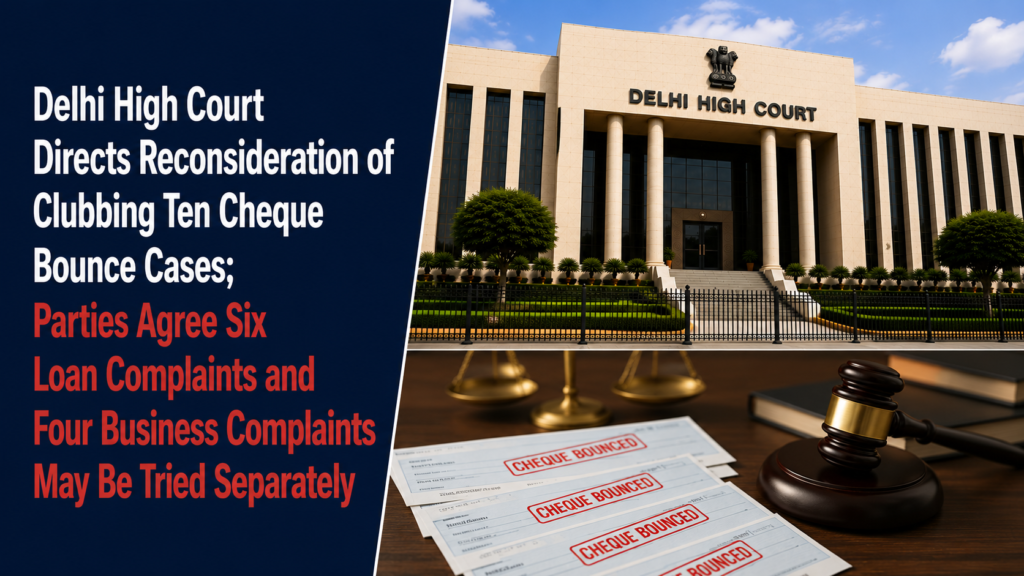
Delhi High Court Directs Reconsideration of Clubbing Ten Cheque Bounce Cases; Parties Agree Six Loan Complaints and Four Business Complaints May Be Tried Separately

Delhi High Court Sends Cheque Bounce Consolidation Dispute Back to Trial Court; Accused Accepts Complainants’ Proposal to Club Ten Cases in Two Groups
Facts
The Delhi High Court considered a petition filed by Ashish Raheja, who was facing prosecution in ten separate complaints under Section 138 of the Negotiable Instruments Act, 1881. Six complaints had been instituted by M/s Leo Ispat Ltd., while the remaining four had been instituted by M/s Leo Ispat, a proprietary concern.
Raheja had moved an application before the Trial Court seeking clubbing and joinder of trial of all ten cheque dishonour complaints. The Trial Court rejected that request, leading him to challenge the order before the Delhi High Court.
Before the High Court, the complainants pointed out that they had already offered a limited concession before the Trial Court: the six complaints filed by M/s Leo Ispat Ltd. could be clubbed together, while the four complaints filed by M/s Leo Ispat could separately be clubbed together.
The distinction was based on the underlying transactions. The six complaints arose from a loan transaction, whereas the other four arose from a business transaction.
Issues
The immediate issue before the High Court was whether the Trial Court’s rejection of the petitioner’s request for clubbing and joint trial of the ten Section 138 NI Act complaints required interference.
More specifically, the controversy narrowed to whether:
- all ten complaints should be consolidated into one trial; or
- the complaints could instead be divided into two distinct groups, with six loan-transaction cases tried together and four business-transaction cases tried together.
The Court ultimately did not adjudicate the broader legal question on merits because the parties reached substantial agreement on how the clubbing application could be reconsidered.
Petitioner’s Arguments
The petitioner had initially insisted before the Trial Court that all ten complaints should be clubbed together and jointly tried.
That position had led to disagreement because the complainants were willing to consent only to separate consolidation of the two categories of complaints.
During arguments before the High Court, however, the petitioner modified his position.
He informed the Court that he would no longer insist upon clubbing all ten complaints together and had no objection to the complainants’ proposal that:
- six complaints concerning the loan transaction be clubbed together; and
- four complaints concerning the business transaction be clubbed separately.
He consequently sought permission to withdraw the petition with liberty to address the Trial Court afresh on the clubbing application.
Respondents’ Arguments
The respondents reiterated the concession they had already made before the Trial Court.
They stated that they had no objection to clubbing and joining the trial of the six complaints filed by M/s Leo Ispat Ltd.
Likewise, they had no objection to the four complaints filed by M/s Leo Ispat being clubbed together separately.
Their objection was therefore not to consolidation per se, but to the petitioner’s earlier demand that all ten complaints arising from two different kinds of transactions be merged into one consolidated trial.
Analysis of the Law
Court Did Not Decide a General Rule on Clubbing Section 138 Cases
A significant limitation of this judgment should be noted.
The High Court did not finally decide the legal parameters governing mandatory clubbing or joint trial of multiple Section 138 NI Act complaints.
Nor did it hold as a proposition of law that complaints arising from loan transactions must necessarily be tried separately from complaints arising from business transactions.
Instead, the petition was disposed of because the parties’ positions converged during the hearing.
The petitioner withdrew his insistence upon one joint trial of all ten complaints, while the complainants maintained their consent to grouping the cases into two sets.
Distinct Transactions Justified Fresh Consideration
The factual distinction between the two groups remained important.
The six complaints instituted by M/s Leo Ispat Ltd. arose from a loan transaction, while the remaining four complaints instituted by M/s Leo Ispat arose from a business transaction.
This distinction formed the basis of the complainants’ proposal for two separate groups.
Once the petitioner accepted that arrangement in principle, the High Court considered it appropriate to permit the Trial Court to reconsider the clubbing application afresh.
Trial Court Directed to Decide Afresh
The operative direction is significant.
The High Court requested the Trial Court to reconsider the petitioner’s application in light of the statements made by both sides before the High Court and pass an appropriate order in accordance with law.
Importantly, the High Court directed that the Trial Court undertake this exercise without being influenced by the observations contained in its earlier impugned order.
Thus, while the High Court did not itself formally order the six-plus-four clubbing arrangement, it effectively reopened the issue for a fresh and uninfluenced determination in light of the parties’ agreement.
Precedent Analysis
The judgment does not cite or analyse any judicial precedent concerning clubbing, joinder of trials, Section 138 NI Act prosecutions, or the procedural rules governing multiple cheque dishonour complaints.
Accordingly, no broader ratio regarding mandatory consolidation of Section 138 proceedings should be attributed to this decision.
Its value lies primarily in its procedural disposition: where the parties substantially agree upon a workable grouping of multiple cheque dishonour complaints, the High Court may permit the Trial Court to reconsider an earlier rejection of clubbing in light of that changed position.
Court’s Reasoning
The Court adopted a pragmatic approach rather than deciding the original challenge on merits.
There was no longer any real controversy regarding the petitioner’s earlier demand for a single consolidated trial because he expressly stated that he would not insist upon clubbing all ten complaints together.
At the same time, the complainants had consistently indicated their willingness to permit:
Group 1: Six complaints concerning the loan transaction.
Group 2: Four complaints concerning the business transaction.
In these circumstances, the proper course was to allow the Trial Court to reconsider the application afresh instead of having the High Court determine an issue on which the parties’ positions had materially changed.
Pending Cross-Examination
The High Court also ensured that the clubbing dispute would not unnecessarily derail the ongoing criminal proceedings.
The cases were already fixed for cross-examination on the following day.
The Court therefore clarified that the petitioner must render due assistance to the Trial Court so that, once the clubbing application was disposed of, the scheduled testimony could also be recorded, subject to the convenience of the Trial Court’s Board.
This indicates that the fresh consideration of consolidation was not intended to operate as an automatic stay of the Section 138 proceedings.
Conclusion
The Delhi High Court did not itself order clubbing of the ten cheque dishonour complaints.
Instead, after the petitioner withdrew his insistence upon consolidation of all ten cases and accepted the complainants’ proposal in principle, the Court disposed of the petition with a direction to the Trial Court to reconsider the clubbing application afresh.
The Trial Court was directed to decide the application in accordance with law without being influenced by the observations in its earlier order.
The petitioner was also directed to cooperate with the scheduled cross-examination so that evidence could proceed after disposal of the application, subject to the Trial Court’s convenience.
Case Details
Case: Ashish Raheja v. M/s Leo Ispat Ltd. & Anr.
Court: High Court of Delhi at New Delhi
Case Number: CRL.M.C. 5934/2026 with CRL.M.A. 24727/2026 & CRL.M.A. 24728/2026; CNR No. DLHC010374142026
Judge: Justice Manoj Jain
Date: 13 August 2026
Result: Petition disposed of; Trial Court directed to reconsider the clubbing application afresh in light of the parties’ agreement, without being influenced by its earlier observations.