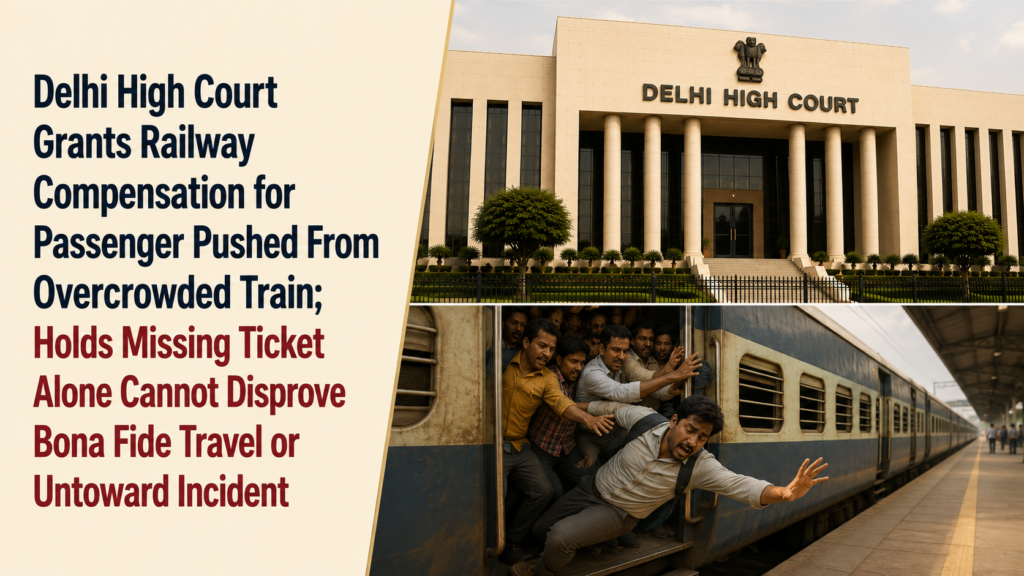
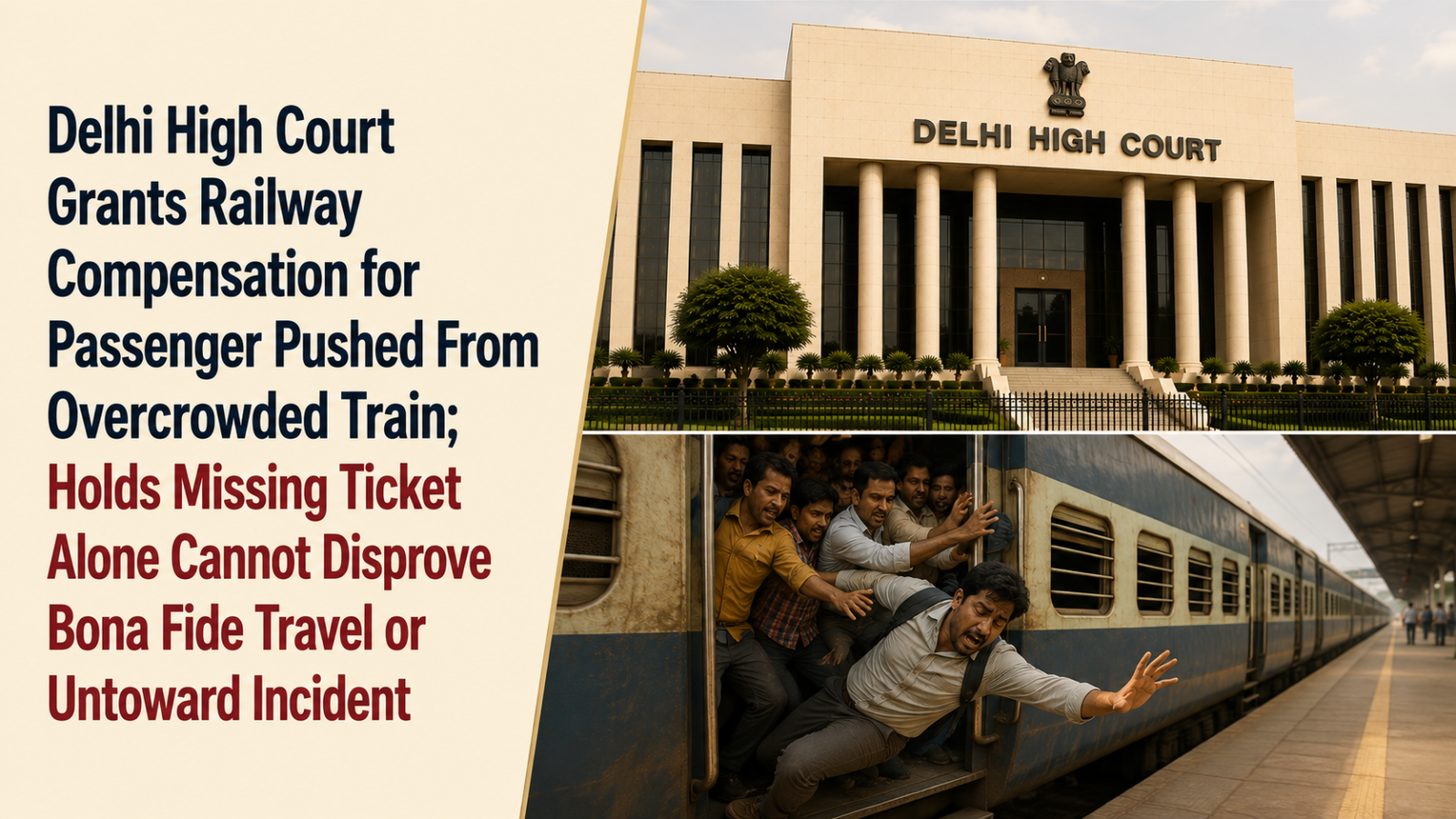
Delhi High Court Grants Railway Compensation for Passenger Pushed From Overcrowded Train; Holds Missing Ticket Alone Cannot Disprove Bona Fide Travel or Untoward Incident

Delhi High Court Remands Fatal Railway Accident Claim for Compensation; Holds Unsupported DRM Run-Over Finding Cannot Defeat Evidence of Accidental Train Fall
Facts
The appeal was filed by Smt. Lalita and others under Section 23 of the Railway Claims Tribunal Act, 1987 against the Railway Claims Tribunal’s judgment dated 28 May 2018 dismissing their compensation claim arising from the death of Radheshyam.
On 3 December 2016, Radheshyam, a labourer working at Badli, Delhi, was travelling to his native village in Uttar Pradesh. His younger brother accompanied him to Badli Railway Station, where a ticket for the journey up to Delhi Railway Station was purchased. Radheshyam thereafter boarded an overcrowded EMU train and had to stand near the doorway.
According to the claimants, when the train reached Adarsh Nagar Railway Station, a sudden and forceful push from fellow passengers caused Radheshyam to fall from the moving train. He suffered grievous injuries, was taken first to Dr. B.R. Ambedkar Hospital and thereafter to LNJP Hospital, where he died on 4 December 2016.
The Tribunal accepted that death due to a fall from the train might have occurred and that the injuries were consistent with an “untoward incident” under the Railways Act, 1989. Nevertheless, it dismissed the claim because the deceased had allegedly not been proved to be a bona fide passenger.
Issues
The principal issues before the High Court were:
- Whether Radheshyam could be treated as a bona fide passenger despite the journey ticket not being recovered from his body.
- Whether consistent testimony regarding purchase of the ticket was sufficient to discharge the claimants’ initial burden of proof.
- Once that initial burden was discharged, whether the burden shifted to the Railways to prove that the deceased was travelling without a valid ticket.
- Whether the death resulted from an “untoward incident” by accidental fall from a moving train.
- Whether the DRM Report’s conclusion that the deceased had entered the railway track unauthorisedly and was run over could prevail without independent supporting evidence.
Appellants’ Arguments
The appellants contended that the Tribunal had wrongly concluded that Radheshyam was not a bona fide passenger.
The deceased’s younger brother, Sonu (AW-2), had specifically testified that he accompanied Radheshyam to Badli Railway Station, purchased a ₹10 ticket from Badli to Delhi and handed it to him before he boarded the train.
AW-2 further stated that overcrowding resulted in a sudden heavy thrust from passengers, causing the deceased to fall from the moving train.
The appellants emphasised that the Railways neither examined any witness nor produced material contradicting this account or affirmatively establishing that Radheshyam was travelling ticketless.
Their central submission was that mere non-recovery of a journey ticket after a serious railway accident cannot automatically lead to the conclusion that the passenger had travelled without one.
Respondent’s Arguments
The Union of India supported the Tribunal’s judgment.
It argued that although Sonu claimed to have purchased and handed over a ticket to Radheshyam, no railway ticket was recovered from the deceased’s person.
The Railways also relied upon the DRM Report and contemporaneous police record, which allegedly indicated that Radheshyam had made an unauthorised entry onto the railway track and had subsequently been run over.
Accordingly, the respondent argued that the claimants had failed to establish that the deceased was travelling with a valid ticket and, consequently, could not establish an untoward incident attracting railway compensation.
Analysis of the Law
Non-Recovery of Ticket Is Not Conclusive
The High Court rejected the proposition that absence of a physical ticket from the deceased’s body automatically establishes ticketless travel.
The claimants had consistently maintained from the inception that Radheshyam possessed a valid ticket.
The claim application specifically pleaded that the ticket had been purchased from Badli to Delhi and was lost during the accident. His wife reiterated that version in her affidavit.
Most importantly, Sonu gave categorical evidence that he personally accompanied his brother to the station and purchased the ₹10 ticket for him. He remained consistent on the material particulars even during cross-examination.
Bona Fide Passenger and Burden of Proof
The Court relied on the settled principle that mere non-recovery of the railway ticket does not, by itself, negate its purchase, particularly where the journey is short and the ticket is computerised.
The consistent and unrebutted testimony of AW-2 was sufficient to establish that Radheshyam was travelling as a bona fide passenger.
The claimants had therefore discharged their initial evidentiary burden.
Once they did so, the burden shifted to the Railways to establish that the deceased was not a bona fide passenger. The Railways failed to discharge that burden.
Whether the Death Was an “Untoward Incident”
Having held that Radheshyam was a bona fide passenger, the Court examined whether his death constituted an “untoward incident” under the Railways Act.
The Tribunal itself had acknowledged that death by falling from the train could have occurred and that the post-mortem injuries were consistent with such an incident.
The Railways nevertheless relied upon the DRM Report, which attributed the death to the deceased’s own negligence and described the incident as a run-over case.
The High Court found that conclusion unsupported by reliable evidence.
DRM Report Cannot Override Unrebutted Evidence
The Court noted that the Railways had:
- examined no witness supporting the run-over theory;
- produced no documentary material establishing that Radheshyam had not fallen from the train;
- produced no evidence that he had been seen crossing or walking on the railway tracks.
By contrast, the claimants had produced unrebutted testimony establishing that Radheshyam was travelling with a valid ticket.
The Court therefore held that the DRM Report, standing alone, could not displace the consistent evidence concerning the deceased’s journey and accidental fall.
Consequently, the incident constituted an “untoward incident” within the meaning of the Railways Act.
Precedent Analysis
Union of India v. Rina Devi, (2019) 3 SCC 572
The High Court relied upon Rina Devi for the proposition that mere non-recovery of a ticket from the deceased’s body does not automatically establish that the person was travelling without a valid ticket.
The claimant must first establish bona fide travel through credible evidence. Once sufficient evidence is produced, the burden shifts and the Railways cannot rely merely upon the absence of the physical ticket.
This principle directly supported the appellants because Sonu had given consistent first-hand evidence that he personally purchased the ticket and handed it to Radheshyam.
Lata v. Union of India, 2026 SCC OnLine SC 1350
The Court also relied upon the recent Supreme Court decision in Lata, which reiterated the principles governing the evidentiary burden in railway compensation claims involving disputed passenger status.
Together, these decisions supported the conclusion that the claimants had discharged their initial burden and that the Railways thereafter failed to establish ticketless travel.
Court’s Reasoning
The High Court found two fundamental errors in the Tribunal’s approach.
First, the Tribunal treated non-recovery of the ticket as effectively decisive, despite direct and consistent testimony establishing its purchase.
Second, the Railways’ alternative theory that Radheshyam had entered the tracks and been run over rested principally upon the DRM Report without supporting witnesses or reliable documentary evidence.
The claimants’ version, on the other hand, remained consistent: a ticket had been purchased, Radheshyam boarded an overcrowded train, was forced to stand near its doorway and fell after being pushed by passengers.
Accordingly, the Court held that:
Radheshyam was a bona fide passenger, and his fatal fall from the moving train constituted an untoward incident under the Railways Act.
Conclusion
The Delhi High Court allowed the appeal and set aside the Railway Claims Tribunal’s judgment dismissing the family’s compensation claim.
Instead of itself quantifying compensation, the Court remanded the matter to the Tribunal to assess the compensation payable in accordance with law.
The Tribunal was directed to ensure that the concerned authorities disburse the compensation within two months from receipt of the High Court’s order. The matter was directed to be listed before the Tribunal on 27 August 2026.
Case Details
Case: Smt. Lalita & Ors. v. Union of India
Court: High Court of Delhi at New Delhi
Case Number: FAO 411/2018
Judge: Justice Manoj Kumar Ohri
Date: 13 August 2026
Result: Appeal allowed; deceased held to be a bona fide passenger and his fatal fall an untoward incident; Tribunal directed to assess and secure disbursement of compensation within two months.