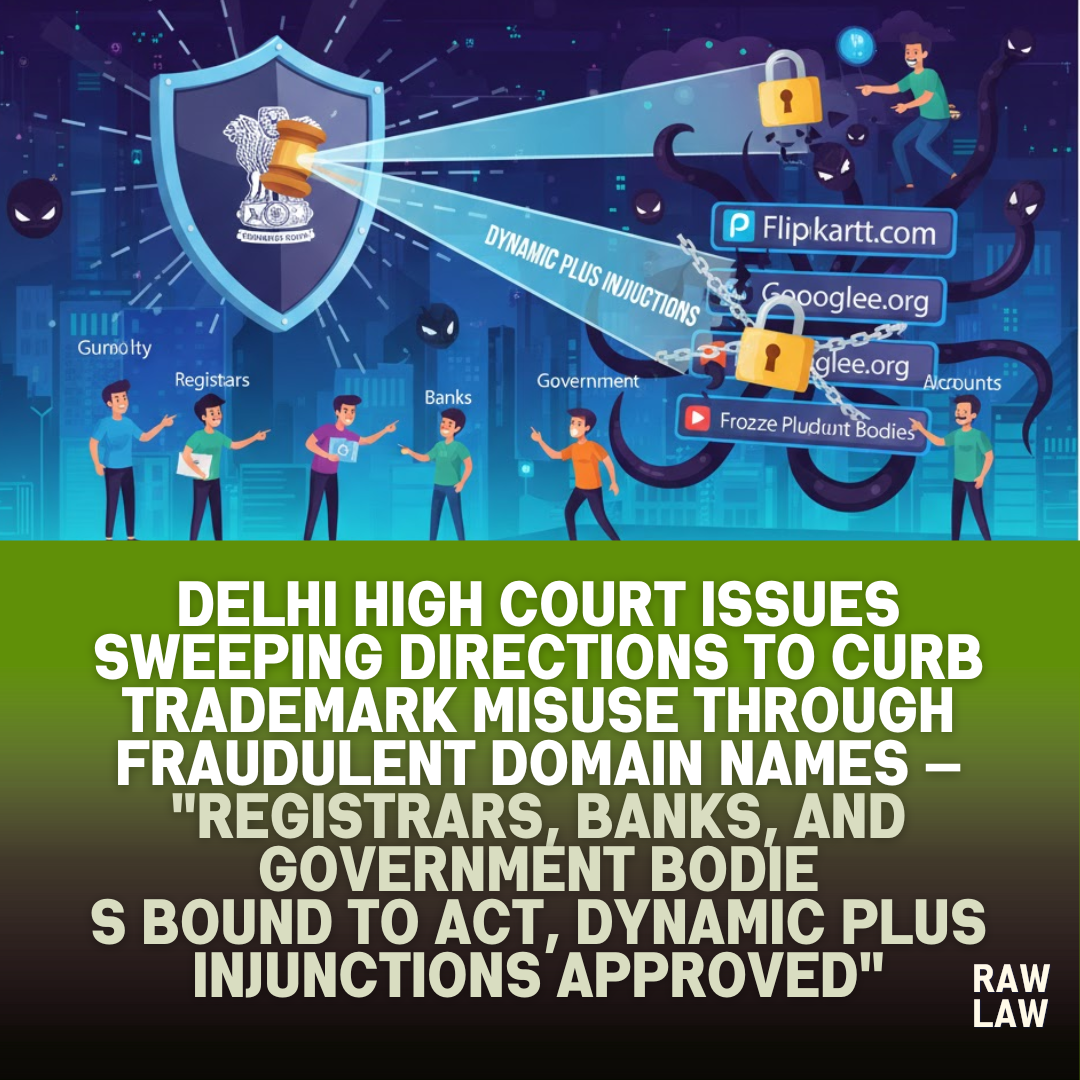
Delhi High Court issues sweeping directions to curb trademark misuse through fraudulent domain names — “Registrars, banks, and government bodies bound to act, dynamic plus injunctions approved”

Headnote
Trade Marks Act, 1999 – Domain name infringement – Fraudulent websites – Cyber fraud – Passing off – Domain Name Registrars – Intermediary obligations – Safe harbour – Dynamic and Dynamic Plus injunctions – Role of banks and law enforcement agencies.
Held, rampant misuse of well-known trademarks through fraudulent domain names and deceptive websites constitutes not merely trademark infringement and passing off, but a large-scale organised cyber fraud affecting unsuspecting members of the public. Domain names form the “online soul” of a business, and unauthorised registration of domains incorporating registered or well-known trademarks undermines brand goodwill, consumer trust, and public safety. Domain Name Registrars, while intermediaries, cannot adopt a passive or mechanical role and are bound by due diligence obligations to prevent abuse of their systems. Privacy-protect and proxy services cannot be allowed to shield fraudsters. Courts are empowered to issue dynamic and dynamic plus injunctions to prevent repeated registration of infringing domain names and to direct registrars, registry operators, banks, and government authorities to implement systemic safeguards. Comprehensive directions were issued to Domain Name Registrars, banks, RBI, MeitY, law enforcement agencies, and other stakeholders to strengthen verification mechanisms, ensure swift freezing of fraudulent accounts, and protect trademark owners and consumers from escalating cyber-enabled fraud.
Court’s decision
The Delhi High Court, in a batch of commercial suits led by a trademark infringement action concerning misuse of the well-known “COLGATE” mark, delivered a landmark judgment addressing systemic abuse of trademarks through fraudulent domain names. The Court permanently injuncted the infringing domain names, upheld the grant of dynamic and dynamic plus injunctions, and issued extensive binding directions to Domain Name Registrars, registry operators, banks, government departments, and law enforcement agencies to curb online financial fraud and trademark misuse.
Facts
The lead suit was instituted by global and Indian entities of a well-known oral care brand whose trademarks enjoy extensive goodwill and recognition. Unknown persons had registered multiple domain names incorporating the plaintiffs’ trademarks and brand identifiers. These domains were used to host fake websites and send fraudulent emails impersonating the plaintiffs’ human resources department, offering fictitious job interviews, dealerships, and business opportunities.
Victims were induced to deposit money into bank accounts falsely represented as belonging to the plaintiffs. The registrants’ identities were masked using privacy-protect services, fictitious contact details, temporary email addresses, and forged identity documents. Even when interim injunctions were granted and accounts frozen, fresh infringing domain names were repeatedly registered, demonstrating an organised and recurring modus operandi.
Given the scale and recurrence of fraud, the Court clubbed multiple similar suits filed by different trademark owners to examine systemic issues transcending individual disputes.
Issues
The Court framed wide-ranging issues, including the obligations of Domain Name Registrars in preventing misuse of trademarks, adequacy of existing verification mechanisms, legality of privacy-protect services in cases of fraud, enforceability of court orders against registrars, scope of dynamic and dynamic plus injunctions, and the role of banks, regulators, and law enforcement agencies in preventing and investigating cyber-enabled financial fraud.
Plaintiffs’ arguments
The plaintiffs contended that domain names are integral to brand identity and that fraudulent registration of domains incorporating well-known trademarks enables large-scale deception. It was argued that existing remedies such as UDRP were inadequate to deal with rapid, repeated registrations. The plaintiffs sought robust injunctive relief, disclosure of registrant information, blocking of infringing domains, freezing of linked bank accounts, and systemic reforms involving registrars, banks, and government bodies. They emphasised that without court-mandated safeguards, brand owners and consumers would remain vulnerable.
Defendants’ arguments
Domain Name Registrars and registry operators argued that they function merely as intermediaries with limited obligations and claimed protection under safe harbour principles. They resisted blanket injunctions, contending that not every domain containing a trademark string is infringing. Banks and payment intermediaries highlighted operational and regulatory constraints, while government departments urged judicial restraint in policy matters.
Analysis of the law
The Court undertook an exhaustive analysis of the Domain Name System, contractual frameworks governing registrars, intermediary liability, trademark rights in domain names, and the intersection of intellectual property law with cybercrime regulation. It held that while registrars are intermediaries, they are not absolved of responsibility when their platforms are repeatedly misused for fraud. Privacy-protect services cannot override court orders or due diligence obligations.
The Court recognised that traditional injunctions are ineffective against serial domain registrations and affirmed the necessity of dynamic and dynamic plus injunctions to prevent infringing domains from re-entering the common pool for re-registration.
Precedent analysis
The Court relied on prior Delhi High Court jurisprudence recognising domain names as protectable identifiers and approving dynamic injunctions in intellectual property disputes. It also drew from Supreme Court precedent on intermediary due diligence, consumer protection, and evolving remedies in the digital environment, while distinguishing cases where blanket injunctions were impermissible.
Court’s reasoning
The Court found that fraudulent domain registrations constitute a sophisticated cybercrime ecosystem involving registrars, hosting services, payment systems, and identity misuse. Passive compliance after harm has occurred was held insufficient. The Court emphasised that judicial remedies must evolve to meet technological realities and protect both trademark owners and the public.
Balancing trademark protection, intermediary obligations, and public interest, the Court crafted tailored directions rather than indiscriminate prohibitions, ensuring proportionality and enforceability.
Conclusion
The Delhi High Court decreed the suits in favour of the plaintiffs, confirmed permanent injunctions against infringing domain names, and upheld the legality of dynamic and dynamic plus injunctions. The Court issued comprehensive directions to Domain Name Registrars, registry operators, banks, RBI, MeitY, and law enforcement agencies to strengthen verification, disclosure, enforcement, and coordination mechanisms.
Implications
This judgment marks a watershed in Indian cyber and intellectual property jurisprudence. It elevates domain name fraud from a private trademark dispute to a systemic public law concern, mandates accountability across digital intermediaries, and significantly strengthens remedies available to brand owners. The ruling is expected to reshape registrar practices, banking responses to cyber fraud, and enforcement strategies nationwide.
Case-law references
- Snapdeal Pvt. Ltd. v. GoDaddy.com LLC – Limits on blanket domain injunctions.
- Sony Interactive Entertainment v. Vikash Kumar – Approval of targeted domain blocking.
- Fashnear Technologies Pvt. Ltd. v. Meesho Online Shopping Pvt. Ltd. – Consolidated approach to domain name fraud.
FAQs
1. What is a dynamic plus injunction?
It prevents infringing domain names from re-entering the common pool and being re-registered after suspension or expiry.
2. Are Domain Name Registrars liable for fraudulent domains?
While intermediaries, they have due diligence obligations and must comply with court directions to prevent abuse.
3. Why is this judgment significant for consumers?
It targets the infrastructure enabling online fraud, improving protection for unsuspecting victims.