

Court’s decision
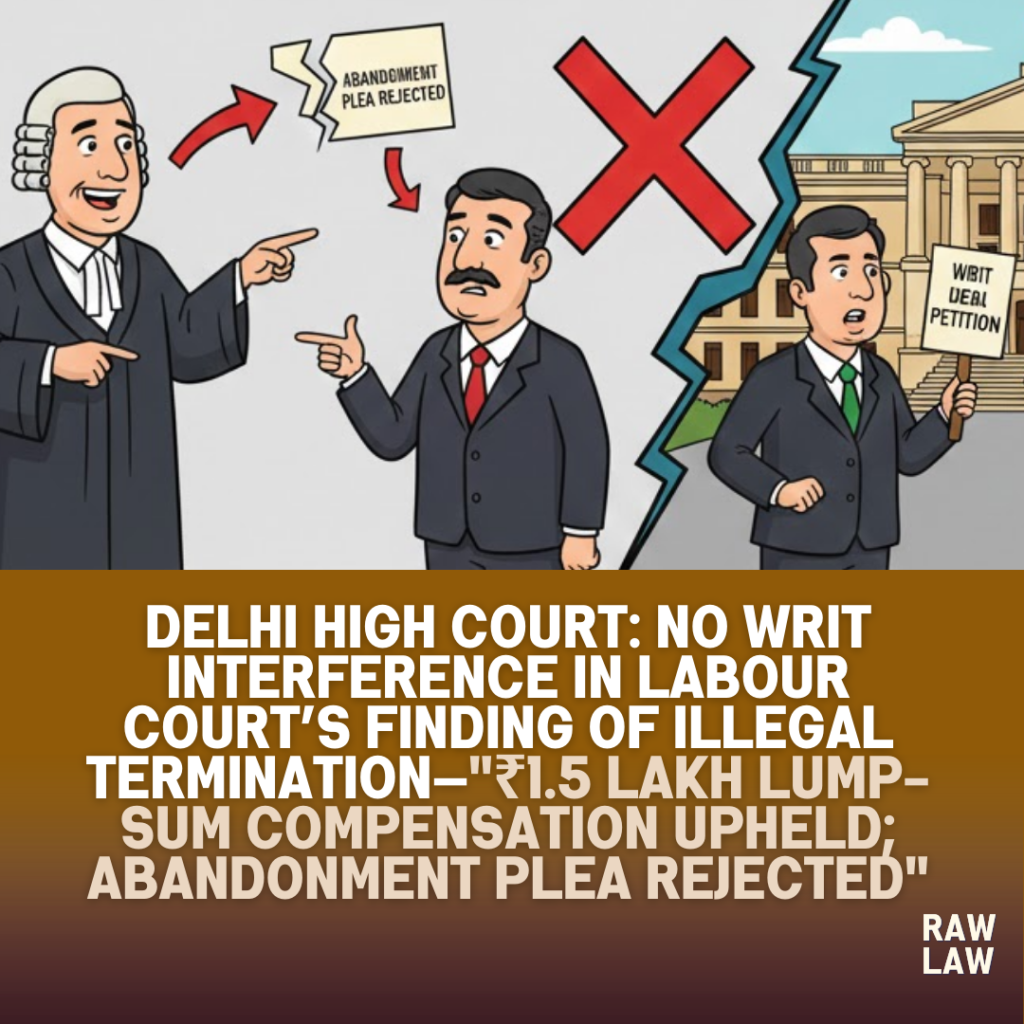
The Delhi High Court dismissed a writ petition filed by Precision Scientific and Testing Equipment Pvt. Ltd. challenging a Labour Court award directing payment of ₹1,50,000 as lump-sum compensation to a terminated workman for violation of Section 25F of the Industrial Disputes Act, 1947. The Court held that the Labour Court’s findings were based on evidence, including categorical admission by the management’s director that services were terminated. It ruled that under Article 226, findings of fact cannot be reappreciated unless perverse or unsupported by evidence. The award was upheld.
Facts
The petitioner company, engaged in manufacturing testing machines and laboratory equipment, ceased operations from 1 April 2023. The respondent was a former employee who raised an industrial dispute alleging illegal termination.
The Labour Court-IV, Rouse Avenue Courts, adjudicated the reference under Sections 10(1)(c) and 12(5) of the Industrial Disputes Act and held that termination violated Section 25F. Instead of reinstatement, the Court awarded ₹1,50,000 as lump-sum compensation.
The management approached the High Court under Article 226 contending that the award was perverse, arbitrary, and unsupported by evidence.
Issues
- Whether the Labour Court’s finding of illegal termination was perverse or unsupported by evidence.
- Whether the respondent had abandoned service rather than being terminated.
- Whether award of ₹1,50,000 lump-sum compensation in lieu of reinstatement and back wages was arbitrary.
- Scope of judicial review under Article 226 in labour adjudication.
Petitioner’s arguments
The management argued that the workman had abandoned employment voluntarily and was not terminated. It contended that compensation was arbitrarily awarded without rational computation. It further relied on cross-examination wherein the workman admitted to earning intermittently as a daily wager post-termination.
It was also argued that reinstatement had been offered at another unit in Manesar, Haryana, but the workman declined the offer. The petitioner claimed that the Labour Court failed to appreciate this aspect and that the award violated Section 11 of the Industrial Disputes Act.
Respondent’s position
The workman maintained that he was illegally terminated without compliance with Section 25F, which mandates notice and retrenchment compensation. He denied abandoning service and asserted that no show-cause notice or termination letter was ever issued.
He further contended that the alleged offer of reinstatement at Manesar was never disclosed in pleadings and pertained to a separate proprietorship firm of a director’s mother, not the petitioner company.
Analysis of the law
The High Court reiterated settled principles limiting writ interference with factual findings of labour tribunals. Relying on Indian Overseas Bank v. I.O.B. Staff Canteen Workers’ Union, Syed Yakoob v. K.S. Radhakrishnan, and Management of Madurantakam Coop. Sugar Mills Ltd. v. S. Viswanathan, the Court held that it cannot reappreciate evidence or substitute its own findings unless the award is perverse or based on no evidence.
The Court noted that the management’s director admitted termination during cross-examination. No show-cause notice, termination letter, or documentary evidence of abandonment was produced.
Under settled law, even in cases of alleged absenteeism, the employer must demonstrate efforts to call upon the employee to resume duty. No such evidence was placed on record.
Precedent analysis
The Court relied upon established jurisprudence on writ scope, including:
- Indian Overseas Bank v. I.O.B. Staff Canteen Workers’ Union (2000) 4 SCC 245
- Syed Yakoob v. K.S. Radhakrishnan (AIR 1964 SC 477)
- Hari Vishnu Kamath v. Ahmed Ishaque (AIR 1955 SC 233)
- State of Haryana v. Devi Dutt (2006) 13 SCC 32
On compensation, reliance was placed on Maharashtra State Road Transport Corporation v. Mahadeo Krishna Naik (2025) 4 SCC 321, which clarified that lump-sum compensation may be granted in lieu of reinstatement depending on circumstances.
Court’s reasoning
The Court found that the Labour Court’s finding of illegal termination was supported by evidence, particularly the categorical admission by the management’s witness. The plea of abandonment was unsupported by documentary material.
Regarding reinstatement at Manesar, the Court observed that such an offer was neither pleaded nor substantiated and concerned a different entity. The Labour Court rightly rejected it.
On compensation, the High Court held that since the workman admitted intermittent daily wage earnings, full back wages were not granted. Instead, a balanced lump-sum compensation was awarded, which was neither disproportionate nor perverse.
Violation of Section 25F rendered termination void ab initio. The relief granted was within judicial discretion.
Conclusion
The writ petition was dismissed. The award directing payment of ₹1,50,000 lump-sum compensation to the workman was upheld. Pending applications were disposed of.
Implications
This ruling reinforces the limited scope of judicial review over labour tribunal findings. It affirms that abandonment must be strictly proved and cannot be presumed without documentary evidence.
The judgment also clarifies that lump-sum compensation may be preferred over reinstatement, particularly where the employer has shut down operations.
Employers must strictly comply with Section 25F; failure to issue notice or retrenchment compensation renders termination illegal.
Case Law References
- Indian Overseas Bank v. I.O.B. Staff Canteen Workers’ Union (2000) 4 SCC 245
- Syed Yakoob v. K.S. Radhakrishnan (AIR 1964 SC 477)
- State of Haryana v. Devi Dutt (2006) 13 SCC 32
- Maharashtra State Road Transport Corporation v. Mahadeo Krishna Naik (2025) 4 SCC 321
FAQs
1. Can High Courts reappreciate evidence in labour awards under Article 226?
No. High Courts exercise supervisory jurisdiction and interfere only if findings are perverse or unsupported by evidence.
2. Is compliance with Section 25F mandatory before termination?
Yes. Failure to issue notice and pay retrenchment compensation renders termination illegal.
3. Can lump-sum compensation be awarded instead of reinstatement?
Yes. Courts may grant lump-sum compensation depending on facts such as closure of establishment or intermittent employment of the workman.


