Delhi High Court Upholds ₹15.16 Crore Interest on NITCO Customs Settlement; Holds Settled Show-Cause Notice Cannot Be Reopened Indirectly on Limitation Grounds Later

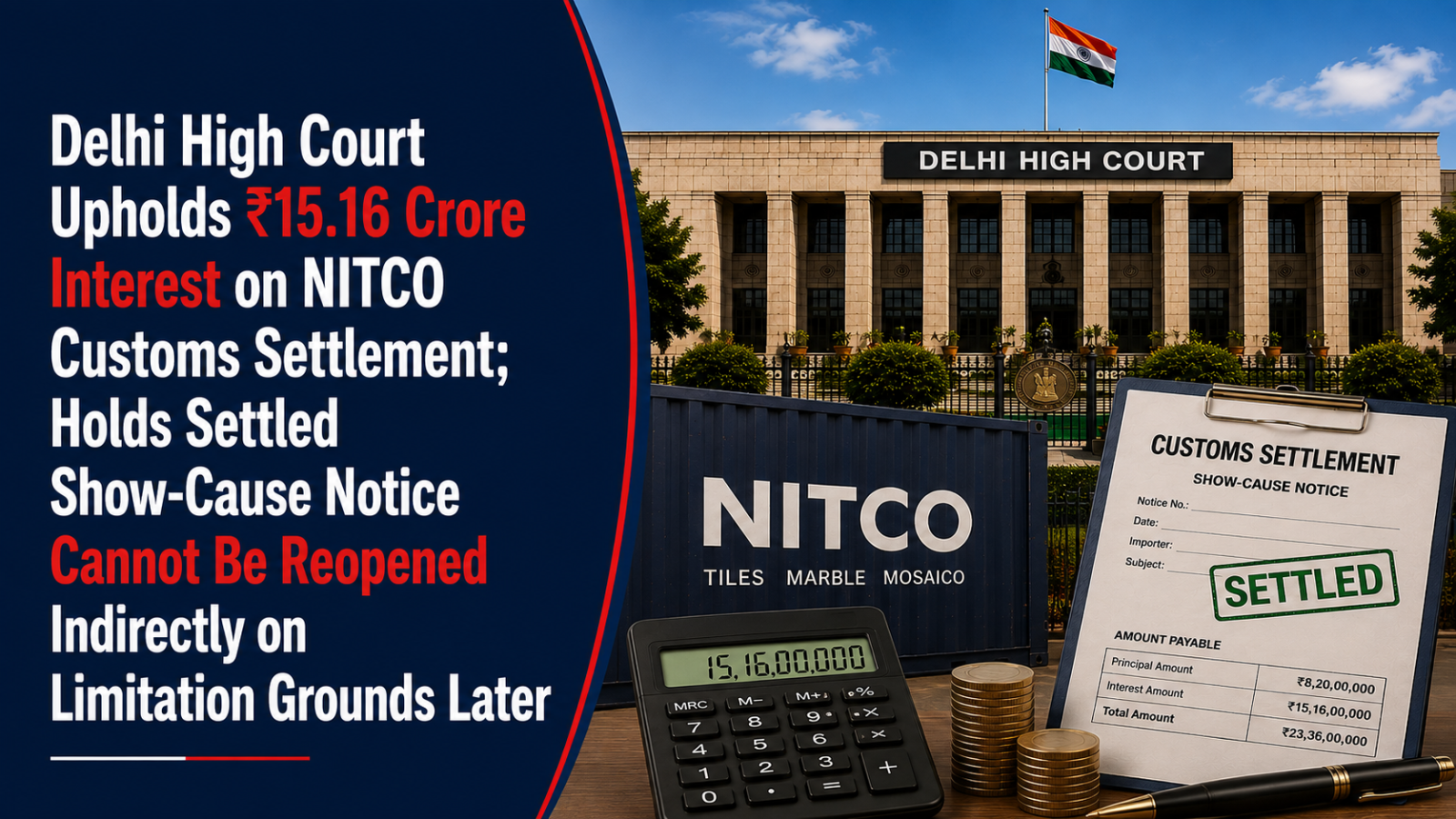
Delhi High Court Rejects NITCO’s Challenge to ₹15.16 Crore Customs Interest; Holds Settled Show-Cause Notice Cannot Later Be Reopened on Limitation Grounds
Facts
The petitioners, M/s NITCO Ltd. and another, approached the Delhi High Court under Article 226 challenging a limited portion—Clause (e) of paragraph 51(ii)—of the Customs, Central Excise & Service Tax Settlement Commission’s order dated 14 November 2019. The controversy was confined to their liability to pay interest pursuant to the settlement order.
The dispute had its origins in investigations by the Directorate of Revenue Intelligence against NITCO concerning various alleged customs violations, including evasion of customs/anti-dumping duty on tiles imported from China, alleged misdeclaration concerning marble imports and alleged misuse of the Export Promotion Capital Goods (EPCG) Scheme.
In relation to EPCG authorisations, DRI investigated allegations that NITCO had improperly availed concessional customs duty benefits and attempted to obtain export obligation discharge certificates on the basis of allegedly non-existent exports. Nine EPCG authorisations issued from Mumbai were cancelled ab initio by DGFT Mumbai.
The dispute presently before the Court concerned the remaining EPCG authorisation issued by DGFT, New Delhi, involving alleged customs duty of approximately ₹10.30 crore. After further investigation, DRI issued a show-cause notice dated 18 June 2018, demanding customs duty of ₹10,29,81,146 along with interest.
The Commissioner of Customs (Export), Mumbai Customs Zone-I adjudicated the show-cause notice on 13 March 2019. Instead of challenging that adjudication through the ordinary appellate mechanism, NITCO approached the Settlement Commission seeking settlement of the dispute.
On 14 November 2019, the Settlement Commission determined the customs duty liability at ₹6,69,57,333. After giving credit for ₹1,41,49,366 already paid, the balance duty payable was fixed at ₹5,28,07,967.
NITCO itself had calculated the interest payable at ₹1,10,04,634. The Settlement Commission, however, did not accept this figure as final. It directed the jurisdictional Commissioner to verify and quantify the actual interest payable and inform NITCO if any additional amount remained due.
The jurisdictional Commissioner thereafter recalculated the interest at ₹15,16,65,821 and communicated the amount to NITCO on 2 January 2020.
NITCO consequently filed the present writ petition challenging the Settlement Commission’s direction and the resultant interest demand.
Issues
The principal issues before the High Court were:
- Whether NITCO, after voluntarily approaching the Settlement Commission and obtaining settlement of the customs proceedings, could subsequently challenge the underlying 2018 show-cause notice as time-barred.
- Whether Clause (e) of paragraph 51(ii) directing the jurisdictional Commissioner to verify and quantify interest could be separated from the remaining settlement order and challenged independently.
- Whether the Settlement Commission’s order could be interfered with under Article 226 on the ground that the eventual interest quantified at ₹15.16 crore substantially exceeded NITCO’s own calculation of ₹1.10 crore.
- What is the permissible scope of judicial review over orders of the Settlement Commission.
- Whether statutory interest survives and remains payable after the underlying customs duty liability has been settled.
Petitioner’s Arguments
NITCO principally argued that the show-cause notice dated 18 June 2018 itself had been issued beyond the limitation period prescribed under Section 28 of the Customs Act, 1962.
It submitted that the Settlement Commission’s earlier order dated 30 June 2014 had permitted DRI to issue a show-cause notice only within the statutory period.
According to NITCO, the “relevant date” under Explanation 1(d) to Section 28 should be:
- 6 November 2006, when the customs duty was paid; or alternatively
- 2009, when the alleged short-payment and fraud came to the knowledge of DRI.
On either calculation, according to the petitioners, the 2018 show-cause notice was beyond the five-year limitation period contemplated under Section 28(4).
In the alternative, NITCO submitted that even where a statute prescribes no specific limitation period, a statutory authority must exercise its powers within a reasonable period.
NITCO further objected to the increase in interest from its calculation of approximately ₹1.10 crore to the Commissioner’s determination of approximately ₹15.16 crore.
Respondent’s Arguments
The respondent argued that the Settlement Commission’s order was conclusive under Section 127J of the Customs Act.
It emphasised that NITCO had voluntarily elected to invoke the Settlement Commission’s jurisdiction instead of pursuing ordinary adjudicatory or appellate remedies.
Having consciously selected settlement and obtained a settlement order, NITCO could not subsequently challenge the same underlying show-cause notice which formed the foundation of the settlement proceedings.
In substance, the respondent argued that NITCO could not accept the favourable portions of the settlement while attempting to isolate and challenge the consequential direction concerning interest.
Analysis of the Law
1. Judicial review of Settlement Commission orders is extremely limited
The Court began by examining the permissible scope of interference under Article 226 with orders passed by the Settlement Commission.
Relying upon the Supreme Court’s decisions, the Court held that although the High Court’s constitutional jurisdiction is wide, a Settlement Commission order cannot be interfered with merely because another conclusion may have been possible.
Judicial review is generally confined to recognised defects such as:
- violation of statutory provisions;
- jurisdictional infirmity;
- legally recognised prejudice;
- fraud;
- bias; or
- malice.
The High Court cannot reassess the material before the Settlement Commission or substitute its own opinion for the Commission’s conclusions.
2. A writ court cannot act as an appellate court over the Settlement Commission
The Court emphasised the Supreme Court’s warning that High Courts should not scrutinise Settlement Commission proceedings as though exercising appellate jurisdiction.
Frequent interference with reasoned settlement orders would undermine the statutory settlement mechanism and encourage further litigation instead of finality.
Therefore, the question was not whether the High Court might independently have reached another conclusion, but whether the Settlement Commission’s direction suffered from one of the limited defects recognised in judicial review.
3. NITCO consciously chose settlement instead of statutory appeal
This consideration was decisive.
The 2018 show-cause notice had already been adjudicated by the Commissioner of Customs on 13 March 2019.
NITCO did not challenge that adjudication through the statutory appellate remedy. Instead, it consciously approached the Settlement Commission and sought settlement of the proceedings arising from that very show-cause notice.
Having chosen settlement and obtained an order determining its liability, NITCO could not subsequently invoke Article 226 to reopen the validity of the very show-cause notice it had voluntarily placed before the Settlement Commission.
4. Interest direction cannot be isolated to reopen the settled dispute
The Court rejected NITCO’s attempt to challenge only Clause (e) relating to interest.
It held that NITCO could not isolate the consequential direction concerning interest and use that challenge as a vehicle to reopen the limitation or validity of the underlying show-cause notice.
The settlement proceedings had to be viewed as a whole.
Importantly, however, the Court drew a distinction between:
(a) challenging the validity of the underlying show-cause notice; and
(b) challenging whether the Commissioner had correctly calculated the quantum of interest under the relevant statutory provisions.
The second issue was conceptually distinct and could be examined independently if otherwise maintainable.
5. Limitation challenge could not be revived after settlement
NITCO argued that the five-year limitation should run from either 2006 or 2009.
The Court declined to adjudicate that contention because doing so would necessarily require it to examine whether the 2018 show-cause notice was valid.
That notice had already been adjudicated and thereafter voluntarily submitted by NITCO to the Settlement Commission.
Allowing the limitation argument at this stage would effectively convert the writ proceedings into an appellate examination of proceedings which had already culminated in settlement.
The Court similarly rejected the argument that the notice was issued beyond a “reasonable period,” since that argument again attacked the initiation of the original proceedings rather than demonstrating any defect in the Settlement Commission’s order.
6. NITCO’s ₹1.10 crore interest calculation was never accepted as final
A critical factual aspect was that NITCO itself had placed before the Settlement Commission an interest calculation of ₹1,10,04,634.
However, the Settlement Commission did not accept that figure as finally determining NITCO’s liability.
Instead, it specifically directed the jurisdictional Commissioner to independently verify and quantify the interest and communicate any additional amount payable.
Therefore, the subsequent figure of ₹15.16 crore did not contradict a final interest determination already made by the Settlement Commission.
7. Statutory interest survives settlement of customs duty
The High Court laid down an important principle:
Liability to pay interest is a statutory consequence of the liability to pay customs duty and does not disappear merely because the quantum of customs duty has been settled by the Settlement Commission.
Accordingly, settlement of the principal duty did not extinguish statutory interest.
The fact that the Commissioner ultimately calculated interest at ₹15.16 crore—substantially higher than NITCO’s own calculation—was not by itself sufficient to invalidate the Settlement Commission’s direction.
The Court found no infirmity in directing the jurisdictional Commissioner to undertake the statutory calculation.
Precedent Analysis
Jyotendrasinhji v. S.I. Tripathi
The Supreme Court decision in Jyotendrasinhji v. S.I. Tripathi, 1993 Supp (3) SCC 389 formed the principal basis for defining the scope of judicial review.
The precedent establishes that orders of the Settlement Commission passed in exercise of statutory discretion ordinarily cannot be interfered with merely because another view is possible.
Interference is confined to narrow grounds such as contravention of the governing statute, legally recognised prejudice, fraud, bias or malice.
The Delhi High Court applied this principle and found no such defect in the Settlement Commission’s order.
Kotak Mahindra Bank Ltd. v. Commissioner of Income Tax
The Court also relied heavily upon the Supreme Court’s decision in Kotak Mahindra Bank Ltd. v. Commissioner of Income Tax, Bangalore & Ors.
The Supreme Court had reaffirmed Jyotendrasinhji and held that the sufficiency of material placed before a Settlement Commission and the conclusions reached on that material ordinarily fall outside judicial review.
Of particular importance was the Supreme Court’s caution that High Courts should not examine Settlement Commission orders as appellate courts and that frequent interference with settlement proceedings should be avoided.
The Delhi High Court applied this principle to reject NITCO’s attempt to revive its limitation challenge to the underlying show-cause notice.
Court’s Reasoning
The Court’s reasoning proceeded on the principle of finality attached to a consciously chosen statutory settlement mechanism.
NITCO had a statutory appellate remedy against the Commissioner’s adjudication of the 2018 show-cause notice. It chose not to pursue that remedy.
Instead, it voluntarily invoked the Settlement Commission’s jurisdiction and obtained settlement of the customs liability.
Once that choice was made, NITCO could not use a writ petition challenging the consequential interest direction to indirectly reopen the validity of the underlying show-cause notice.
The Court further found that the Settlement Commission never fixed ₹1.10 crore as NITCO’s final interest liability. That figure was merely NITCO’s own computation. The Commission specifically directed the jurisdictional Commissioner to verify and quantify the correct statutory interest.
The subsequent calculation of ₹15.16 crore was therefore traceable to the Settlement Commission’s direction and did not amount to reopening the settled customs duty liability.
Finally, NITCO failed to demonstrate that the Settlement Commission’s direction violated any provision of the Customs Act, exceeded its jurisdiction, or caused the type of prejudice recognised by Supreme Court precedent as sufficient to justify judicial review.
Conclusion
The Delhi High Court dismissed the writ petition.
It held that NITCO could not challenge the 2018 show-cause notice on limitation grounds after consciously choosing to have the dispute settled by the Settlement Commission.
The Court found no infirmity in the Settlement Commission’s direction requiring the jurisdictional Commissioner to verify and quantify statutory interest.
It further held that statutory interest does not disappear merely because the underlying customs duty liability has been settled.
Accordingly, the Court refused to interfere with the Settlement Commission’s order dated 14 November 2019 and dismissed the writ petition along with the pending application.
Case Details
Case: M/s NITCO Ltd. & Anr. v. Customs, Central Excise and Service Tax Settlement Commission
Court: High Court of Delhi at New Delhi
Case Number: W.P.(C) 976/2020 & CM APPL. 3160/2020; CNR No. DLHC010100452020
Judges: Justice Anil Kshetrapal and Justice Harish Vaidyanathan Shankar
Date: 21 August 2026
Result: Writ petition dismissed; Settlement Commission’s direction for quantification of interest upheld, and challenge to underlying show-cause notice on limitation grounds not permitted.