Delhi High Court upholds conviction for digital rape of mother by son — victim’s testimony sufficient, medical corroboration not mandatory; appeal dismissed

Court’s decision
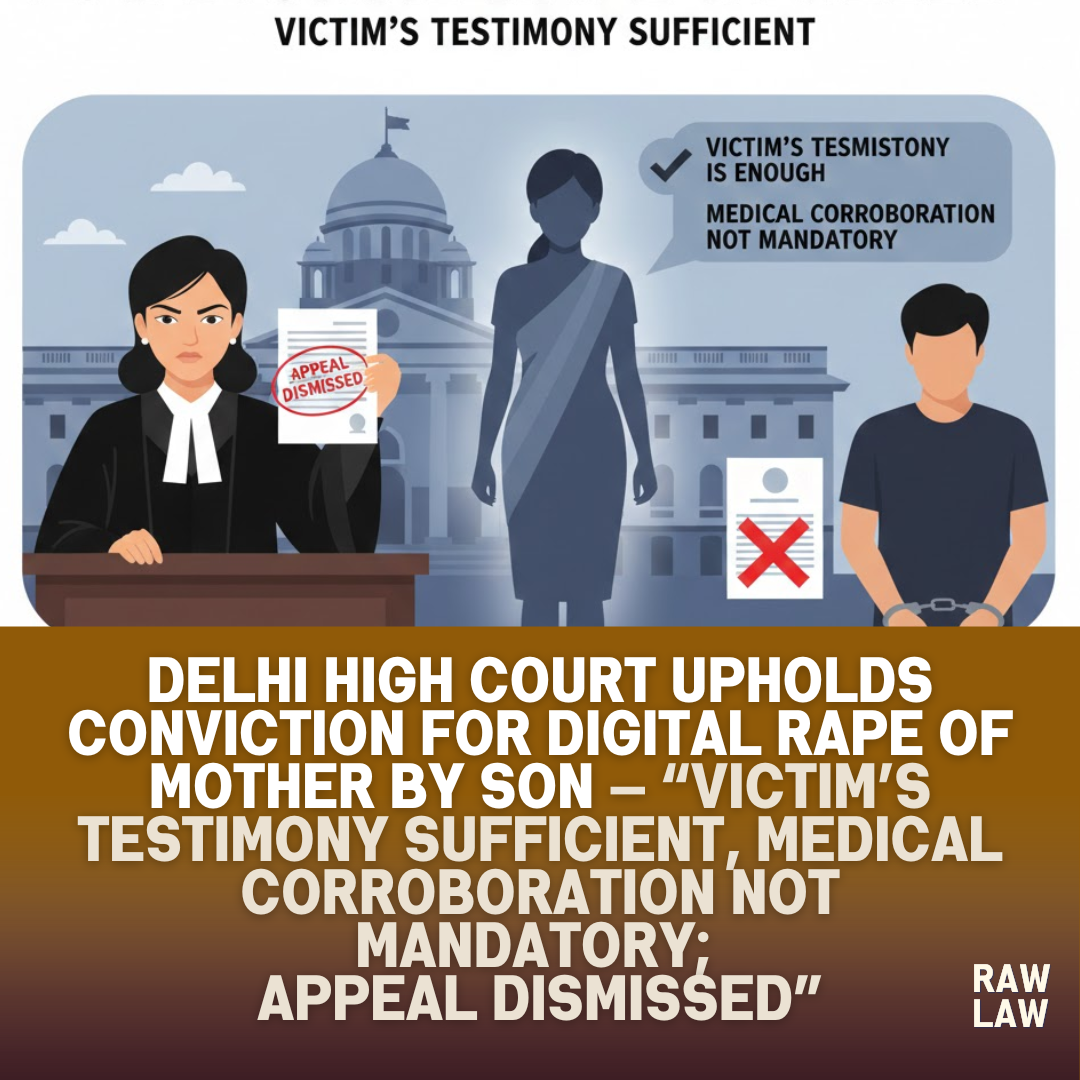
The Delhi High Court dismissed a criminal appeal and affirmed the conviction and sentence of a man for committing digital rape on his own mother, holding that the consistent and credible testimony of the victim, duly supported by immediate neighbour witnesses, was sufficient to sustain conviction under rape law even in the absence of medical corroboration or seizure of clothing. The Court ruled that digital penetration squarely falls within the definition of rape and that courts must adopt a realistic and sensitive approach while assessing evidence in sexual assault cases.
Court’s decision
The Court upheld the trial court’s judgment convicting the appellant for the offence punishable under Section 376(2)(f) of the Indian Penal Code and the sentence of ten years’ rigorous imprisonment with fine. It rejected arguments of physical impossibility, absence of injuries, and non-seizure of garments, holding that none of these factors discredited the unimpeached testimony of the prosecutrix. Finding no perversity or legal infirmity, the appeal was dismissed in its entirety.
Facts
The prosecution case was that in March 2021, the accused, while heavily intoxicated, entered the room of his mother, forcibly undressed her, and digitally penetrated her vagina multiple times. When the victim managed to create an opportunity by asking for water, she opened the door and cried for help. Neighbours rushed in and rescued her while the accused attempted to pull her back inside the room. The police were informed and an FIR was registered the same day. After investigation, the accused was chargesheeted and tried for rape. The trial court convicted him and imposed a sentence of ten years’ rigorous imprisonment.
Issues
The primary issue before the High Court was whether the conviction for rape could be sustained in the absence of medical evidence of penetration, internal examination, or seizure of the victim’s saree or undergarments. The Court also examined whether the incident, as narrated by the victim, was physically improbable and whether, at best, the facts disclosed only an offence of outraging modesty rather than rape.
Appellant’s arguments
The accused contended that the allegation of forcible removal of saree and digital penetration was contrary to human probability, particularly because neighbours arrived almost immediately and found the victim clothed. It was argued that a saree is a complex garment and could not have been removed and re-draped so quickly. The defence stressed that there were no injuries on the victim’s genitalia, she had refused internal medical examination, and no clothing was seized, all of which undermined the prosecution case. Relying on multiple precedents, the appellant argued that in the absence of proof of penetration, conviction under Section 376 was unsustainable and the case, if at all, fell under Section 354 IPC.
Respondent’s arguments
The State opposed the appeal, submitting that the testimony of the victim was consistent from the FIR to her deposition before the court. It was argued that the victim had no conceivable reason to falsely implicate her own son and that her testimony was corroborated by neighbours who witnessed her being dragged and heard her cries for help. The prosecution contended that digital penetration constitutes rape and that medical evidence is only corroborative. The absence of injuries or seizure of garments, it was submitted, does not negate a credible ocular account of sexual assault.
Analysis of the law
The Court analysed the law governing proof of rape, reiterating that penetration, however slight, satisfies the statutory requirement and that digital penetration is expressly covered. It emphasised that there is no rule of law requiring medical corroboration in every case of rape. The testimony of the prosecutrix stands on a high pedestal, akin to that of an injured witness, and can form the sole basis of conviction if it inspires confidence. The Court cautioned against applying rigid notions of “human probability” divorced from lived realities, especially in cases involving sexual violence within domestic spaces.
Precedent analysis
The Court distinguished a series of judgments relied upon by the defence where convictions were set aside due to vague testimony, material contradictions, or complete absence of evidence of penetration. In contrast, the present case involved a clear, specific, and consistent assertion of digital penetration, supported by immediate disclosure and neighbour testimony. The Court relied on settled Supreme Court jurisprudence holding that absence of medical injuries or refusal of internal examination does not discredit an otherwise reliable victim’s account.
Court’s reasoning
The Court found the testimony of the victim to be unwavering and natural, noting that no contradictions were proved in accordance with law. It rejected the argument that the incident was physically impossible, holding that the victim need not be found naked for sexual assault to have occurred. The Court also rejected the contention that non-seizure of saree or undergarments was fatal, observing that the prosecution never alleged tearing or ejaculation. Given the familial relationship, the Court held that false implication was highly improbable. The cumulative evidence clearly established digital rape beyond reasonable doubt.
Conclusion
Dismissing the appeal, the Delhi High Court upheld the conviction and sentence imposed by the trial court. It held that the prosecution had successfully proved the charge of rape through credible ocular evidence and that no interference was warranted. The Court ordered that all pending applications also stand disposed of.
Implications
This judgment reinforces the principle that the testimony of a sexual assault survivor, if credible and consistent, does not require medical corroboration to sustain a conviction. It affirms that digital penetration constitutes rape and clarifies that courts must not import unrealistic expectations of resistance, injury, or disrobing. The ruling is significant in addressing sexual violence within the family, underscoring that the law will not dilute accountability merely because the offence occurred in a domestic setting.
Case law references
- Proof of rape: Penetration, however slight, including digital penetration, constitutes rape. Applied to uphold conviction.
- Role of medical evidence: Medical evidence is corroborative and not mandatory where ocular testimony is reliable. Applied to reject defence arguments.
- Credibility of prosecutrix: Testimony of the victim can be sole basis of conviction if consistent and trustworthy. Applied to affirm trial court findings.
FAQs
1. Is medical evidence mandatory to prove rape?
No. Courts have repeatedly held that credible testimony of the victim is sufficient even without medical corroboration.
2. Does digital penetration amount to rape under Indian law?
Yes. Digital penetration clearly falls within the statutory definition of rape.
3. Can conviction be sustained without seizure of clothes?
Yes. Non-seizure of clothing is not fatal if the prosecution case does not hinge on torn garments or forensic traces.