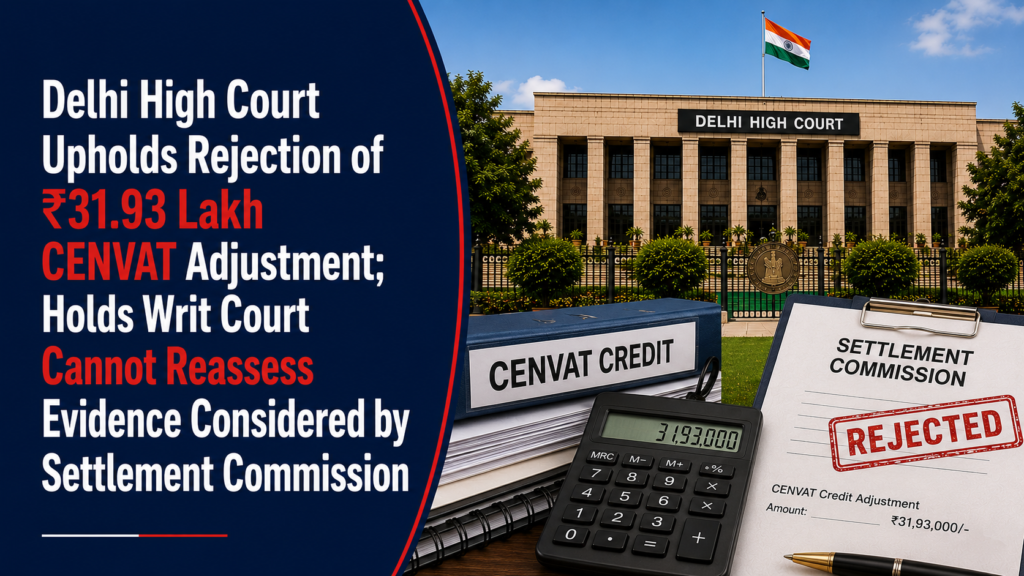
Delhi High Court Upholds Rejection of ₹31.93 Lakh CENVAT Adjustment; Holds Writ Court Cannot Reassess Evidence Considered by Settlement Commission

Delhi High Court Rejects Jindal Lifestyle’s ₹31.93 Lakh CENVAT Adjustment Claim; Holds Settlement Commission’s Evidence Assessment Cannot Be Reopened in Writ Jurisdiction
Facts
The petitioner, M/s Jindal Lifestyle Ltd., challenged the final order dated 29 April 2020 passed by the Customs, Central Excise & Service Tax Settlement Commission, Principal Bench, New Delhi. The Settlement Commission had refused to grant adjustment of ₹31,93,569 claimed by the petitioner towards reversal of CENVAT credit against its excise duty liability.
The controversy related to the petitioner’s manufacturing activities between January and December 2005. During that period, it manufactured stainless-steel cladding and railings but stopped paying Central Excise duty on the belief that the activity did not amount to “manufacture.” It later accepted its duty liability and approached the Settlement Commission.
The petitioner claimed that, during January to September 2005, it had made a pro-rata reversal of CENVAT credit, and from October to December 2005 it had reversed credit at 10% of the sale price under Rule 6(3) of the CENVAT Credit Rules, 2004. The total claimed reversal was ₹31,93,569.
The petitioner had previously approached the Delhi High Court in W.P.(C) 3652/2007. By judgment dated 11 May 2010, the High Court directed the Settlement Commission to reconsider the petitioner’s claim regarding adjustment/reversal of CENVAT credit. The Court also expressly permitted the Commission to call for further information from either party if necessary.
After remand, the Settlement Commission asked the petitioner to produce additional records, including RG-23A Part II registers, input invoices and other supporting documents. The Department maintained that the petitioner failed to furnish complete records for the entire relevant period and that ER-1 returns and correlation statements alone did not sufficiently establish the claimed reversal.
The petitioner argued that the ER-1 returns, RG-23A records, sales working sheets and correlation statement already produced were sufficient. It contended that the Settlement Commission had wrongly reopened the question of admissibility of CENVAT credit instead of merely examining the reversal already directed by the High Court.
The Settlement Commission ultimately rejected the claim for adjustment of ₹31,93,569, leading to the present writ petition.
Issues
The principal issues before the High Court were:
- Whether the Settlement Commission had travelled beyond the Delhi High Court’s earlier remand directions dated 11 May 2010 by requiring additional statutory records and invoices.
- Whether the documents already produced by the petitioner sufficiently established reversal of CENVAT credit amounting to ₹31,93,569.
- Whether the High Court, exercising jurisdiction under Article 226, could reassess the evidentiary value and sufficiency of documents considered by the Settlement Commission.
- Whether the absence of an appellate remedy against the Settlement Commission’s order enlarged the scope of judicial review.
- Whether any statutory violation, jurisdictional error, fraud, bias, mala fides or legally recognised prejudice had been established to justify interference.
Petitioner’s Arguments
The petitioner argued that the Settlement Commission exceeded the High Court’s earlier directions.
According to it, the 2010 judgment required reconsideration only of whether the claimed CENVAT reversal had actually been made. It did not authorise the Settlement Commission to reopen the separate question of whether the CENVAT credit had originally been validly availed.
The petitioner further submitted that it had already produced:
- ER-1 returns;
- RG-23A Part II records;
- sales working sheets; and
- a detailed correlation statement.
According to the petitioner, these documents were sufficient to establish the reversal and the Settlement Commission failed to properly appreciate them.
It also argued that the Department had never earlier disputed the availment or reversal of CENVAT credit and could not, after more than fifteen years, compel it to prove the admissibility of the credit again.
The petitioner stressed that the relevant documents dated back to 2005 and were therefore difficult to retrieve after such a long passage of time.
Respondent’s Arguments
The respondents contended that the writ petition was essentially an attempt to obtain appellate re-appreciation of evidence.
They argued that the earlier High Court order had specifically allowed the Settlement Commission to seek further information if needed.
Accordingly, requesting registers, invoices and other documents necessary to verify the CENVAT reversal was squarely within the authority granted by the remand order.
The respondents further emphasised that the Settlement Commission is a specialised statutory forum exercising discretionary jurisdiction.
Reliance was placed on Jyotendrasinhji v. S.I. Tripathi to submit that courts cannot interfere merely because a different view of the evidence is possible.
Analysis of the Law
1. Judicial review of Settlement Commission orders is narrow
The High Court began by examining the permissible scope of judicial review over orders of the Settlement Commission.
It relied upon the Supreme Court’s decisions in Jyotendrasinhji v. S.I. Tripathi and Kotak Mahindra Bank Ltd. v. Commissioner of Income Tax.
The governing principle is that orders of the Settlement Commission, particularly those involving discretionary assessment of material, are subject to only a narrow judicial review.
Interference may be justified where the order:
- violates the governing statute;
- causes legally recognised prejudice;
- suffers from jurisdictional error;
- is affected by fraud;
- is affected by bias; or
- is affected by malice.
The High Court cannot function as an appellate court over the Settlement Commission.
2. Sufficiency of documents is for the Settlement Commission to assess
The petitioner’s core grievance was that its ER-1 returns, correlation statement and other records were sufficient to prove reversal of ₹31.93 lakh.
The High Court held that this question concerned the sufficiency, adequacy and evidentiary value of the material placed before the Settlement Commission.
Those issues fall within the Settlement Commission’s domain.
Once the Commission considered the documents and concluded that they were insufficient, the writ court could not reassess the same evidence and substitute its own conclusion.
3. Settlement Commission did not exceed the 2010 remand order
The Court rejected the petitioner’s argument that the Commission had travelled beyond the earlier High Court directions.
The 2010 judgment had expressly permitted the Settlement Commission to call for further information from either party if necessary.
Therefore, requiring statutory registers, invoices and supporting documents to verify whether the CENVAT reversal had actually been made could not be characterised as an action outside the scope of the remand.
The Court held that asking for RG-23A Part II registers and input invoices did not, by itself, show jurisdictional overreach.
Whether those documents were necessary or whether the documents already supplied were sufficient remained matters of evidentiary appreciation.
4. Earlier non-dispute over CENVAT credit did not compel allowance of adjustment
The petitioner argued that the Department had not previously disputed its availment of CENVAT credit.
The High Court held that this did not resolve the issue before the Settlement Commission.
The relevant question was whether the petitioner had sufficiently proved the claimed reversal of ₹31,93,569.
That evidentiary question was for the Settlement Commission to determine and could not be reassessed by the writ court.
5. No recognised ground for judicial interference was established
The Court noted that there was:
- no allegation of fraud;
- no allegation of bias;
- no allegation of mala fides; and
- no demonstrated violation of the Central Excise Act of the kind warranting judicial review.
At its highest, the petitioner’s grievance was that the Settlement Commission should have accepted the documents produced by it.
The Court held that such a grievance amounted to disagreement with the evidentiary conclusion, not a jurisdictional or statutory defect.
6. Absence of an appeal does not convert writ jurisdiction into appellate review
The petitioner also relied upon the fact that there was no ordinary appellate remedy against the Settlement Commission’s order.
The High Court rejected the argument that this enlarged the scope of judicial review.
While Article 226 may remain available where no appeal exists, the writ court must still respect the established limitations applicable to judicial review of specialised statutory bodies.
Thus, the absence of an appeal did not permit the Court to re-appreciate evidence.
Precedent Analysis
Jyotendrasinhji v. S.I. Tripathi
The Supreme Court decision in Jyotendrasinhji v. S.I. Tripathi, 1993 Supp (3) SCC 389 provided the foundational principle governing judicial review of Settlement Commission orders.
It establishes that constitutional courts ordinarily cannot interfere with such orders merely because another view is possible.
Intervention is confined to narrow circumstances such as statutory contravention, prejudice, fraud, bias or malice.
The Delhi High Court applied this principle directly to the petitioner’s attempt to secure a fresh assessment of its documentary evidence.
Kotak Mahindra Bank Ltd. v. Commissioner of Income Tax
The Court also relied upon Kotak Mahindra Bank Ltd. v. Commissioner of Income Tax, Bangalore & Ors.
The Supreme Court had reaffirmed Jyotendrasinhji and specifically held that questions concerning the sufficiency of material and particulars placed before a Settlement Commission normally fall beyond the scope of judicial review.
The Supreme Court further cautioned that High Courts should not scrutinise Settlement Commission orders as appellate courts, since frequent interference would undermine the finality and purpose of settlement proceedings.
The Delhi High Court found this principle directly applicable because the petitioner’s entire case effectively required the Court to reconsider whether the documents submitted before the Settlement Commission were sufficient.
Court’s Reasoning
The Court treated the controversy primarily as an evidentiary dispute rather than a jurisdictional one.
The Settlement Commission had examined the petitioner’s documents and concluded that they did not sufficiently prove the claimed CENVAT reversal.
The petitioner wanted the High Court to reach a different conclusion from the same or similar material.
The Court held that Article 226 does not permit such a substitution of views.
It further found that the Settlement Commission’s demand for additional statutory records was expressly supported by the earlier 2010 remand order, which had allowed it to seek further information.
There was therefore no breach of the remand directions.
The Settlement Commission’s order was also a reasoned order, and the question was not whether its evidentiary assessment was the best possible one, but whether it suffered from a legally reviewable defect. The High Court found none.
Conclusion
The Delhi High Court dismissed the writ petition.
It held that:
- the Settlement Commission acted within the scope of the 2010 remand directions;
- it was entitled to require additional records and invoices to verify the claimed CENVAT reversal;
- questions concerning the sufficiency and evidentiary value of documents fall within the Settlement Commission’s domain;
- Article 226 cannot be used to obtain appellate re-appreciation of those findings;
- no fraud, bias, statutory contravention or jurisdictional error was established; and
- absence of an ordinary appeal does not enlarge the scope of writ review.
Accordingly, the Court refused to interfere with the Settlement Commission’s order dated 29 April 2020 and declined the petitioner’s claim for adjustment of ₹31,93,569 against the duty demand.
Case Details
Case: M/s Jindal Lifestyle Ltd. v. Union of India & Ors.
Court: High Court of Delhi at New Delhi
Case Number: W.P.(C) 8723/2020 & CM APPL. 28099/2020; CNR No. DLHC010299932020
Judges: Justice Anil Kshetrapal and Justice Manmeet Pritam Singh Arora
Date: 21 August 2026
Result: Writ petition dismissed; Settlement Commission’s refusal to adjust ₹31,93,569 towards CENVAT credit reversal upheld