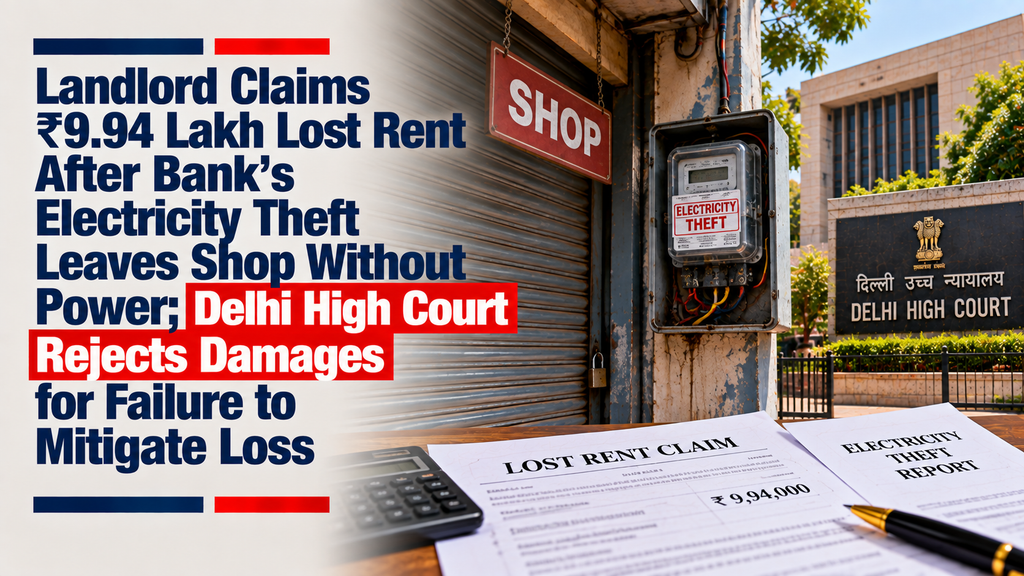
Landlord Claims ₹9.94 Lakh Lost Rent After Bank’s Electricity Theft Leaves Shop Without Power; Delhi High Court Rejects Damages for Failure to Mitigate Loss

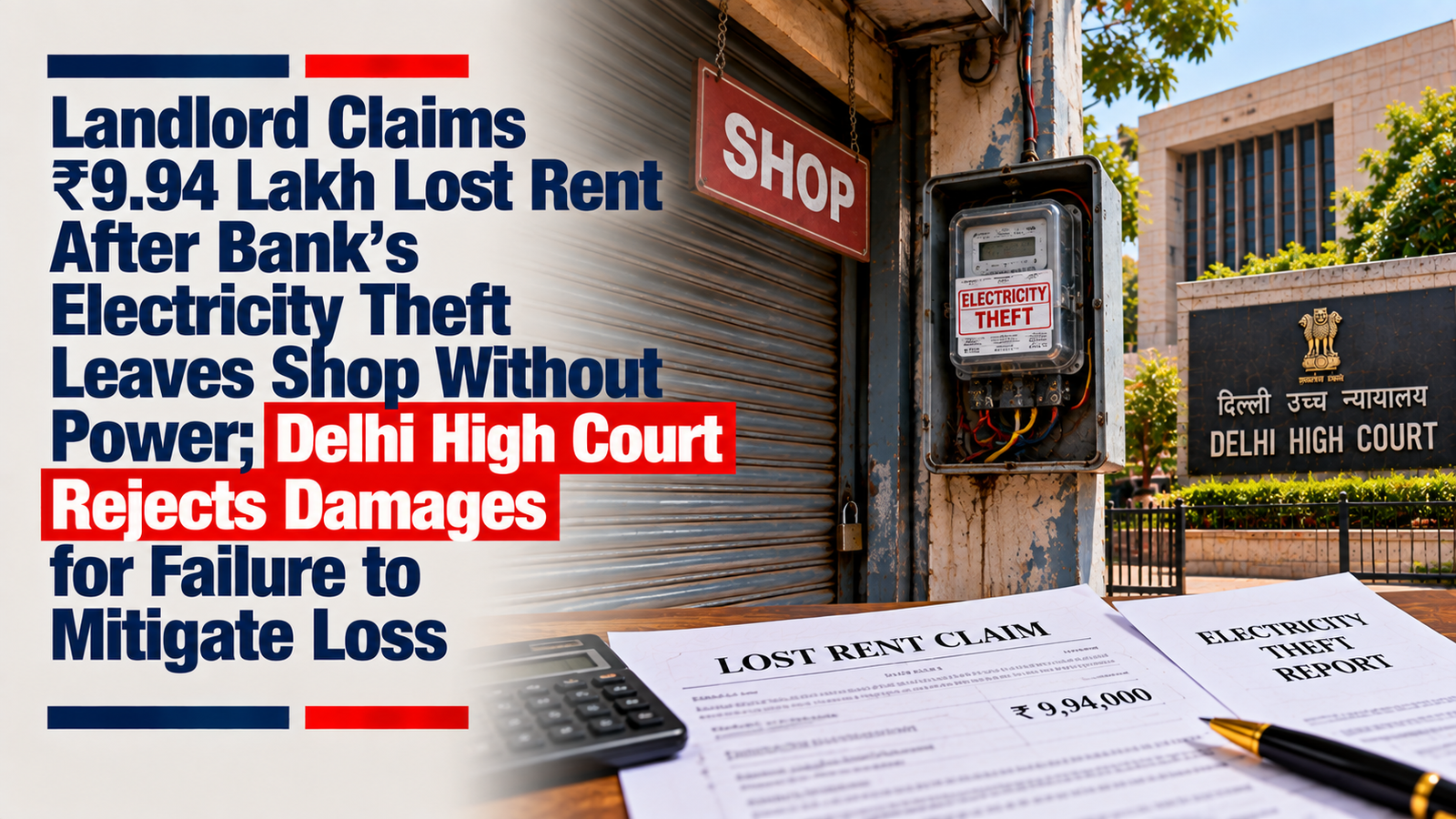
Shop Remains Without Electricity After Bank Vacates; Delhi High Court Says Landlord Cannot Recover Avoidable Loss for Years of Vacancy
Facts
The appeal was filed by Girish Kumar Jain against UCO Bank, challenging the dismissal of his suit seeking ₹9.94 lakh as damages and interest for alleged loss of rental income. The property was a 379 sq. ft. commercial premises at Dr. Mukherjee Nagar, Delhi, which had been leased to UCO Bank from March 1994.
The landlord alleged that the electricity meter provided to UCO Bank was burnt because of excessive load and that the Bank thereafter drew electricity directly, resulting in an electricity-theft bill. The electricity supply was consequently disconnected by NDPL on 9 March 2006.
During an earlier possession proceeding, UCO Bank vacated the premises. The landlord initially refused to accept the keys because of the electricity dispute but eventually accepted possession on 25 January 2008. He claimed that because electricity had not been restored, he was unable to use or re-let the property.
Eventually, on 15 April 2013, he arranged electricity from another premises associated with his company and rented the property to Rajesh Kumar Sharma for ₹27,000 per month. He claimed damages at ₹24,000 per month for three years, totalling ₹8.64 lakh, plus ₹1.30 lakh interest—an aggregate claim of ₹9.94 lakh.
The Trial Court dismissed the claim, principally finding that the landlord had not explained why an alternative electricity arrangement—which he ultimately made in 2013—could not have been made earlier.
Issues
The Delhi High Court identified two central questions: whether the property genuinely could not have been rented during the relevant period because of circumstances beyond the landlord’s control, and whether the claimed market rent of ₹24,000 per month had actually been proved.
Appellant’s Arguments
The landlord argued that the disconnection arose directly from electricity theft committed by UCO Bank’s officials and that, without electricity, the commercial property could not practically be rented.
He challenged the Trial Court’s finding that he could have obtained electricity from another premises earlier. According to him, the other premises belonged to M/s G.B.S. Chits (P) Ltd., electricity could not simply be supplied from one property to another without NDPL’s permission, and the required load was enhanced only later.
Respondent’s Arguments
UCO Bank disputed liability and had also raised objections based on limitation, Order II Rule 2 CPC and the landlord’s earlier proceedings.
On the electricity issue, the Bank asserted that electricity had been supplied through a sub-meter and that it had paid consumption charges to the landlord, who allegedly failed to deposit them with NDPL. It denied committing electricity theft.
Analysis of the Law
The High Court applied Section 73 of the Indian Contract Act, 1872, particularly its Explanation requiring courts, while assessing damages, to consider the means available to the claimant for remedying the inconvenience caused by non-performance.
The governing principle is the duty to mitigate loss. A person claiming damages cannot passively allow losses to accumulate where reasonable measures were available to reduce them.
The Court relied on Murlidhar Chiranjilal v. Harishchandra Dwarkadas, where the Supreme Court held that while damages should ordinarily place the injured party in the position it would have occupied had the contract been performed, the claimant must take reasonable steps to mitigate the resulting loss.
It also relied on M. Lachia Setty & Sons Ltd. v. Coffee Board, reiterating that a plaintiff cannot recover losses which reasonable steps could have avoided.
Precedent Analysis
Apart from the mitigation authorities, the High Court relied on Fortune Infrastructure v. Trevor D’Lima, (2018) 5 SCC 442, which holds that damages arising from breach must be established with reasonable certainty and ordinarily measured with reference to the position at the relevant time of breach.
This became particularly important because the landlord relied principally upon a 2013 lease at ₹27,000 per month to support his claim that the property could have fetched ₹24,000 per month from 2008 onwards.
The Court held that a lease executed in April 2013 could establish the market position at that time, but could not, without supporting evidence, establish the market rent prevailing in January 2008.
Court’s Reasoning
Interestingly, the High Court found evidence supporting the landlord on the underlying electricity incident.
The original electricity bill showed UCO Bank as the user and the landlord as the owner. The Court found that a separate electricity connection had been provided for the Bank’s use and that electricity theft had occurred, resulting in disconnection.
Further, the dispute was eventually settled, with UCO Bank paying ₹88,300 to TPDDL, and a new connection was installed on 21 April 2016.
But proving the Bank’s wrongdoing was not enough to recover the claimed damages.
The landlord had produced no document showing when the alternative electricity connection became available, its sanctioned load, any application seeking permission to draw electricity from it, or any technical impediment preventing the alternative arrangement earlier. Since the same mechanism was ultimately used in 2013, he failed to prove why it could not reasonably have been used earlier.
The Court therefore concluded that the landlord had failed to mitigate his loss. The entire period of vacancy could not be attributed to UCO Bank merely because the original electricity disconnection resulted from the Bank’s conduct.
There was a second independent weakness: quantum was not proved.
The landlord claimed ₹24,000 per month, but his principal supporting document was the 2013 lease at ₹27,000. An earlier judicial determination concerning the same property had assessed rent at approximately ₹9,762.50 per month for the period ending December 2006. The landlord produced no comparable leases, property dealer evidence or other material demonstrating that market rent had risen to ₹24,000 by January 2008.
More fundamentally, there was no advertisement, property listing, correspondence with prospective tenants or testimony from anyone who had inspected the premises and refused to rent it because electricity was unavailable. Thus, even the causal proposition that the property remained vacant specifically because it lacked electricity was not proved.
Conclusion
The Delhi High Court held that although the evidence established electricity theft and consequent disconnection, the landlord still had to prove that the claimed rental loss was actually caused by that wrongdoing, could not reasonably have been mitigated, and was quantified with reasonable certainty.
He failed on those requirements. The Court therefore found no merit in the appeal and dismissed it, affirming the rejection of the ₹9.94 lakh damages claim.
Case: Girish Kumar Jain v. UCO Bank
Court: Delhi High Court
Case No.: RFA 634/2026
CNR: DLHC010292852026
Judge: Justice Neena Bansal Krishna
Date: 22 September 2026
Result: Appeal dismissed; landlord’s claim for ₹9.94 lakh damages for alleged loss of rent rejected.