

Court’s decision
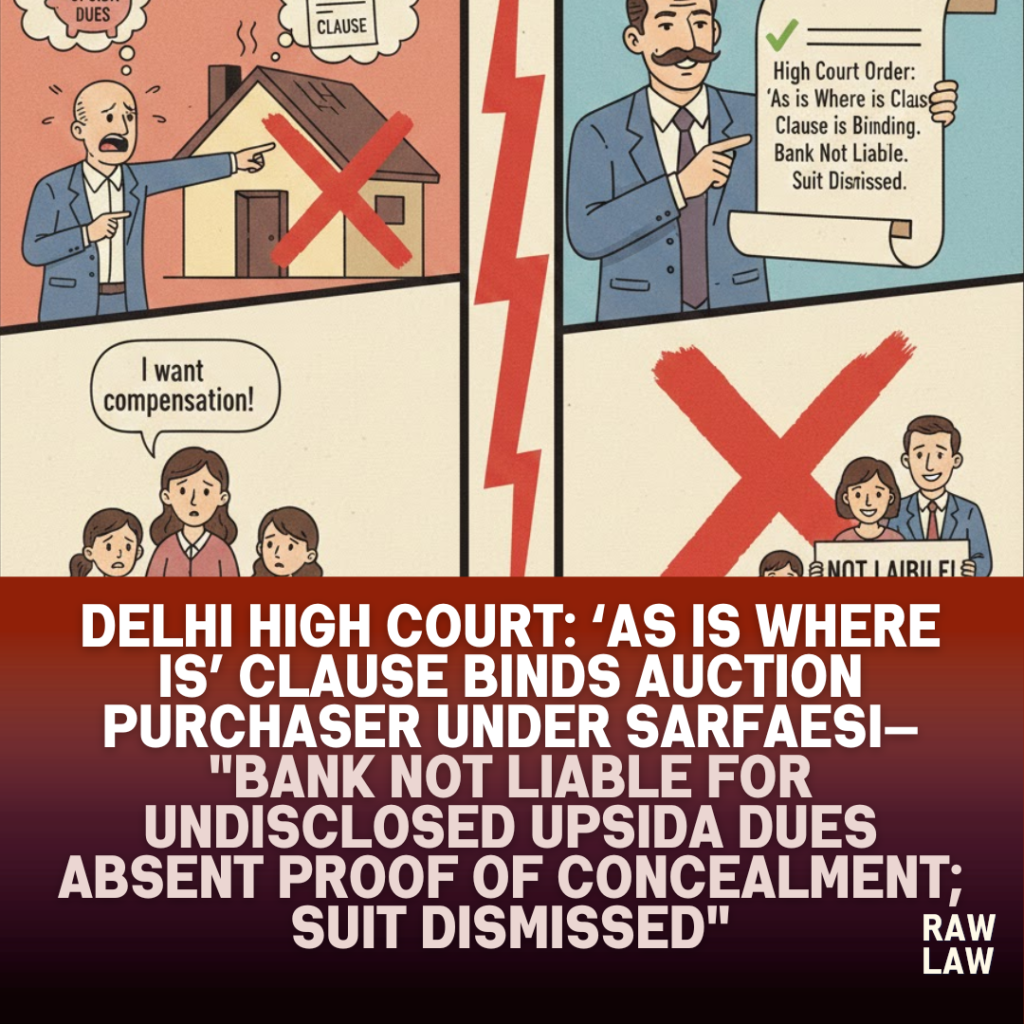
The Delhi High Court allowed the appeal filed by a secured creditor bank and set aside the Commercial Court’s decree that had directed reimbursement of statutory dues paid by an auction purchaser. The Court held that where an auction notice under the SARFAESI Act expressly stipulates that all statutory dues and authority charges shall be borne by the purchaser, and there is no proof of active concealment by the bank, the purchaser cannot seek recovery of pre-sale liabilities.
The suit filed by the auction purchaser was dismissed, reaffirming the binding nature of “as is where is” terms in commercial auctions.
Facts
The appellant bank, acting as a secured creditor under the Securitisation and Reconstruction of Financial Assets and Enforcement of Security Interest Act, 2002, issued a public notice dated 28 November 2018 for e-auction of leasehold industrial properties situated in UPSIDA Industrial Area, Sikandrabad, Uttar Pradesh.
The auction notice clearly provided that the sale would be conducted on an “as is where is,” “as is what is,” and “whatever there is” basis. Clause 12 of the terms specifically stated that any tax liability, penalty, or authority charges levied in respect of the property would be borne by the purchaser in addition to the sale price.
The respondent participated in the e-auction and emerged as the successful bidder with an offer of ₹6.07 crores. Upon payment of full consideration, a sale certificate dated 29 December 2018 was issued, stating that the sale was free from encumbrances “known to the secured creditor.” Possession was delivered on 1 January 2019.
Subsequently, UPSIDA demanded ₹25,06,846 towards outstanding lease rent and transfer charges pertaining to the pre-auction period. The purchaser paid the amount under protest and filed a commercial suit seeking reimbursement. The Commercial Court partly decreed the suit, holding the bank liable. The bank appealed.
Issues
The principal issue before the Delhi High Court was whether, in a SARFAESI auction conducted on “as is where is” terms, the secured creditor is liable to reimburse statutory dues discovered post-sale.
The Court also examined whether failure to clear pre-sale statutory dues amounts to breach of disclosure obligations under Section 55 of the Transfer of Property Act, 1882 and the Security Interest (Enforcement) Rules, 2002.
Appellant’s arguments
The bank contended that the auction terms expressly allocated the burden of statutory dues and authority charges to the purchaser. It argued that Clause 12 of the auction notice constituted a clear contractual indemnity.
Relying on Section 13(6) of the SARFAESI Act, the bank submitted that upon payment of sale consideration, all rights vest in the purchaser as if the transfer were made by the owner, subject to auction conditions.
The bank emphasized that the sale certificate only warranted absence of encumbrances “known” to the secured creditor. There was no proof that the bank had knowledge of UPSIDA’s specific dues or suppressed them. It invoked the doctrine of caveat emptor and argued that the purchaser, being a sophisticated bidder in a high-value transaction, was expected to conduct due diligence.
Respondent’s arguments
The purchaser argued that the “as is where is” clause cannot shield non-disclosure of material liabilities. It relied on Rule 8(6) of the Security Interest (Enforcement) Rules, 2002, which obligates the authorized officer to disclose material facts affecting value.
It was contended that the bank’s declaration of sale as free from encumbrances created a legitimate expectation of clear title. The purchaser argued that statutory dues payable to UPSIDA constituted material encumbrances and that the bank failed to exercise due diligence before auction.
The respondent relied on precedents emphasizing transparency in SARFAESI auctions and argued that equity demanded reimbursement.
Analysis of the law
The Court examined Section 55(1)(a) of the Transfer of Property Act, 1882, which requires disclosure of material defects known to the seller and not discoverable by ordinary care.
The Court also considered Rule 8(6)(a) and (f) of the Security Interest (Enforcement) Rules, 2002, mandating disclosure of material particulars in sale notices.
Relying on Delhi Development Authority v. Corporation Bank & Ors., Punjab National Bank v. Mithilanchal Industries Pvt. Ltd., and Rekha Sahu v. UCO Bank, the Court observed that an “as is where is” clause does not provide blanket immunity where there is active concealment of known encumbrances.
However, the Court clarified that liability arises only when concealment or misrepresentation is established.
Precedent analysis
In Delhi Development Authority v. Corporation Bank & Ors., the Supreme Court quashed an auction for failure to disclose statutory “unearned increase” charges known to the authority.
In Punjab National Bank v. Mithilanchal Industries Pvt. Ltd., the Supreme Court emphasized transparency in secured asset sales.
In Rekha Sahu v. UCO Bank, the Allahabad High Court held that “as is” clauses cannot shield non-disclosure of known encumbrances.
The Delhi High Court distinguished these cases, noting that in the present matter there was no evidence that the bank had actual knowledge of UPSIDA’s dues or deliberately suppressed them. The auction terms specifically warned bidders that authority dues would be borne by the purchaser.
Court’s reasoning
The Court held that the auction notice did not contain a vague “as is” clause but an explicit allocation of risk concerning statutory dues. Clause 12 categorically stated that any dues levied by any authority would be borne by the purchaser.
The sale certificate clarified that the property was free from encumbrances “known” to the secured creditor. The purchaser failed to demonstrate that the bank had knowledge of UPSIDA’s outstanding claims.
The Court applied the principle of caveat emptor, observing that the dues were matters of public record and could have been ascertained through inquiry with UPSIDA. The purchaser accepted the sale certificate and took possession without protest.
The Court held that in absence of fraud or active concealment, contractual terms must prevail. Allowing reimbursement would undermine finality of SARFAESI auctions and create uncertainty in secured asset enforcement.
Conclusion
The Delhi High Court allowed the appeal, set aside the Commercial Court’s judgment dated 31 January 2023, and dismissed the purchaser’s suit for recovery.
The Court held that the auction purchaser was bound by the “as is where is” clause and the specific indemnity regarding statutory dues.
Implications
This ruling reinforces contractual certainty in SARFAESI auctions. It clarifies that:
- “As is where is” clauses, when coupled with specific indemnity provisions, are enforceable.
- Secured creditors are not insurers against unknown statutory dues.
- Purchasers must conduct due diligence before bidding.
- Courts will not rewrite commercial contracts absent proof of concealment or fraud.
The decision strengthens finality of statutory auctions and protects banks from post-sale litigation where risks were expressly allocated.
Case law references
- Delhi Development Authority v. Corporation Bank & Ors. (2025 INSC 1161)
Held that non-disclosure of known statutory charges vitiates auction. - Punjab National Bank v. Mithilanchal Industries Pvt. Ltd. (2020 SCC OnLine SC 668)
Emphasized transparency and fairness in SARFAESI auctions. - Rekha Sahu v. UCO Bank (2013 (101) ALR 344)
Held that “as is” clauses do not shield concealment of known encumbrances. - Kalyani (India) Pvt. Ltd. v. Punjab National Bank (2024:DHC:451)
Observed that concealment cannot be protected by contractual clauses. - Royal Star Trading Co. v. IFCI Ltd. (2014:DHC:4559)
Held that auction purchasers cannot renegotiate price after confirmation.
FAQs
1. Does ‘as is where is’ protect banks in SARFAESI auctions?
Yes, particularly where auction terms expressly allocate responsibility for statutory dues to the purchaser and no concealment is proved.
2. Can an auction purchaser recover pre-sale statutory dues?
Only if it is established that the secured creditor knew of the dues and failed to disclose them.
3. What is the buyer’s responsibility in SARFAESI auctions?
Purchasers must conduct independent due diligence, including verifying statutory dues with relevant authorities.


