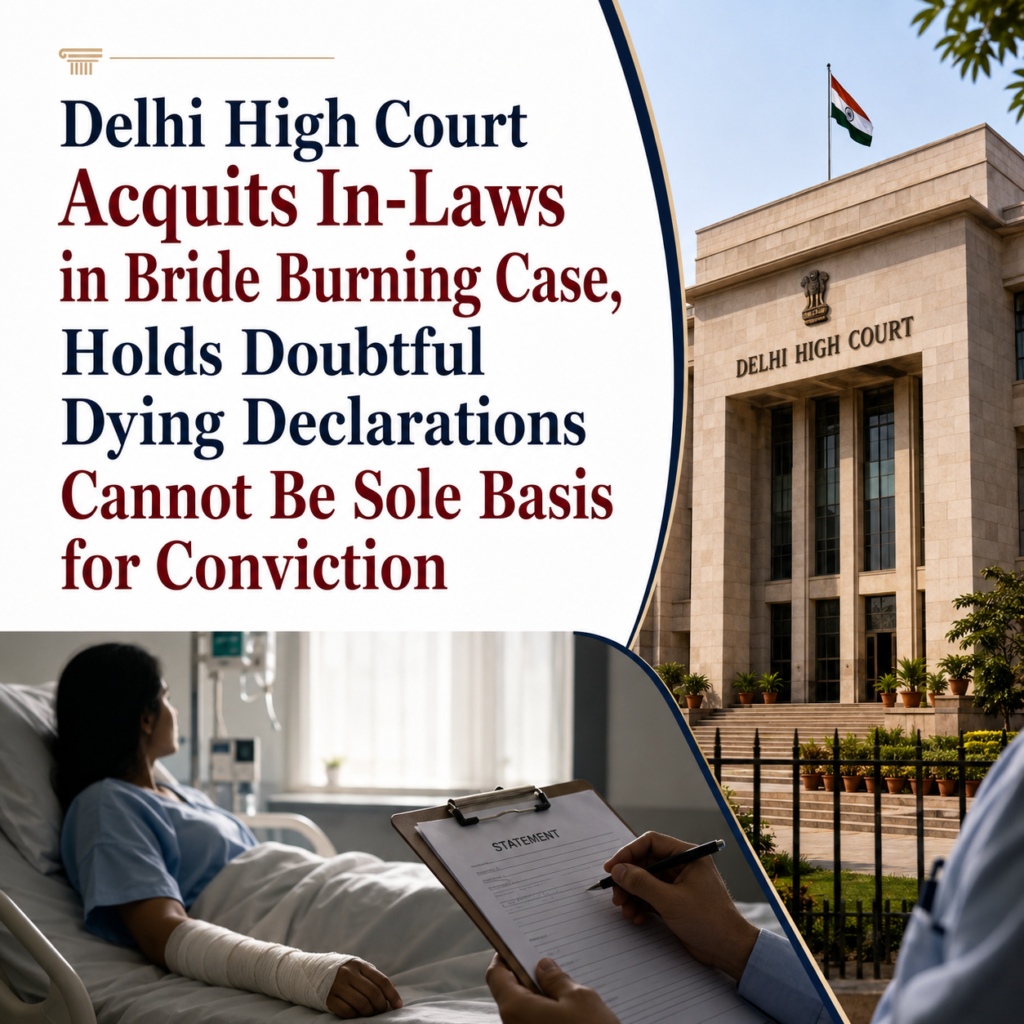
Delhi High Court Acquits In-Laws in Bride Burning Case, Holds Doubtful Dying Declarations Cannot Be Sole Basis for Conviction

Delhi High Court Acquits Surviving In-Laws in 1988 Bride Burning Case, Holds Doubtful Multiple Dying Declarations Cannot Sustain Murder Conviction
Facts
The appeals were filed against the conviction dated 4 October 2002 and sentence dated 7 October 2002 passed by the Trial Court, whereby the appellants were convicted under Sections 498-A and 302 read with Section 34 IPC for allegedly causing the death of Kamlesh by setting her on fire. The Trial Court had sentenced them to life imprisonment for murder and three years’ rigorous imprisonment for cruelty. During the pendency of the appeals, Raj Pal, the husband of the deceased, and Phoolwati, the mother-in-law, passed away, and the appeals abated against them.
The prosecution case was that on 30 October 1988, Kamlesh suffered severe burn injuries and was taken to J.P.N. Hospital by Jaswant, her brother-in-law. The MLC recorded that she had suffered about 90% burns and had stated that she got burnt while cooking food. Later, the prosecution relied upon alleged dying declarations made to her aunt Bimla Yadav and to the SDM, in which the deceased allegedly implicated her husband and in-laws and alleged dowry harassment, starvation and setting her on fire.
Issues
Whether the dying declarations allegedly made by the deceased were reliable enough to sustain conviction under Sections 302 and 498-A IPC.
Whether the contradictions between the MLC version of accidental burns and the later dying declarations created reasonable doubt.
Whether the possibility of tutoring by relatives before the SDM-recorded dying declaration could be ruled out.
Whether the prosecution proved the charges against the surviving appellants beyond reasonable doubt.
Petitioner’s Arguments
The appellants argued that the Trial Court wrongly relied on the dying declaration recorded by the SDM. They submitted that the first version in the MLC stated that the deceased got burnt while cooking, but the SDM did not question her regarding this material contradiction.
They further argued that in cases of multiple inconsistent dying declarations, courts must examine which version inspires confidence, and must look for corroboration where suspicion exists. The appellants contended that the deceased’s aunt, PW-1 Bimla Yadav, had met the deceased before the SDM recorded the statement, and therefore tutoring could not be ruled out.
The appellants also submitted that PW-1’s claim that the deceased spoke to her at 11:30 AM was doubtful because the MLC recorded at 11:15 AM that the deceased was unfit to make a statement. They further pointed out that the deceased’s parents did not support the prosecution case regarding dowry harassment or cruelty.
Respondent’s Arguments
The State argued that the plea of accidental burning was unreliable and that the MLC entry should not be treated as a genuine dying declaration. It was submitted that the deceased was taken to hospital by Jaswant, who was a Delhi Police personnel, and the version of accidental burns may have been supplied by him.
The State further argued that the SDM-recorded dying declaration was reliable because it was recorded after the deceased was declared fit to make a statement. The prosecution also relied upon the CFSL report, post-mortem report, kerosene residue on the clothes and hair, and recovery of burnt articles to contend that the deceased had been set on fire.
The State also relied on the testimony of PW-1 Bimla Yadav, who claimed that the deceased had told her that appellant Suresh had set her on fire and the other family members were present.
Analysis of the Law
The Court reiterated that a dying declaration can form the sole basis of conviction only when it is voluntary, truthful, reliable and inspires full confidence. Since the accused has no opportunity to cross-examine the maker of the statement, courts must scrutinise such evidence carefully, especially where there are multiple dying declarations or material inconsistencies.
The Court relied on the principles governing dying declarations and observed that if there is even an element of suspicion, the court must look for corroboration. In cases involving multiple dying declarations, consistency, medical fitness, surrounding circumstances, possibility of tutoring, and the manner of recording become crucial factors.
Precedent Analysis
The Court referred to Irfan @ Naka v. State of Uttar Pradesh, where the Supreme Court held that dying declarations must be examined with great caution and must inspire full confidence. The Court highlighted that where suspicion exists regarding correctness, conviction based solely on dying declaration becomes unsafe.
The Court also relied on Sanjay Kumar Sharma v. State of Bihar, where the Supreme Court reiterated that dying declarations must be free from prompting, tutoring or coercion, and if there is any suspicion, corroboration is required.
The Court further referred to Abhishek Sharma v. State (Govt. of NCT of Delhi), where principles for dealing with multiple dying declarations were laid down, including that each declaration must be examined independently and material inconsistencies must be assessed with surrounding evidence.
Court’s Reasoning
The Court found that the first version recorded in the MLC stated that the deceased got burnt while cooking food. Although the prosecution sought to doubt this entry, the doctor who recorded it was not examined. Therefore, any doubt regarding the MLC had to operate in favour of the appellants.
The Court held that the alleged dying declaration to PW-1 Bimla Yadav was doubtful. PW-1 allegedly met the deceased at 11:30 AM, but the MLC showed that the deceased was declared unfit for statement at 11:15 AM. Further, PW-1’s version was affected by the non-examination of another aunt who was allegedly told about prior threats and starvation. The deceased’s parents also did not support PW-1’s version.
The Court also found serious doubts in the SDM-recorded dying declaration. The medical fitness certificate appeared to have been taken after the statement was recorded, the doctor who gave the fitness certificate was not examined, the SDM did not ask the deceased about the contradiction between the MLC version and the later version, and the SDM did not inquire whether the deceased had met relatives before making the statement. The Court therefore held that the possibility of tutoring could not be completely ruled out.
The Court rejected the prosecution’s reliance on the post-mortem report to prove starvation, noting that although an opinion on signs of starvation had been specifically sought, the post-mortem report did not give any specific opinion that the deceased had been starved.
The Court also considered that the deceased’s mother and father did not support the prosecution case. They stated that there were no dowry demands or complaints of harassment. The Court observed that after losing their daughter, the parents would ordinarily be expected to implicate the accused rather than give them a clean chit, and no reason was shown for them to falsely depose in favour of the appellants.
Conclusion
The Delhi High Court held that the alleged dying declarations were not wholly reliable and contained an element of doubt. The surrounding circumstances also did not form a complete chain sufficient to prove guilt beyond reasonable doubt. Accordingly, the Court allowed the appeals qua the surviving appellants, set aside their conviction and sentence, and acquitted them of all charges. The appeals stood abated against Raj Pal and Phoolwati, who had passed away during pendency.
Case: Raj Pal & Anr. / Smt. Dhanpati & Ors. v. State (Govt. of NCT of Delhi)
Court: Delhi High Court
Case Number: CRL.A. 909/2002 & CRL.A. 938/2002
Judge: Justices Navin Chawla and Ravinder Dudeja
Date: 2 July 2026
Result: Appeals allowed qua surviving appellants; conviction and sentence set aside; surviving appellants acquitted. Appeals abated against deceased appellants Raj Pal and Phoolwati.