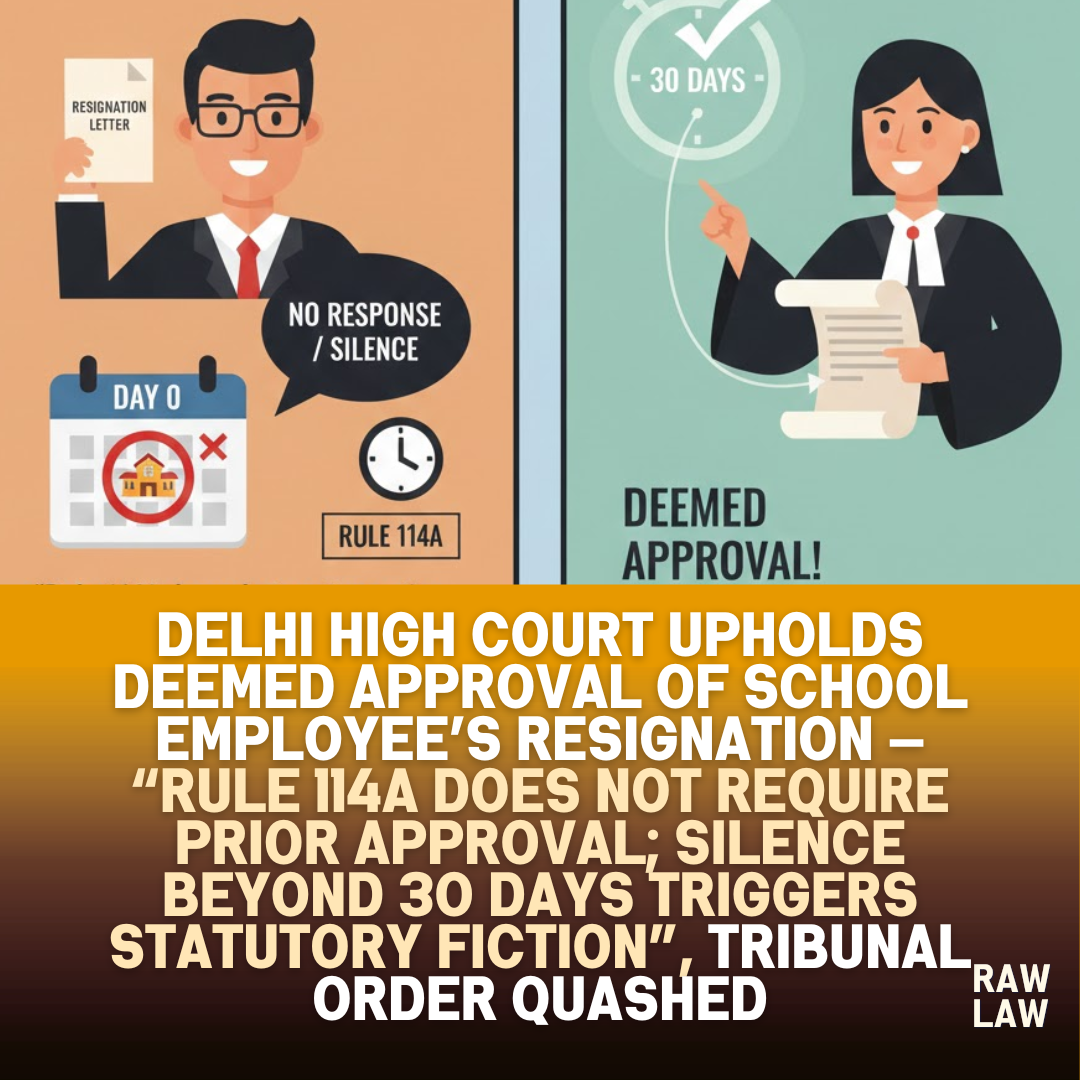
Delhi High Court upholds deemed approval of school employee’s resignation — “Rule 114A does not require prior approval; silence beyond 30 days triggers statutory fiction”, Tribunal order quashed

Court’s decision
The Delhi High Court allowed the writ petition filed by a recognised private school and quashed the order of the Delhi School Tribunal which had reinstated a former employee. The Court held that once a resignation is accepted by the Managing Committee and communicated to the Directorate of Education, the failure of the Directorate to respond within thirty days results in deemed approval under Rule 114A of the Delhi School Education Rules, 1973.
Observing that the employee had neither withdrawn his resignation before acceptance nor protested immediately thereafter, the Court concluded that the Tribunal had misdirected itself in law. The impugned order directing reinstatement with consequential benefits was set aside.
Facts
The employee had joined the petitioner school in 1991 and rose through promotions to the post of Office Superintendent (Accounts). In 2009, following an audit report alleging financial irregularities, he was demoted and later suspended. A criminal case alleging embezzlement was also registered against him.
Subsequently, the employee submitted a resignation dated 04.08.2010. The Governing Body of the school accepted the resignation in its meeting dated 20.08.2010, in the presence of a nominee of the Directorate of Education. A Sub-Committee was constituted to confirm voluntariness, and on 26.08.2010, the employee reaffirmed his resignation and sought release of his dues. He received Rs.1,95,726/- towards gratuity and leave encashment, which he encashed.
The acceptance was communicated to the Directorate of Education. Months later, the Directorate refused approval citing allegations that the resignation was coerced. The Delhi School Tribunal allowed the employee’s appeal and ordered reinstatement.
Issues
The High Court framed the core questions as follows:
- Whether the Directorate of Education can reject acceptance of resignation by the Managing Committee.
- Whether Rule 114A requires prior approval of the Directorate before acceptance becomes effective.
- Whether deemed approval operates if no response is received within thirty days.
- Whether a resignation not withdrawn prior to acceptance can later be invalidated on allegations of coercion.
Petitioner’s arguments
The school contended that under Rule 114A, resignation must be accepted by the Managing Committee and approval sought from the Directorate. However, the Rule does not mandate prior approval. If no communication is received within thirty days, approval is deemed to have been granted.
It was argued that the resignation was accepted on 20.08.2010 by the competent authority. The employee appeared before the Sub-Committee on 26.08.2010, reaffirmed voluntariness, and accepted full and final settlement without protest. No withdrawal was submitted before acceptance.
The school maintained that the Directorate’s refusal dated 23.03.2011 was belated, cryptic, and legally inconsequential since deemed approval had already come into effect. It was further argued that the Tribunal exceeded its jurisdiction under Section 8(3) of the Act, as the matter concerned resignation and not termination.
Respondent’s arguments
The employee contended that the resignation was obtained under coercion and threat of arrest following registration of a criminal case. He alleged that he was forced to sign and deposit the cheque issued as settlement, and that the resignation violated statutory safeguards.
He argued that the Directorate rightly refused approval after he informed it that the resignation was not voluntary. According to him, the Tribunal correctly treated the coerced resignation as termination and reinstated him with benefits.
Analysis of the law
The Court examined Rule 114A of the Delhi School Education Rules, which provides that resignation shall be accepted within thirty days by the Managing Committee “with the approval of the Director”, and if no approval is received within thirty days, approval shall be deemed to have been granted.
Relying on binding precedent, the Court clarified that Rule 114A does not require prior approval. Acceptance by the Managing Committee is valid, subject to post-facto approval. The Managing Committee is the competent authority to accept resignation.
The Court emphasised that the legislative intent is to guard against coercion. However, where resignation is not withdrawn prior to acceptance and no timely objection is raised, allegations of coercion made after statutory timelines cannot defeat deemed approval.
Precedent analysis
The Court relied heavily on the Division Bench judgment in Nand Kishor v. Managing Committee of Rani Datta Arya Vidyalaya, which held that once resignation is accepted and communicated, failure of the Directorate to respond within thirty days triggers deemed approval.
It also referred to Urmil Sharma v. Director of Education, which clarified that the Managing Committee is the appointing and competent authority for acceptance of resignation.
Further reliance was placed on judgments affirming that resignation becomes effective upon acceptance and cannot be withdrawn thereafter unless withdrawn prior to acceptance.
Court’s reasoning
The High Court found that the resignation was accepted by the Governing Body on 20.08.2010. The Sub-Committee’s meeting on 26.08.2010 merely reaffirmed voluntariness.
The employee neither withdrew his resignation before acceptance nor lodged any protest immediately after receiving settlement. The allegation of coercion surfaced only after the Directorate sought clarification months later.
The Court held that the Directorate failed to respond within thirty days of receiving the communication. Therefore, deemed approval under Rule 114A operated automatically. The subsequent refusal dated 23.03.2011 was rendered legally irrelevant.
The Tribunal erred in ignoring settled law and in treating resignation as termination.
Conclusion
The Delhi High Court quashed the Tribunal’s order and upheld the validity of the resignation. It ruled that Rule 114A does not contemplate prior approval and that silence of the Directorate beyond thirty days results in deemed approval.
Since the employee failed to withdraw the resignation before acceptance and accepted full and final dues without protest, the resignation was effective in law. The reinstatement order was set aside.
Implications
This judgment strengthens the doctrine of deemed approval under Rule 114A and clarifies the limits of the Directorate’s supervisory powers. It underscores that resignation, once validly accepted and not withdrawn, attains finality.
For private recognised schools, the ruling provides clarity on procedural compliance. For employees, it reiterates the importance of timely withdrawal or objection before acceptance.
The decision also reinforces that the Tribunal cannot expand its jurisdiction by equating resignation with termination in the absence of statutory breach.
Case Law References
- Nand Kishor v. Managing Committee of Rani Datta Arya Vidyalaya – Held that deemed approval applies if the Directorate does not respond within thirty days.
- Urmil Sharma v. Director of Education – Clarified that the Managing Committee is the competent authority to accept resignation.
- Modern School v. Shashi Pal Sharma – Supreme Court upheld that resignation cannot be withdrawn after valid acceptance.
- Anirudh Kumar Pandey v. Management of Modern Public School – Reaffirmed that Rule 114A does not require prior approval.
The Court applied these precedents to invalidate the Tribunal’s reasoning.
FAQs
1. Does Rule 114A require prior approval of the Directorate before resignation becomes effective?
No. The High Court clarified that Rule 114A requires approval but not prior approval. If the Directorate does not respond within thirty days, approval is deemed to have been granted.
2. Can an employee withdraw resignation after it is accepted?
An employee may withdraw resignation before acceptance by the Managing Committee. Once accepted and communicated, withdrawal is not permissible.
3. What happens if the Directorate refuses approval after thirty days?
If no response is given within thirty days of communication, deemed approval operates automatically. A belated refusal becomes legally inconsequential.